


VIDEOS & DRY ICE BLASTING APPLICATIONS
Here is a non-exhaustive list of business sectors and applications for dry ice blasting that can be carried out with Cryoblaster® equipment.
The list below changes regularly. Visit this section every week to discover new applications.
Aeronautics / Aerospace
- Dry ice blasting runway lights | ATX25-P
- Dry ice blasting of a mold for composite materials | ATX25-E
Post-disaster
Automotive
- Dry ice blasting of a 1986 Porsche 944 Turbo
- Dry ice blasting of an engine BMW 2.40i
- Dry ice blasting of aluminum rims Mercedes
- Dry ice blasting of rims and engine cover
- Dry ice blasting of a Renault Scénic 1999 petrol car engine
- Dry ice blasting of C4 Picasso car seats
- Dry ice blasting of a BMW Z3 car chassis
- Dry ice blasting of classic vehicles: 1935 Rolls Royce
Food
- Removal of hot-melt glue (thermoplastic) from various surfaces | ATX25-E
- Cleaning of an air conveyor
- Stripping burnt grease
- Cleaning of an auger screw
- Cleaning of a food-industry walkway
- Cleaning of bakery baking trays
- Cleaning of bakery swing-bucket cups
- Dry ice blasting of a sliced bread slicer motor
- Motor cleaning with limescale
- Dry ice blasting for food and packaging
- Dry ice blasting of limescale on filling machines
Buildings & Facades
Degreasing
- Degreasing fuel tank
- Degreasing, metallurgy, saw
- Industrial degreasing machine tool
- Cleaning escalator
- Travelator Cleaning
- Pneumatic compressor degreasing
- Degreasing washing machine
- Industrial degreasing by dry ice blasting
- Dry ice blasting on machine tools
- Degreasing and paint removal by dry ice blasting
- Dry ice blasting in glassworks: degreasing cylinders
Electricity
- Cleaning an electrical cabinet after a fire incident
- Cleaning a de-energized electrical cabinet
- Generator cleaning
- Degreasing an electrical cabinet
- Cleaning an electrical cabinet in the food industry
- Cleaning the main LV switchboard room after a fire incident
- Cleaning an electrical cabinet covered with adhesive residues
- Cleaning an electrical cabinet outdoors
Electronics
Packaging
- Stripping, varnish, rechampissage
- Latex residues electro-pneumatic components
- Cleaning plastic residues
- Latex Dry Ice Cleaning
- Latex Dry Ice Cleaning : Tweezers
- Cryogenic stripping of industrial varnishes
- Dry ice cleaning, vacuum metallization process
- Dry ice blasting of a vacuum furnace
- Dry ice blasting of a vacuum furnace: iris phenomenon
- Cleaning an antistatic ionizing bar
Structural work
Industrial maintenance
- General and industrial maintenance
- Electric motor cleaning
- Cleaning a silicone electric motor
- Cleaning tools chemical sealing
- Degreasing hydraulic power valve
- Industrial oven cleaning
- Dry ice blasting electro-pneumatic cabinet
- Forklift maintenance by dry ice blasting
- Dry ice blasting on a staircase (hot-melt glue)
- Dry ice blasting of a ventilation grille covered with hot-melt glue
- Tyre mould cleaning
- Silicon Cryogenic Blasting
- Camshaft cleaning
- Cryogenic Pickling PTFE (Teflon)
- Dry ice blasting of dried ink
Metals and industrial tools
Monuments
Paper industry
Plastics
Epoxy resins
Heat treatment of metals
Dry Ice Snow Cleaning
What are some of the benefits of dry ice blasting for your application?
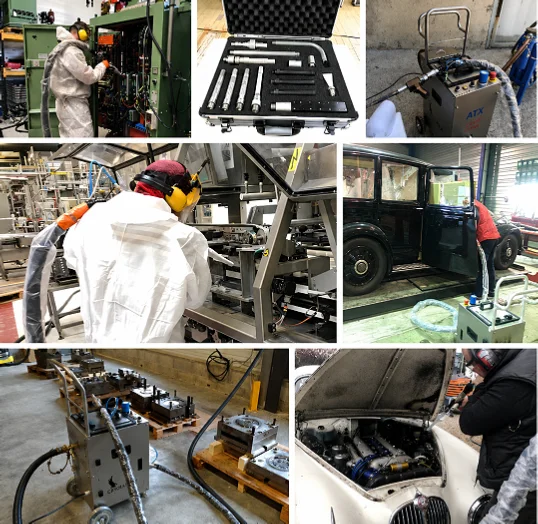
Dry ice blasting is a non-toxic, environmentally friendly method for removing dirt and dust from various surfaces. It is also effective in reducing production downtime and minimizing secondary waste. This is particularly beneficial for industries in which it is necessary to maintain product quality and hygiene .
Dry ice blasting is a non-abrasive process that can be used safely on virtually any surface. It provides superior cleanliness and can eliminate months of buildup. As a result, it is suitable for electrical and mechanical appliances, as well as food processing equipment.
Compared with abrasive sandblasting, dry ice blasting produces no fine particles, dust, or fumes. Therefore, it is ideal for delicate surfaces that cannot withstand abrasive sandblasting.
Dry ice can clean hard-to-reach surfaces, such as between gaps and between large metal parts. Plus, it's a quick and effective method to remove stubborn sticky buildup. In addition, it allows for more frequent cleaning, and therefore a longer service life of the equipment.
Three factors influence the effectiveness of the dry ice blasting process:
1- the thermal conductivity of the contaminant*,
2- firing power (pressure and volume), which transfers kinetic energy to the dry ice. This causes pollution shear.
3- Sublimation, or the transition of ice from a solid to a gaseous state, which, with the help of compressed air, literally blows away the contamination.
*: For example, if the contaminant has a high thermal conductivity, the efficiency of the process will be reduced. On the other hand, if the contaminant has a low thermal conductivity, the efficiency will be increased.
Some applications of dry ice blasting in detail
Some dry ice blasting applications in detail

In the aerospace industry, dry ice blasting is used to remove impurities and fuel residues from aircraft engine parts, helping to improve engine performance and extend service life. In the defense industry, it is used to clean sensitive weapons and equipment, keeping them in good working order.

In the automotive industry, dry ice blasting is used to remove grease residues and oil from mechanical parts, thereby improving performance and vehicle service life. It is also used to clean tools and manufacturing equipment used in car production.

In the energy industry, dry ice blasting is used to clean power-generation equipment, such as gas turbines and wind turbines, helping to improve their energy efficiency. It is also used to clean equipment used in the extraction and refining of raw materials.

In medicine, dry ice blasting is used to clean medical equipment, helping to reduce infection risks and improve quality of care. Dry ice blasting is also used in scientific research to clean sensitive scientific equipment and instruments, such as measuring instruments and research cells. It helps reduce contaminants and impurities, which improves the accuracy of search results.
In summary, dry ice blasting is a versatile process that effectively cleans the surfaces of many types of equipment and instruments, thereby improving the performance, service life, and accuracy of results in the various industries and fields where it is used.