


HOME > COMPRESSORS: HOW TO CHOOSE > FLOW RATE & PRESSURE
Guide: Understanding Compressed Air Flow and Pressure for Cryogenics and Micro Abrasive Blasting
For dry ice blasting and micro abrasive blasting operations, the compressor is the engine of your productivity. This comprehensive guide helps you optimally size your installation based on FAD flow rate (delivered) and the dynamic pressure required at the nozzle.

Two strategic guides to properly configure your air line without experiencing performance loss in the field.
Why Flow Rate Depends Critically on Compressed Air Pressure
At equivalent motor power, available flow rate decreases as you increase operating pressure. In dry ice blasting as in micro abrasive blasting, having "bars" is not enough: you must deliver the corresponding air volume at the right speed and under constant load.
Practical Example
A compressor rated at 2,900 l/min at 7 bars may drop to 2,100 l/min if you increase to 10 bars. Result: an unstable nozzle and an immediate loss of profitability.
Recommendation
Do not operate at the limits of your equipment. Build in a structural margin of 25% to 30% to compensate for transient motor speed drops.
Primary objective: Maintain stable pressure directly at the blasting nozzle when the machine is fully engaged.
Intake Flow vs. Delivered Flow (FAD): Avoid the Classic Pitfall
Relying on the "intake flow" stated in general manufacturer documentation is a common mistake:
- Intake flow: Theoretical data measured at the compressor intake, excluding mechanical compression constraints.
- Delivered flow (FAD — Free Air Delivery): Actual volume of air, compressed and usable at the machine outlet.
To size your projects, rely solely on the **FAD (delivered flow rate)** indicator. This is the only value that quantifies your blaster's working capacity.
The Origin of Pressure Drop: Hoses, Diameters, and Filtration
Compressed air loses force throughout its path. Every component between the tank outlet and your blasting nozzle reduces usable pressure:
- Line length: Beyond 20 meters, pressure drop accelerates significantly.
- Passage diameter: Insufficient diameter creates a bottleneck. For high industrial flow rates, using compressed air hoses with a minimum internal diameter of 1 inch is essential.
- Air treatment: High moisture content restricts airflow, alters abrasive behavior in micro abrasive blasting, and disrupts the dry ice jet.
Actual Flow at the Nozzle: Optimizing the Final Stage
Surface impact depends on the exit velocity of the airflow. In our premium installations, the dual Venturi principle is used to stabilize flow, maximize acceleration, and minimize kinetic energy loss just before the nozzle.
Field Benchmarks: Air Requirements for Cryogenics and Micro Abrasive Blasting
These data represent actual consumption under standard operating conditions:
| Treatment Machine | Minimum Required Flow (FAD) | Recommended Working Pressure | Associated Compressor Configurations |
|---|---|---|---|
| NanoGom Nozzles 2 to 4.5 mm |
≈ 1,300 l/min | 4 to 7 bars | MSP 1300 / MSP 2000 Range |
| Raptor Nozzles 2 to 5.5 mm |
≈ 2,500 l/min | 5 to 7 bars | MSP 3000 Range (continuous flow comfort) |
| XP02 Soft Cryogenics |
≈ 1,400 l/min | 7 bars | MSP 1300 / MSP 2000 Range |
| ATX nano Compact Range |
≈ 3,100 l/min | 6 bars | MSP 3000 / MSP 5000 Range |
| ATX25-E / ATX25-P High Industrial Performance |
≈ 7,000 l/min | 7 to 12 bars | MSP 11000 Range |
Practical Case: Validating Your Installation's Dynamic Pressure
To ensure your compressor delivers the necessary volume, perform this simple test:
- Connect all your hoses and open the blasting valve to maximum load.
- Read the value displayed on your blaster's control gauge during operation.
- If the needle drops significantly below your setpoint, your compressor lacks FAD or your line has a restriction.
- If pressure remains perfectly stable, your installation is properly sized.
Performance Chain Diagram: Air → Nozzle → Surface
Pressurized Airflow Path
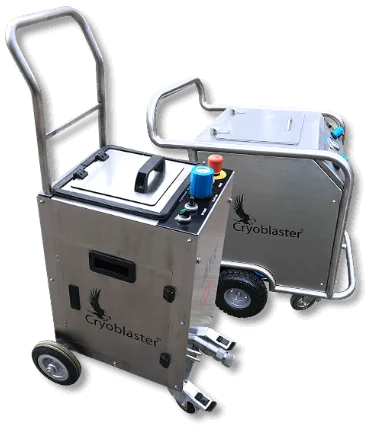
Cryoblaster® Distribution Model
FAQ — Technical Answers from Our Experts
Can I use an undersized compressor for stripping work?
Insufficient flow causes an immediate drop in dynamic pressure during treatment. Your efficiency will collapse, significantly increasing your intervention time and consumption of dry ice or abrasives.
Why does my pressure collapse as soon as I activate the blast trigger?
This is a flow problem or a severe physical restriction in your air line. The compressor can build static pressure when idle but cannot deliver the air volume needed to maintain pressure during continuous flow.
Surface Treatment Equipment & Solutions
Dry Ice Cleaning
High-performance cryogenic blasters adapted to all industrial needs.

Airgum machines
Professional micro abrasive blasting machines for precise, controlled low-pressure stripping.
