


HOME > COMPRESSORS: HOW TO CHOOSE
Which Compressors for Dry Ice Blasting & Sandblasting?
Choose the right air compressor based on your machine, operating pressure under load, and your actual air delivery (FAD). This guide helps you decide quickly, then validate your sizing (safety margins, pressure drops, filtration).
ⓘ - Understanding Flow and Pressure Before Choosing
Selecting a compressor does not only depend on the maximum advertised pressure. In dry ice blasting and sandblasting, the actual Free Air Delivery (FAD), working pressure under load, and pressure drops determine the real performance at the nozzle.
On this page, you will find all the required information to choose the most suitable compressor for your needs, ensuring a successful dry ice blasting or sandblasting operation!
Quick selection: what compressed air flow rate do you need?
Select a compressor based on your needs (cryo / micro abrasive), then refine based on the pressure and flow rate actually available.
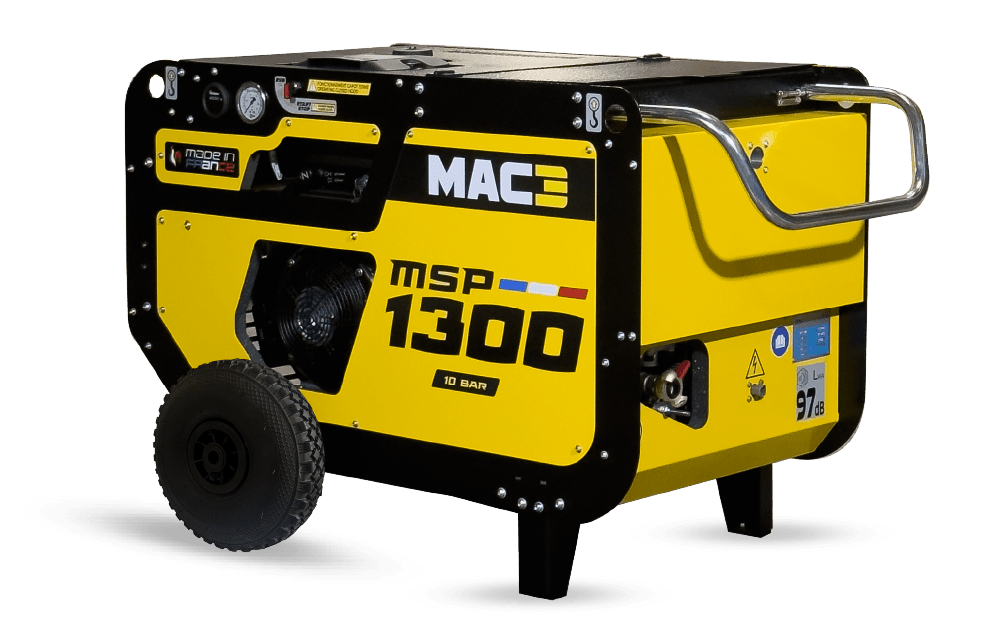
MSP 1300
- Air Delivery: 1,300 L/min (46 CFM)
- Pressure: 7 bar (100 PSI)
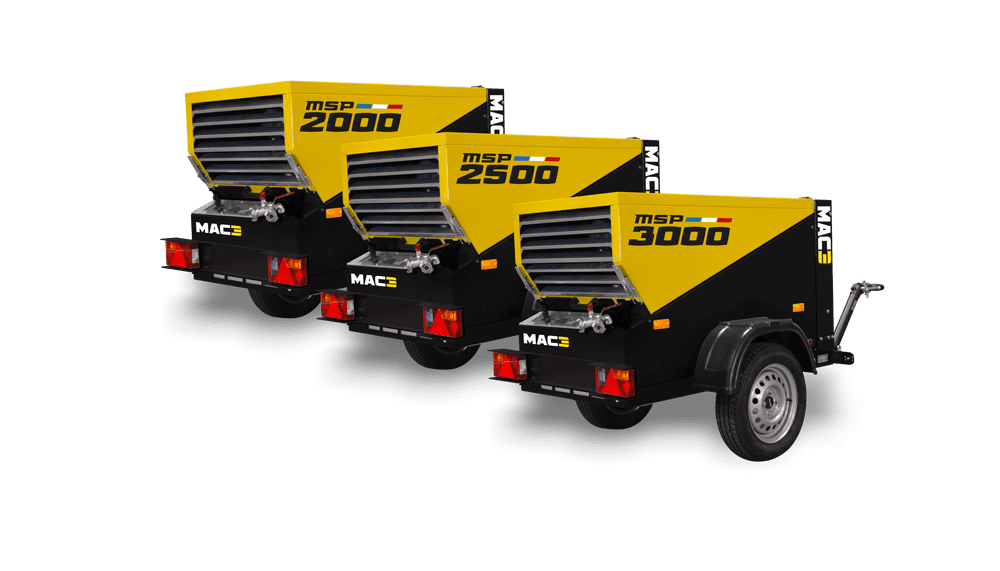
MSP 2000 & 3000
- Air Delivery: 2,000 to 3,000 L/min (70 - 105 CFM)
- Pressure: 7 to 10 bar (100 - 145 PSI)
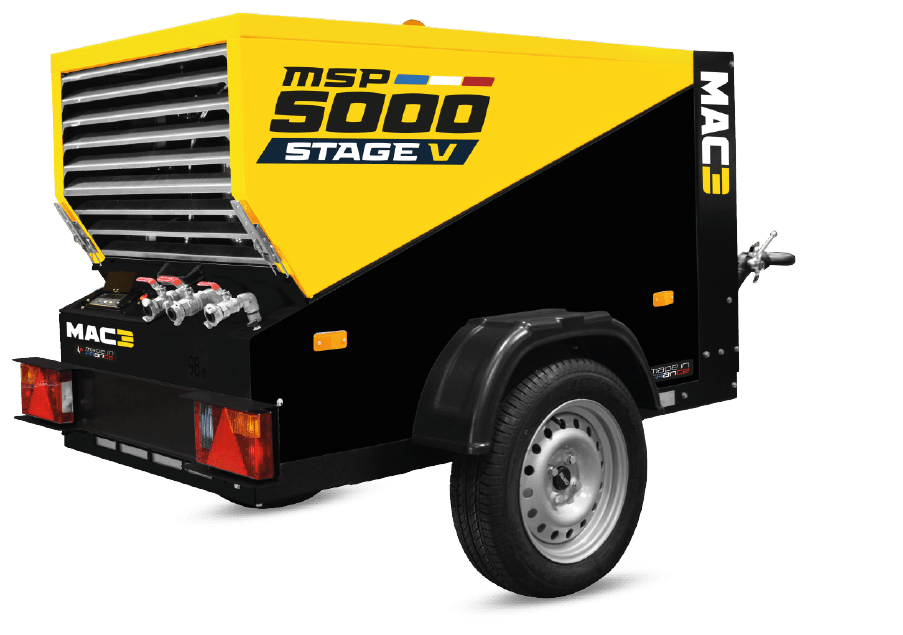
MSP 5000
- Air Delivery: 5,000 L/min (176 CFM)
- Pressure: 7 bar (100 PSI)
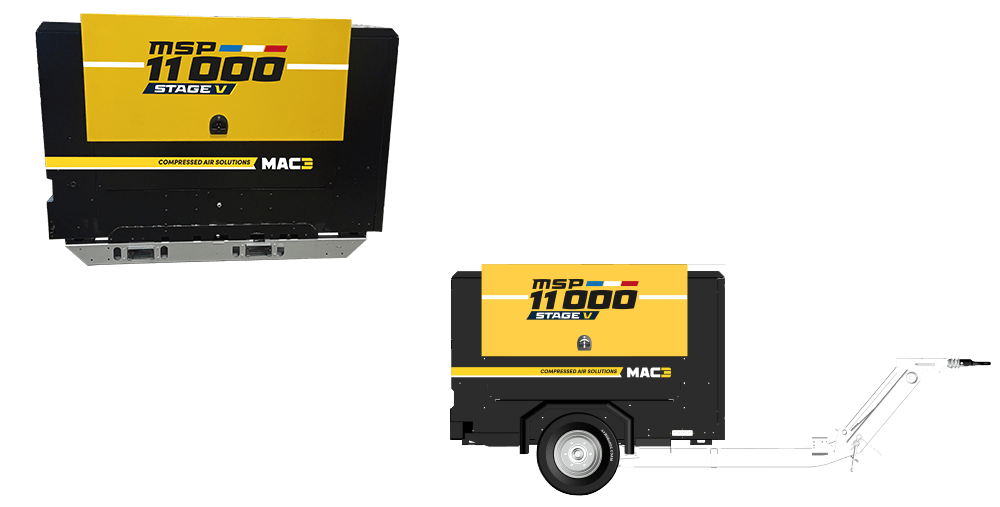
MSP 11000
- Air Delivery: 11,000 L/min (388 CFM)
- Pressure: 7 to 12 bar (100 - 174 PSI)
Understanding “intake” vs “delivered” flow rate (FAD) and the impact on pressure
Choosing a compressor should never be based on a marketing figure. To ensure your equipment operates correctly (e.g., dry ice blasting), you must distinguish between theoretical capacity and actual capacity.
| Criteria | Intake Volume (Theoretical Displacement) | Actual Air Delivery (FAD / Real Output) |
|---|---|---|
| Definition | Volume of air sucked in by the pistons or screws. | Volume of air actually available at the machine outlet (Free Air Delivery). |
| Integrated Losses | None. Does not take into account heat generation or internal friction. | Includes thermal losses, internal leaks, and pressure drops. |
| Practical Use | Often used purely as a commercial marketing argument. | The only reliable value for sizing an air tool or a blasting unit. |
| Reliability | Overestimated by 30% to 40% compared to real-world performance. | Measured according to the strict international standard ISO 1217. |
The Impact of Working Pressure
The FAD flow rate is not fixed: it decreases as the pressure configuration increases. If you work at 7 or 8 bar (100–115 PSI), always check that the advertised air flow corresponds exactly to this target pressure.
The Risk A compressor that is sized "just barely" enough will lead to an immediate pressure drop under heavy load. A drop of only 1 bar (14.5 PSI) can reduce your dry ice blasting or sandblasting efficiency by 20% to 30%.
The Golden Rules of Sizing
- Keep a Safety Margin: Systematically add a 25% to 30% safety margin to your actual air consumption needs.
- Optimization: A compressor that does not run continuously at 100% of its maximum capacity undergoes slower wear and consumes less fuel/energy.
- Standard Sizing Example: For a dry ice blasting unit requiring 3,000 l/min (105 CFM), target a compressor supplying a real FAD of at least 3,800 l/min (134 CFM) at 7 bar (100 PSI).
Comparison table (quick read)
See below the actual delivered flow rate (FAD) values for each compressor!
| MAC3 Model | Air Delivery (FAD) | Working Pressure | Dry Ice Blasting Application | Recommended Blasters | Details |
|---|---|---|---|---|---|
| MSP 1300 | 1,300 L/min (46 CFM) | 7 - 15 bar Adjustable (100-217 PSI) | Light maintenance & precision detailing | XP02, XP07 | Inquire → |
| MSP 2000/3000 | 2,000 - 3,000 L/min (70-105 CFM) | 7 - 10 bar (100-145 PSI) | Intensive & versatile contract cleaning | XP07, ATX nano | Inquire → |
| MSP 5000 | 5,000 L/min (176 CFM) | 7 - 10 bar (100-145 PSI) | High-flow facilities & facility production lines | ATX nano, ATX25-E | Inquire → |
| MSP 11000 | 11,000 L/min (388 CFM) | 7 - 14 bar (100-203 PSI) | Massive industrial production & multi-user setups | ATX25-E, ATX25-P | Inquire → |
Blasting Units & Air Compressors Matching Guide
Select your Cryoblaster® equipment to identify the most suitable MAC3 portable compressor based on your workload.
XP02
PrecisionDelicate cleaning tasks with low air consumption requirements.
XP07
MaintenanceThe ideal compromise between controlled flow rate and real impact power.
ATX nano
VersatileVaried and regular versatile industrial applications.
ATX25-E
ProductionIntensive stripping and highly demanding pneumatic workloads.
ATX25-P
PneumaticHeavy-duty stripping, ideal for remote jobsites and total autonomy.
Recommended models
Recommended models for Cryoblaster equipment: dry ice blasting machines and micro abrasive blasting machines
MAC3 MSP 1300
~ 1,300 L/minCompact compressor oriented toward light-duty site work. A reliable choice if you prioritize mobility and operating simplicity.
- Light maintenance / localized tasks
- Small areas / restricted technical access
- "Simple & highly mobile" setup
- Plan safety margin based on nozzle / pressure load
MAC3 MSP 2000
~ 2,000 L/minThe undeniable "sweet spot" for most contractors: enough air delivery to work cleanly while maintaining a secure, useful margin.
- Regular dry ice blasting tasks
- Light to medium sandblasting operations
- Excellent operators working comfort
- Fewer compromises on targeted working pressure
MAC3 MSP 3000
~ 3,000 L/minEnhanced versatile model: built to increase cleaning yields, maintain stable continuous pressure, and handle inline accessories (filtration, long lines).
- Intensive dry ice blasting cycles
- Regular sandblasting / restoration contract work
- More flow margin = faster execution rates
- High pneumatic stability and output flow regularity
MAC3 MSP 5000
~ 5,000 L/minEngineered for large-scale job sites where continuous high productivity and zero downtime are the top priorities. Extremely effective with yield-oriented nozzles.
- Large industrial surfaces
- Long continuous cleaning interventions
- High-speed stripping cadence
- Heavy-duty flow rate stability under load
MAC3 MSP 11000
~ 11,000 L/minPure production mindset: extreme air delivery for heavy continuous industrial demands. Specifically reserved for massive projects where output performance rules.
- Massive heavy industrial job sites
- High-speed manufacturing multi-user loops
- Massive safety and capacity margin
- Factory-grade "continuous production" flow stability
FAQ (Frequently Asked Questions)
What is the minimum flow rate to get started with dry ice blasting?
To get started with light-duty applications, a flow rate of around 1,300 l/min may be sufficient. To work more comfortably (better output, fewer compromises on pressure), aim for 2,000–3,000 l/min depending on the machine, the nozzle, and the level of soiling.
Why does the “stated” flow rate not always match the available flow rate?
It may be an intake flow rate versus delivered flow rate (FAD), and it depends heavily on pressure. Add losses from hoses, fittings, and filtration: you may lose part of the usable flow if the installation is not optimized.
Do you need a dryer and filtration for dry ice blasting or micro abrasive blasting?
This is strongly recommended: water/oil in the air reduces stability, can disrupt blasting, and can clog certain components. Proper filtration also protects your investment (machine, hoses, nozzles).
Gas-powered compressor versus electric compressor: how do you choose?
A gas-powered compressor provides autonomy on site. An electric compressor is often simpler in a workshop. The choice depends on your context (site, noise constraints, power availability, mobility). We can offer an option suited to your use.
Why is a flow-rate “margin” cost-effective?
A compressor sized “just right” forces you to reduce pressure or slow down. A margin provides a more stable output rate, more stable pressure, and higher productivity, which translates into greater profitability on the job.