
Dry ice cleaning for rust: good or bad idea?
Rust is a well-known phenomenon that affects everyday objects as well as more complex structures such as factory frameworks, bridges, pillars, and steel ship hulls. If you're experiencing this problem, you've likely heard of the dry ice blasting technique for treating rust.
In this article, we'll explain to you: why this solution won't necessarily deliver the expected results, and the complementary or alternative techniques for restoring oxidized surfaces.
This article and video are taken from the section cryogenic blasting
HOME > CRYOGENIC CLEANING > DRY ICE BLASTING > RUST STRIPPING
How does rust form?
La rust forms on metal surfaces made of iron. Often, a simple defect in the surface coating is all it takes for rust to take hold. Everyday objects can be affected and it's often difficult to get rid of it, but more concerning still is when this oxidation settles on metal structures which can cause weakening, and over time, a risk for safety.
For rust to form, three elements are needed: an object made from iron, or oxygen dry ice. It addresses environments where cleaning control takes priority over raw power, particularly when the goal is to preserve surface integrity while ensuring effective and reproducible cleaning. water. When the object is exposed to water and air, a chemical reaction occurs: "oxidation-reduction", more commonly called oxidation.
Rust appears gradually, in the form of a reddish-brown layer on iron surfaces. Another characteristic of rust on iron: it doesn't adhere to the surface and crumbles, unlike oxidation on copper which remains stuck while "protecting" the surface.
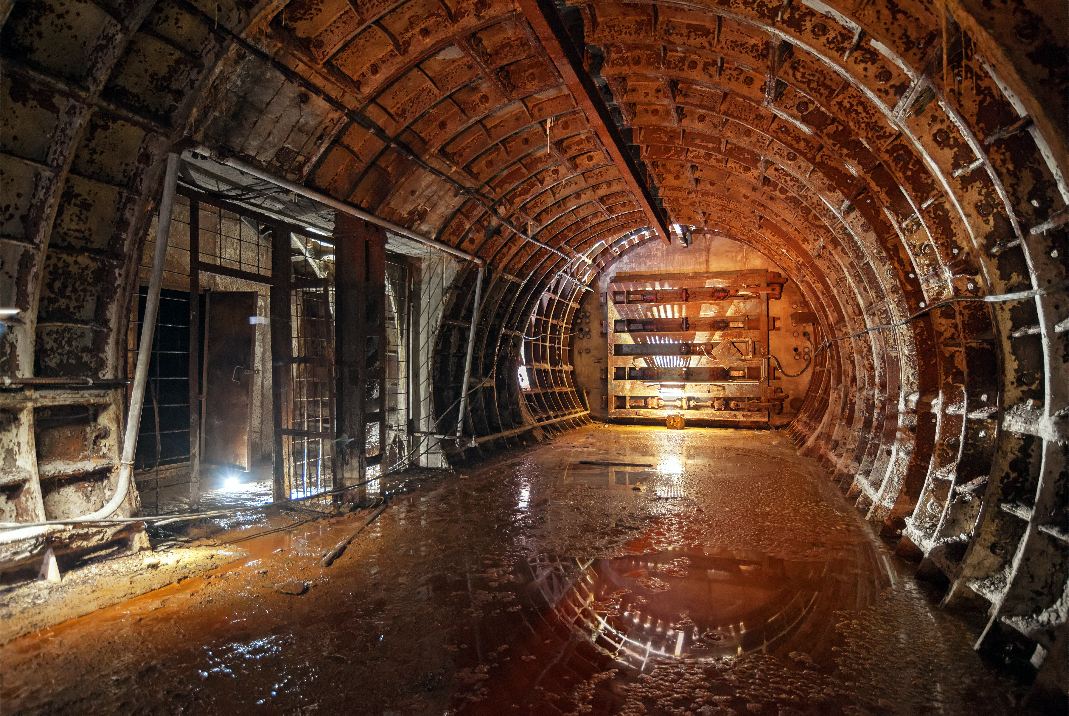
Metal iron structure (tunnel) that has rusted due to the presence of water and oxygen (air)
Unfortunately, if nothing is done, oxidation will continue and will have a corrosive effect on the attacked surface, leading to perforation...
To prevent this corrosion, it is essential to treat the affected surface quickly.
Although many techniques are recommended for treating rust, some of them do not solve the problem in depth, for a lasting result.
But what exactly is dry ice blasting?
The dry ice blasting technique dry ice cleaning uses dry ice as a cleaning agent and requires expertise and proper safety precautions.
To perform a dry ice blasting operation, the professional introduces Carbon dioxide ice in the form of small cylinders or pellets of 3.5 mm, inside the hopper of a Cryoblaster.
Dry ice and compressed air (from the industrial network or a compressor) mix together to allow low-pressure projection of the ice through a delivery hose: the dry ice is then sprayed onto the surfaces to be cleaned, using a gun and projection nozzle.
The impact created when the dry ice reaches the rust surface. This is what we call the "kinetic effect.
Le thermal shock " which then cracks the rust layer by contracting it: it detaches from the base.
Finally, upon impact the dry ice sublimates* passing from solid state to gaseous state in a ratio of . One could speak of micro-explosions.. The rust is literally blown away! All that remains on the ground is loose rust: no water, no sand.
However, it should be noted that only surface rust or thin rust can be treated. Dry ice blasting is an excellent degreasing process, without chemical products (solvents or detergents) and allows cleaning without damaging delicate surfaces.
Dry ice cleaning is cleaning at its driest. Pollutants or contaminants are removed while keeping disassembly to an absolute minimum.
*: Sublimation is the passage of a substance from solid state to gaseous state
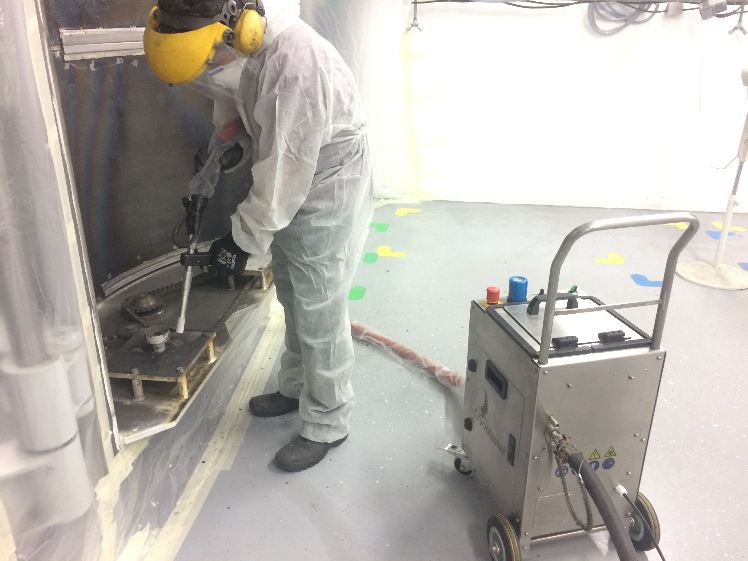
Dry ice blasting operation on metallization furnace with Cryoblaster ATX nano...
Dry ice blasting is used in industrial maintenance, for treatment surface preparation (preparation before painting), in food.
The process is fast et effectiveindustry, and generates little waste (only the removed contamination needs to be vacuumed).
Why can't dry ice blasting treat deep rust?
Dry ice projection on surfaces demonstrates its limits with so-called "deep" rust. Simply because the hardness of solid CO₂ is only 2 Mohs that is, the hardness of chalk. Suffice it to say that the process is not because the hardness of dry ice is close to that of chalk:.
Dry ice blasting is indeed suitable for cleaning delicate surfaces such as plastic injection molds, electrical cabinets, car engines, etc... but is not really ou is not recommended for rust stripping.
The ideal solution would therefore be to have a technique capable of removing the effects of oxidation on metal surfaces, while being the least invasive in terms of waste.
Alternative solutions to dry ice blasting for rust
There are proven solutions to effectively replace dry ice blasting for treating oxidation on metals, particularly on steels.
Here are therefore 3 alternative solutions.
Air blasting
This treatment method is well-known, similar to sandblasting and consists of stripping surfaces through mechanical action by projecting abrasives at high velocity. However, air abrasive blasting consumes up to 10 times less abrasive than sandblasting for the same type of work.
To do this, an abrasive or aggregate suitable for stripping oxidation is placed inside the hopper of the air abrasive blaster, then the abrasive is mixed with a stream of compressed air and projected onto surfaces using a gun and projection nozzle.
Stripping by air abrasive blasting is fast and extremely effective : the metal is exposed. Furthermore, projecting abrasive onto metal surfaces creates porosity that allows better paint adhesion.
The mechanical stripping action of air abrasive blasting is based primarily on the impact of the granulate, and therefore kinetic energy.
The type of abrasive (angular, round), its nature (synthetic, mineral, vegetable) and therefore its hardness, the pressure and volume of air and the type of nozzle used: all these parameters, combined with the contractor's expertise, allow for highly refined work.
Air abrasive blasting can also be used for stripping delicate surfaces (in the food industry for example), in which case bicarbonate can be used depending on the surface being treated.
At the end of the work, vacuuming the rust residue and dust will allow for quick cleaning of the treated area.
For more information on our air abrasive blasting products, click the blue button
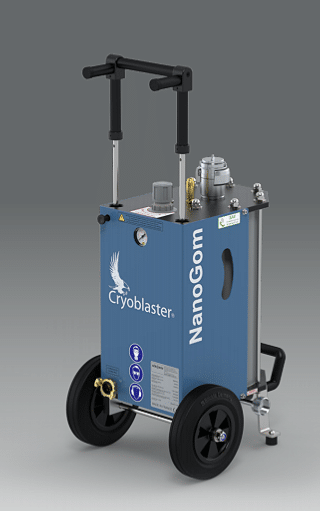
Air abrasive blasting is used as an anti-corrosiontreatment, for stripping woodwork, cleaning after fire, cleaning facade, etc.
Dry ice blasting
This technique combines advantages of dry ice cleaning and media projection abrasive. The spray gun performs a mixture de Carbon dioxide ice et of abrasive through a venturi system and allows rust stripping with a reduction in media quantity up to 3 times less compared to the air abrasive blasting technique.
Waste reprocessing is still necessary, but this technique allows for a drastic reduction in the amount of abrasive used.
Dry ice blasting is primarily recommended when the quantity of media and . It allows cleaning equipment directly on-site, without disassembly or drying, offering immediate productivity gains.must be reduced minimized. Otherwise, air abrasive blasting should be favored.
To discover our dry ice blasting solution, click the orange button.
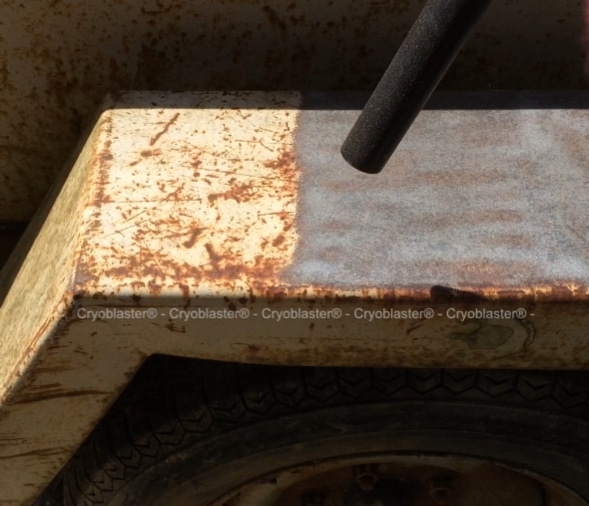
Laser stripping
This technology is quite recent and uses thousands of high-energy light pulses per second (M.O.P.A technology) to eliminate rust.
Unlike air abrasive blasting and dry ice blasting techniques, laser stripping does not remove a layer of metal; only the contamination is stripped.
You benefit from precision cleaning without needing to reprocess secondary waste, due to its absence. However, the laser cleaner should be preferred for stripping","123"::", where the use of abrasive is completely prohibited! small, et medium, surfaces techniques, là où l'utilisation d'abrasif est totalement proscrite !
Discover laser stripping solutions by clicking the green button

In conclusion
Depending on the depth of rust to be stripped, the environmental constraint (limitation of secondary waste), and the you'll find below the pricing list for Cryoblaster® dry ice blasting machines of the parts to be treated, you can choose one of these 4 techniques : dry ice blasting, air abrasive blasting, dry ice blasting, or laser stripping.
To help you make your choice, Cryoblaster has these 4 stripping technologies.
Feel free to contact us by filling out the form below. We'll be happy to answer your request.


