
Understanding Cryogenic Cleaning
Dry ice cleaning: how does it work? Cryogenic cleaning technology represents a major breakthrough in industrial cleaning standards. However, it remains a mystery to many newcomers, and you might just be one of them.Discover in this article and video the explanation of the process cryogenic cleaning
Discover the Power of Cryogenic Cleaning
HOME > CRYOGENIC CLEANING > LEARN MORE
Cryogenic cleaning in a nutshell...
Cryogenic cleaning is a cleaning technique that uses dry ice and its physical properties as a means of instantly removing contaminants or soiling.
Since dry ice (solid carbon dioxide) has the hardness of chalk, this process cleans surfaces gently. To discover all the advantages of this industrial cleaning technology, click on the link at the bottom of the page, Benefits of Cryogenic Cleaning.
The Cryoblaster® process uses dry ice projection through blasters and compressed air. See illustration below.
Cryogenic cleaning explained in video...
Cryogenic cleaning is based on the simultaneous action of 3 physical phenomena
Watch the video below
1- Kinetic Energy
La dry ice,in the form ofpelletswith a diameter of3 mm,is projected at veryhigh speedonto the surfaces to be treated thanks tocompressed airandsupersonic nozzles (convergence/divergence).
La Carbon dioxide ice gains kinetic energy (Ec = 1/2 mV²).
Uponthe impact, the pellets generate ashock wavelocalized, facilitating thedetachmentofcontaminants on the treated surface.
However, it is important to note that the energy transfer to the substrate is minimal, and this is for 2 reasons :
First : hardness of Carbon dioxide ice is comparable to that of chalk. Less dense and lighter, dry ice is non-abrasive.
- Second : passage nearly instantaneous (or thousandths of a second) of solid state to gaseous state of Carbon dioxide ice therefore only allows minimal energy transfer as indicated above.
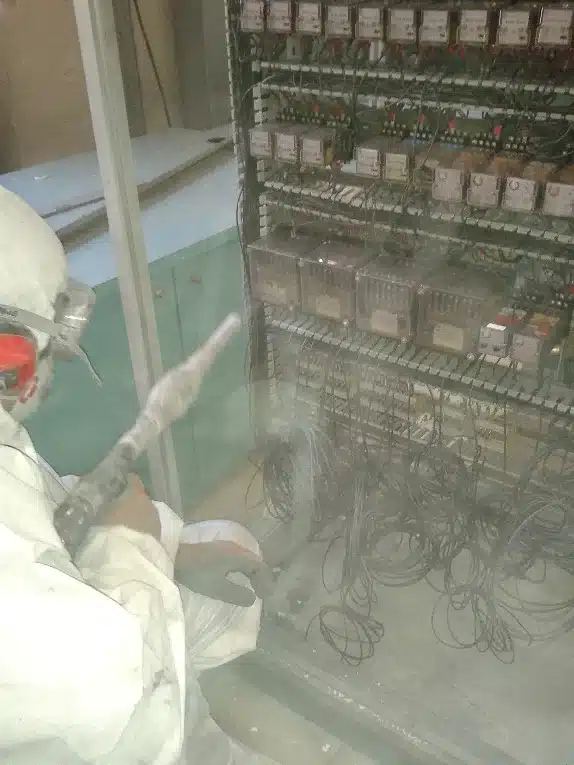
Dry ice blasting service on electrical cabinet...
2- Thermal Differential
La temperaturevery low temperature of dry ice pellets, at-78.5 °C,gives the dry ice blasting process undeniablethermodynamic properties!
Depending on the type of contamination or pollutant being treated, atemperature differencebetween the dry ice and the substrate, orthermal shock, can occur. As the temperature of a contaminant or pollutant decreases, it becomes more brittle, allowing the pellets to impact the pollutant.
Le thermal gradient or the differential between two different materials, with different thermal expansion coefficients, can also facilitate the separation of the pollutant from the substrate. This thermal shock or thermal differential is more evident when dry ice blasting a non-metallic coating (e.g., electrical cabinets covered with dry residue) or a contaminant bonded to a metallic substrate (e.g., coating on foundry mold)
The warmer the temperature of the surface to be treated is hot, and the faster the dry ice blasting process is economical et (e.g., aluminum gravity foundry mold). Many companies are interested in the dry ice blasting process, but worry about how their tools will react to the cold from dry ice:
studies have shown that the temperature drop occurs only on the surface de , so there isno risk of thermal stress within the metal mass of the substrate with dry ice blasting . Example: plastic injection molds.3- Sublimation
upon impact,
À sublimes (transition from solid to gaseous state) at a ratio of la Carbon dioxide ice [[NUM]] to [[NUM]] . One could speak of micro-explosions.The dirt is literally blown away. All that remains is to vacuum up the dirt or residue. The process is dry and generates no secondary waste unlike using a high-pressure cleaner or sandblaster.
Delta Diffusion/Cryoblaster® all rights reserved 2026.

Implementing a Dry Ice Blasting Operation
Step 1

Dry Ice Production
Dry ice is produced from liquid CO2, forming solid pellets ready to use.
Step 2
High-Speed Projection
Dry ice pellets are projected at high speed onto the surface to be cleaned, disintegrating contaminants.
Step 3
Impeccable Results
Contaminants are eliminated without leaving residue, providing a clean surface ready for use.
The dry ice blasting process in detail (s
ee image above):. After plugging in the
- (1)compressed air supply (compressor or factory pressurized air network) and, starting the dry ice blasting unit . Introduce the,
- (2)in the form of dry ice,pellets3 mm,into the blaster, inside the tank. The.
- (3)is Carbon dioxide ice mixed with the compressed air flow au inside the blaster . Then it is,
- (4)propelled through a " blast hose"(5). Finally, the dry ice is projected onto the surfaces to be cleaned using a.
- gun equipped with asupersonic speed spray nozzle Benefits of Dry Ice Blasting.
Unmatched Efficiency
Dry ice blasting offers superior cleaning efficiency, eliminating contaminants without leaving residue.
Environmental Respect
This process uses dry ice, a non-toxic and environmentally friendly material, thus reducing ecological footprint.
Non-Abrasive
Dry ice blasting is non-abrasive, preserving delicate surfaces while ensuring deep cleaning.
Frequently Asked Questions
Discover answers to the most common questions about dry ice blasting.
What is dry ice blasting?
(solid CO2 at -78.5°C). Unlike traditional methods, it eliminates pollutants without solvents and without abrasion, thanks to a combination of thermal shock and kinetic energy. Carbon dioxide ice What are the benefits of dry ice blasting?
non-abrasive nature : its(zero chemicals) character and the complete absence of ecological secondary waste . It allows cleaning equipment directly on-site, without disassembly or drying, offering immediate productivity gains.Is dry ice blasting safe for all surfaces?
How does dry ice blasting work?
(weakens the dirt), the thermal shock (detaches the pollution) and thekinetic energy (the gaseous CO2 "lifts" the dirt from within by increasing its volume). sublimation Which industries can benefit from this process?
food industryfood industry (greases), theautomotive industry (foundry molds), theelectronics industry (live electrical cabinets), plastic molding, and disaster recovery renovation.
The calculation of Return on Investment (ROI) is very favorable. The savings realized from reducing production downtime and the absence of waste treatment costs (sand, contaminated water) more than offset the operating cost.


