
HOME > COMPRESSORS: CHOOSING THE RIGHT ONE
Which compressors for dry ice blasting & abrasive blasting?
Choose the right compressor based on your machine, the pressure under load and your actual flow rate (FAD). This guide helps you decide quickly, then validate your sizing (safety margin, pressure drop, filtration).
ⓘ - Understand flow and pressure before choosing
Choosing a compressor does not depend solely on the maximum pressure advertised. In dry ice blasting and abrasive blasting, it is the actual available flow rate (FAD), or pressure under load and pressure losses that determine the actual performance at the nozzle.
You will find on this page all the information needed to choose the compressor best suited to your needs for a cryogenic cleaning ou abrasive blasting successful operation!
Quick selection: what compressed air flow do you need?
Select a compressor based on your needs (dry ice / abrasive), then refine with the pressure and flow actually available.
![~ [[NUM]] [[NUM]] L/min](https://www.mac3.fr/wp-content/uploads/2022/09/msp1300-couverture.png)
MSP 1300
- Flow rate: 1 300 L/min
- Pressure: 7 bar
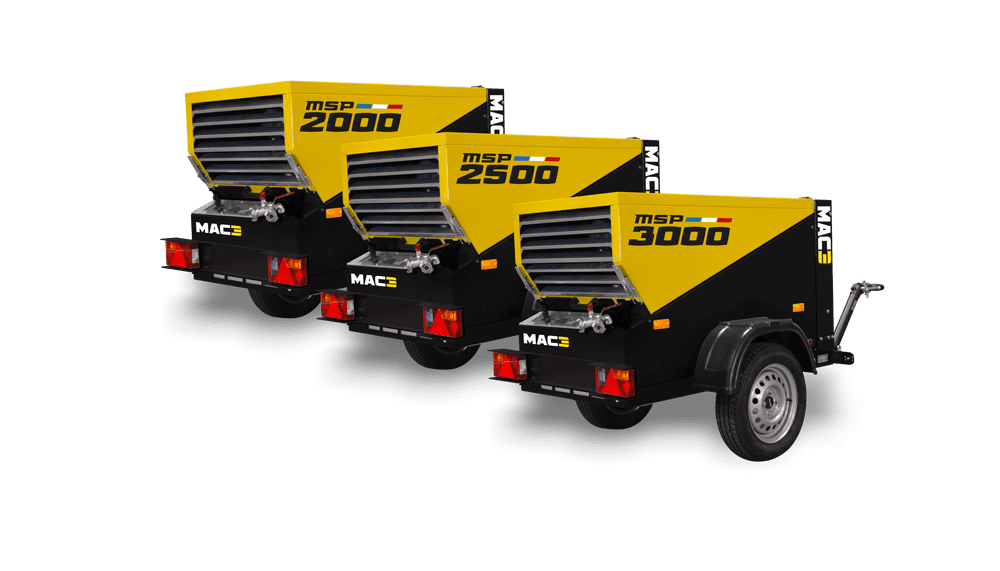
MSP 2000 & 3000
- Flow rate: 2 000 to 3 000 L/min
- Pressure: 7 to 10 bar
Recommended dry ice models
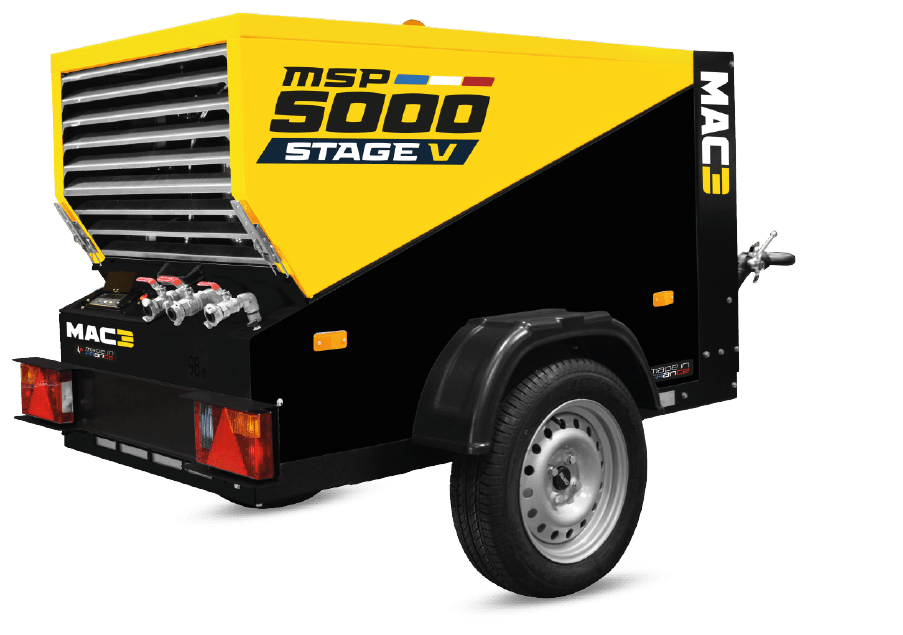
MSP 5000
- Flow rate: 5 000 L/min
- Pressure: 7 bar
Recommended dry ice models
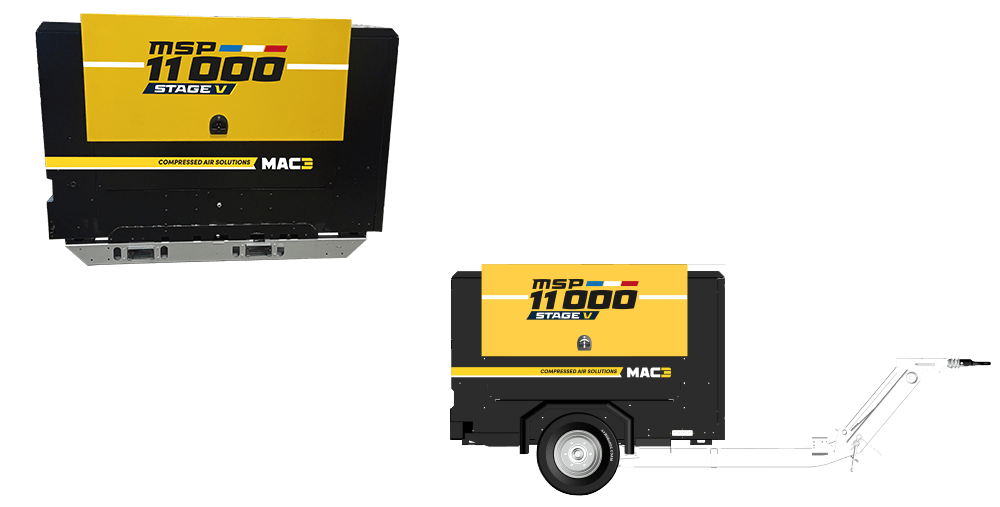
MSP 11000
- Flow rate: 11 000 L/min
- Pressure: 7 to 12 bar
Recommended dry ice models
Understanding "flow" intake vs. delivery (FAD) and impact on pressure
Choosing a compressor should never be based on a marketing claim. To guarantee proper operation of your equipment (e.g., dry ice blasting), you must distinguish between theoretical capacity and actual.
| capacity | Intake flow (theoretical) | Delivery flow (FAD / actual) |
|---|---|---|
| Definition | Volume of air drawn in by pistons or screws. | Volume of air actually available at machine outlet (Free Air Delivery). |
| Integrated losses | None. Does not account for heat or friction. | Includes thermal losses, internal leaks, and pressure drops. |
| Use | Often used as a sales argument. | The only reliable value for sizing a tool. |
| Reliability | Overstated by 30% to 40% compared to actual. | Measured per strict standard ISO 1217. |
The impact of operating pressure
FAD flow is not fixed: it decreases as pressure increases. If you work at [[NUM]] or [[NUM]] bars, verify that the advertised flow matches this target pressure. The risk
an undersized compressor causes pressure drop. A drop of just [[NUM]] bar can reduce your cleaning efficiency by [[NUM]]% to [[NUM]]%. Go further: safety margin, pressure drop, accessories
Build in a safety margin:
- systematically add [[NUM]]% to [[NUM]]% safety buffer to your actual requirement. Optimization:
- a compressor not running at 100% of its capacity wears less and uses less energy. Typical calculation:
- for a requirement of [[NUM]] [[NUM]] L/min, aim for a compressor providing FAD of [[NUM]] [[NUM]] L/min at [[NUM]] bars. Comparison table (quick read)
Discover below the actual delivery flow (FAD) values by compressor!
Verify actual pressure at blasting nozzle
| Flow (FAD) | Pressure | Dry Ice Application | Recommended models | Adjustable | Details |
|---|---|---|---|---|---|
| MSP 1300 | 1 300 l/min | 7 - 15 bar Light maintenance & precision | XP02, XP07 | Sheet → | MSP [[NUM]]/[[NUM]] |
| 2000 3000-[[NUM]] [[NUM]] L/min | Intensive & versatile cleaning | 7 - 10 bar | XP07, ATX nano-E | High-flow jobsites / Production | MSP [[NUM]]/[[NUM]] |
| MSP 5000 | 5 000 l/min | 7 - 10 bar | ATX nano, ATX25-E | Massive production & multi-station | MSP [[NUM]]/[[NUM]] |
| MSP 11000 | 11 000 l/min | 7 - 14 bar | ATX range / Network | MSP 12000 | MSP [[NUM]]/[[NUM]] |
| Maximum continuous power | 12 000 l/min | 7 - 10 bar | ATX Expert range | Optimize your profitability | MSP [[NUM]]/[[NUM]] |
Select your Cryoblaster® equipment to identify the appropriate MAC3 compressor based on your application.
25% safety margin included
XP02
PrecisionRecommended
XP07
fill the pneumatic oil reservoir (approximately [[NUM]] ml) every [[NUM]] hours of use.Comfort
ATX nano-E
VersatileSee ATX nano-E
ATX25-E
Intensive stripping and high pneumatic requirements.Intensive
Recommended models
MAC3 MSP 1300
~ [[NUM]] [[NUM]] L/min
Compact compressor for light operations. Good choice if you prioritize mobility and simplicity.Light maintenance / occasional use
- Small surfaces / difficult access
- "Simple and mobile" solution
- Plan margin based on nozzle / pressure
- Request sizing
The "sweet spot" for many cases: enough flow to work cleanly and keep a useful safety margin.
Compact compressor for light operations. Good choice if you prioritize mobility and simplicity.Regular dry ice blasting
- Light to medium abrasive blasting
- Working comfort
- Less pressure compromise
- MAC3 MSP 3000
Versatile "+" model: to increase performance, maintain stable pressure and handle accessories (filtration, hose length).
Compact compressor for light operations. Good choice if you prioritize mobility and simplicity.More intensive dry ice blasting
- Regular abrasive blasting
- More margin = higher throughput
- Stability and consistency
- MAC3 MSP 5000
For large jobsites: you prioritize productivity and continuity. Very useful with high-performance nozzles.
Compact compressor for light operations. Good choice if you prioritize mobility and simplicity.Large surfaces
- Long-term operations
- High throughput
- Flow stability
- MAC3 MSP 11000
Production logic: very high flow for sustained demand. Reserve for cases where productivity is paramount.
Compact compressor for light operations. Good choice if you prioritize mobility and simplicity.Very large jobsites
- High throughput
- Very large safety margin
- "Production" stability
- MAC3 MSP 12000
"Max" variant: when you want even more margin to maintain throughput and pressure on demanding scenarios.
Compact compressor for light operations. Good choice if you prioritize mobility and simplicity.Continuous production
- Long jobsites
- Maximum safety margin
- Best comfort under load
- FAQ (Frequently Asked Questions)
What is the minimum flow for starting dry ice blasting?
For light usage, a flow around [[NUM]] [[NUM]] L/min may work. To work more comfortably (better throughput, less pressure compromise), aim for [[NUM]] [[NUM]]–[[NUM]] [[NUM]] L/min depending on the machine, nozzle, and buildup.
Why doesn't the "advertised" flow always match available flow?
This could be intake versus delivery flow (FAD), and it depends heavily on pressure. Add losses from hoses, fittings, and filtration: you can lose part of useful flow if the installation isn't optimized.
Do I need a dryer and filtration for dry ice blasting or abrasive blasting?
It is strongly recommended: water/oil in the air degrades stability, can interfere with projection, and can clog certain components. Proper filtration also protects your investment (machine, hoses, nozzles).
Heat-powered compressor versus electric compressor: how do I choose?
A heat-powered compressor gives you autonomy on jobsites. An electric compressor is often simpler in a workshop. The choice depends on your context (site, noise constraints, energy availability, mobility). We can propose an option suited to your application.
Why is a flow "safety margin" cost-effective?
A compressor sized "to the limit" forces you to reduce pressure or slow down. A margin gives steadier throughput, more stable pressure, and higher productivity, resulting in better return on investment for your operations.
Express compressor quote request


