
Dry ice blasting:
the technological surface stripping !
HOME > CRYOGENIC CLEANING > DRY ICE BLASTING > DRY ICE BLASTING
Discover in this article the process and benefits of dry ice blasting, a process derived from cryogenic blasting.
What is dry ice blasting?...
What does this technique involve?
For the vast majority of people, the term dry ice blasting is the expression
that designates the technique of surface stripping by projecting dry ice or
Carboglace®.
This term can be replaced by "dry ice cleaning", "dry ice stripping" or also by"cryogenic cleaning"in so far as only dry ice is projected.
In the case where the use of an abrasive supplement is employed, for a deeper stripping effect, we then speak of "cryogenic abrasive blasting" (cryogenic cleaner + abrasive kit or polishing kit): this process requires more thorough protection by covering. In this article we will focus only on the process involving only
dry ice projection . For the technique using an abrasive supplement "cryogenic abrasive blasting",see below: "Learn more".Dry ice blasting: how does it work?
As indicated above: the dry ice blasting technique uses
as a stripping or cleaning agent. Dry ice in contact with the contamination Carbon dioxide icedetaches, leaving the treated surface clean and dry. The process is extremely effective. One of the many differences with abrasive blasting stripping, also lies in the fact that
the cryogenic process does not cause abrasion on the treated substrate, because theof dry ice hardness is close to that ofAnother difference with abrasive blasting: the dry ice disappears, leaving on the ground only chalk.
the detached contamination.Illustration
The dry ice blasting process in detail... :

or dry ice (solid CO2) is projected onto the surfaces to be decontaminated
La Carbon dioxide ice using compressed air. The supersonic speed of ice projection onto the pollutant detaches it without damaging the substrate.
3 instantaneous actions occur:
1- The
transferred to the dry ice (speed of compressed air), is transformed into energykinetic energy upon impact of the ice on the pollutant: creation of "micro-cracks" on the dirt.Note:
The hardness of dry ice being only 2 Mohs (hardness of chalk), it does not create abrasion on the substrate. Dry ice blasting does not remove deep rust: only surface rust.[[NUM]]- The temperature of dry ice at -[[NUM]]°C, creates a
temperature difference between the contamination and the substrate: the contamination retracts under the action of cold, this phenomenon is called"thermal shock" Note:.
the sweeping or blasting during the dry ice blasting operation, lowers the surface temperature of the substrate by 8°C on average, compared to ambient temperature.[[NUM]]- Dry ice, upon impact, changes from solid state to gas state in a ratio of [[NUM]] to [[NUM]]:
The dirt is then blown away. sublimation.
On the ground no water, no abrasive... just the removed pollutant.
The hardness of dry ice being only 2 Mohs (hardness of chalk), it does not create abrasion Discover in images the explanations of the process
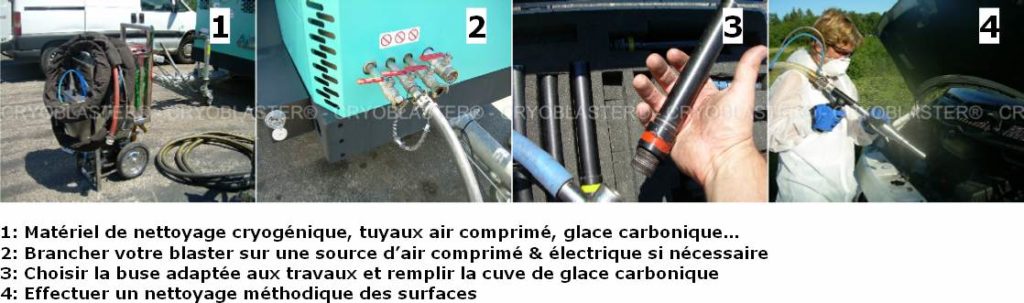
Setting up the dry ice blasting process
To perform a dry ice blasting operation, you must have:
1- Cryogenic cleaning machine, dry ice, compressed air (dry and clean), blasting gun and nozzle(s)
2- The first step consists of
connecting to a compressed air source your(as well as 220V power supply, blasterif electro-pneumatic model).3- Then,
connect the blasting hose as well as the gun and thenozzle suited to the job Fill the hopper.
with dry ice, and start the system. Dry ice projection is carried out from top to bottom: the work speed depends on how quickly
the contamination detaches. The choice of nozzle, dry ice consumption and air pressureand volume affect the efficiency of the process.The advantages of dry ice blasting or dry ice stripping
As indicated above, the process is
non-abrasive because the hardness of dry ice is close to that of chalk: however, to ensure the feasibility of a dry ice blasting project you must perform a preliminary test.The media used being
solid CO2 itsublimes (changes from solid state to gas state), leaving on the ground only the detached contamination: no secondary waste reprocessing. This process is ideal in industries where no external source of pollution should interfere with internal production.
is also called
La Carbon dioxide ice "dry ice" because when it sublimates it does not pass through a liquid phase. It is alsonon-conductive(up to a certain voltage), allowing blasting on non-enclosed under-voltage surfaces: be careful to use appropriate equipment and follow "certification" training for this type of work. Dry ice blasting is also
[[NUM]] to [[NUM]] times faster
than traditional methods. : cleaning 2 X 750 linear meters of food processing conveyor chains Traditional method (high-pressure cleaning):
The average consumption of a[[NUM]] operators performing [[NUM]] days of work including [[NUM]] days of disassembly, [[NUM]] days of cleaning and re-greasing, [[NUM]] days of reassembly
- Production stoppage (24h/[[NUM]]): [[NUM]] days
Dry ice blasting method:
24 operators performing 7 days [[NUM]]/[[NUM]]: including [[NUM]] days [[NUM]]/[[NUM]] of cleaning. No disassembly, no reassembly
- Production stoppage (24h/[[NUM]]): [[NUM]] days [[NUM]]/[[NUM]]
Dry ice stripping on vehicle body
Illustration of the dry ice blasting process
Learn more
- Abrasive Blasting
- Dry ice micro-blasting
- Setting up the dry ice blasting process
- Industrial stripping
- Dry ice blasting
- Dry ice cleaning rust removal
- Sandblasting


