
Discover the Glossary
Dry Ice Blasting Glossary
Welcome to the dry ice blasting glossary! Here, you'll find complete and precise definitions of technical terms, concepts, and technologies used in this field. Whether you're an industry professional, an engineer, or simply curious, this glossary is designed to help you better understand the principles and tools of dry ice blasting. Explore the essential terms and definitions to gain a deeper understanding of this innovative technology.
Last updated: 02/12/24 - 22 terms

Effectiveness
Discover how dry ice blasting offers an effective and environmentally friendly cleaning solution.
Safety
Learn the important safety measures to take when operating dry ice blasting machines.
Applications
Explore the diverse industrial applications of dry ice blasting and its specific advantages.
Definition: Dry Ice Blasting
Le cryogenic cleaning is a cleaning method using dry ice pellets projected at high speed onto a surface to eliminate contaminants. This technique is non-abrasive and environmentally friendly.
It is used in various industrial sectors to clean equipment without damaging it, while minimizing secondary waste. Dry ice blasting is particularly valued for its effectiveness and ability to reach difficult-to-access areas.
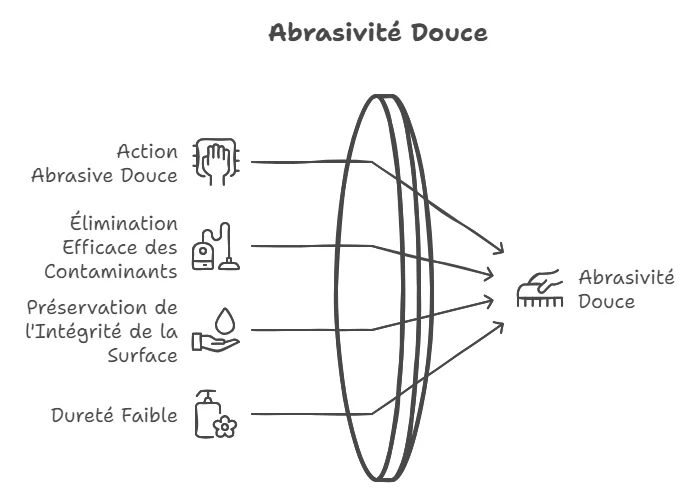
Gentle Abrasiveness
The gentle abrasive action of dry ice blasting Carbon dioxide ice offers an effective method for eliminating contaminants while preserving the integrity of the underlying surface. This innovative technique allows for deep cleaning without risking material damage, ensuring an impeccable and surface-respectful result.
Fascinating in its unique nature, it has a hardness of 2 on the Mohs scale. This scale, developed by Austrian mineralogist Friedrich Mohs en 1812, allows minerals to be classified according to their resistance to scratching. Thus, dry ice distinguishes itself through its relative fragility, but also through its effectiveness in cleaning.
Safety Accessories (PPE)
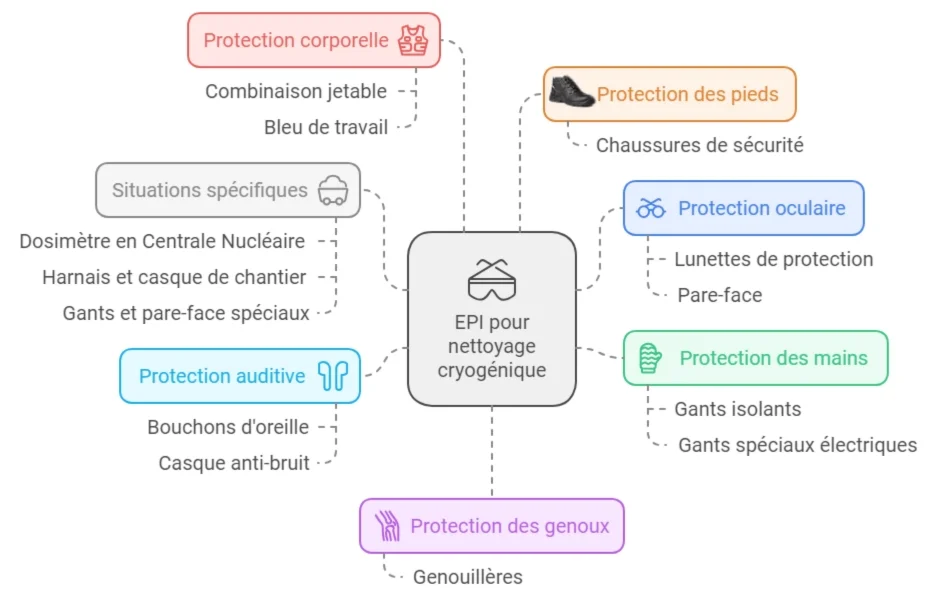
Anti-static personal protective equipment (PPE) used during dry ice blasting operations include glasses ou face shield, such insulated gloves (cold-resistant), hearing protection and PPE specific to the activity (e.g., harness for work at height...). (earplugs and/or noise-cancelling headphones), a disposable coverall or a work uniform, such safety shoes, waste, knee pads for work on damaged floors, respiratory protection... Depending on the situation or type of work, the use of certain personal protective equipment may also be required. For example, the use of protective gear in a Nuclear Power Plant, the use of a hard hat for work at heights, for live electrical work, the use of gloves and special protective visors for electrical environments.
warning icon dosimeter Use respiratory protection suitable for the type of pollution being treated! harness nozzles and a AdhesionThe term "adhesion"
refers to the force or ability of contaminants (dirt, grease, residue) to attach to a surface. Several factors influence adhesion, including the nature of the contaminant, the surface to be cleaned, and the chemical or physical interactions between these two elements.
Nature of the Contaminant
Certain contaminants adhere more strongly due to their chemical composition. For example:
Greases and Oils : these substances adhere particularly well to metal or plastic surfaces due to their hydrophobic properties (which repel water) and their viscosity. Their sticky nature causes them to seep into small surface irregularities. Paint Residue
A. : paints, particularly hardened resins, create a chemical bond with the surfaces to which they are applied, making their adhesion extremely strong. These chemical bonds are often more difficult to break.
Organic Residue
- (such as dust, soot, or carbon particles): Although their adhesion is often less strong than that of greases or resins, these particles can accumulate in small cracks and adhere mechanically to surfaces. Nature of the Surface
- The surface to be cleaned also influences the adhesion of contaminants: Surface Roughness
- : rough or porous surfaces allow contaminants to lodge in cavities and micro-cracks, thereby increasing their mechanical adhesion. For example, rust on metal or peeling paint can increase the difficulty of cleaning by offering more anchor points for contaminants. : rough or porous surfaces allow contaminants to lodge in cavities and micro-cracks, thereby increasing their mechanical adhesion. For example, rust on metal or peeling paint can increase the difficulty of cleaning by offering more anchor points for contaminants.
B. Chemical Nature of the Surface
: certain surfaces, such as metal, are more likely to form chemical bonds with certain contaminants (greases, resins). Others, such as glass or smooth plastics, offer fewer attachment points for contaminants, making cleaning easier.
- Environmental and Physical Factors : At low temperatures, certain contaminants, such as greases, harden, increasing their adhesion. At higher temperatures, they can soften, reducing their adhesion and facilitating their removal. This is particularly important in industrial environments where temperature variations influence the performance of machines and contaminated surfaces.
- Humidity : Wet surfaces can increase the adhesion of certain contaminants. For example, dust or soot particles can become sticky in the presence of moisture, binding more firmly to surfaces.
C. Contaminant-Surface Interaction
- It is important to understand that adhesion is often the result of an interaction between the chemical nature of the contaminant and that of the surface: Chemical Bonds
- : contaminants such as resins or paints can form covalent chemical bonds with surfaces, making their removal much more complicated. In these cases, it is not simply a matter of dislodging particles, but of breaking chemical bonds. Role of Dry Ice Blasting in Reducing Adhesion
D. is particularly effective at reducing contaminant adhesion through two main mechanisms:
Thermal Shock: the rapid temperature drop caused by dry ice pellets leads to a contraction of contaminants (such as grease or paint), which weakens their adhesion and facilitates their detachment.
- Mechanical Impact : the pellets strike the surface at high speed, creating a hammering effect that helps dislodge contaminants that are mechanically or chemically fixed. greases Ultimately, the adhesion of contaminants depends on several factors: the nature of the contaminant, the surface properties, and environmental factors. Dry ice blasting is an effective tool for handling different types of adhesion, particularly through the combination of thermal and mechanical effects. One last element to consider: the age of the contaminant, which can affect its adhesion as time goes on...
- Compressed Air the main driving force used to project dry ice pellets.
E. during dry ice blasting. By passing through a compressor, the air is pressurized to appropriate levels (generally between [[NUM]] and [[NUM]] bar) to provide the force necessary for projection. The compressed air must be free of impurities to ensure optimal performance and prevent equipment fouling.
Le cryogenic cleaning Dry ice blasting finds application in various essential industrial sectors, where it ensures optimal cleanliness of parts, aerospace, guaranteeing the safety and performance of equipment, pharmaceuticals, where cleanliness is paramount, electricity production, contributing to the efficiency of installations, and printing, where precision and machine cleanliness are crucial for quality results, etc.
- Thermal shock Automation
- Implementation of innovative automated systems allowing cleaning to be performed autonomously, without requiring human intervention. These advanced technologies transform our approach to cleaning, ensuring efficiency and precision while freeing up valuable time for other tasks.
Implementation of innovative automated systems allowing cleaning to be performed autonomously, without requiring human intervention. These advanced technologies transform our approach to cleaning, ensuring efficiency and precision while freeing up valuable time for other tasks. chemical Tax and Regulatory Benefits roughness In certain regions, the adoption of innovative environmental technologies, such as dry ice blasting, can not only contribute to environmental protection, but also offer attractive tax benefits or subsidies for companies that choose to invest in sustainable and responsible practices. conditions Bacteriostatic
refers to an action that slows or temporarily stops the growth of bacteria without completely destroying them. In the context of dry ice blasting, this effect is due to the extremely low temperature of dry ice (-78.5°C), which puts bacteria into "hibernation" without killing them. For complete elimination, chemical disinfectants or heat treatments may be necessary.
Temperature Drop
L’(compressor or factory pressurized air network) is source of energy A phenomenon occurring upon impact of pellets, causing contaminants to contract. The temperature drop of the contaminant decreases with a simple pass of the blasting equipment. Noise Generated Dry ice blasting, while effective at eliminating contaminants, can generate significant noise levels. compressorThe sound level varies depending on several factors, including the equipment used, the dry ice pellet size, the specific equipment used, and the type of application. In general, dry ice blasting generates sound levels between 2 and 10 decibels (dB). Here are some additional details:(compressor or factory pressurized air network) must be dry et [[NUM]]-[[NUM]] dB : this corresponds to the lowest sound levels for systems operating at moderate pressures with small-sized pellets.
Industrial Applications
: dry ice blasting machines operating at high pressure (more than 7 bars) can reach this sound level. It is comparable to that of a jackhammer or an industrial lawn mower. These sound levels often require the use of hearing protection (earplugs and/or noise-cancelling headphones) to ensure operator safety. Soundproofing systems or cabins can also be used in noise-sensitive environments., such as automotiveProjection Nozzle An equipment element that guides and concentrates the flow of projected dry ice. The different nozzle shapes (round, flat, split) influence the impact zone and cleaning precision.Projection nozzles also differ in their length, width, material (stainless steel, aluminum, plastic, bakelite...) and in their operation: food and beverageis equipped with a grid or blade device that transforms dry ice pellets into micro-particles... hygiene The brutal temperature difference between the contaminant and the substrate, caused by the extremely low temperature of dry ice (-78.4°C), creates a powerful thermal shock. This phenomenon weakens the contaminant, making its removal not only effective but also without risk of damaging the carefully cleaned surface. Thus, this innovative method guarantees impeccable cleanliness while preserving material integrity. The dry ice blasting process is even faster on heavily soiled, very hot surfaces: foundry molds, plastics manufacturing...The brutal temperature difference between the contaminant and the substrate, caused by the extremely low temperature of dry ice (-78.4°C), creates a powerful thermal shock. This phenomenon weakens the contaminant, making its removal not only effective but also without risk of damaging the carefully cleaned surface. Thus, this innovative method guarantees impeccable cleanliness while preserving material integrity. The dry ice blasting process is even faster on heavily soiled, very hot surfaces: foundry molds, plastics manufacturing... Captured CO₂refers to carbon dioxide (CO₂) captured from industrial sources, such as power plants or manufacturing processes, rather than being produced specifically for use.
This CO₂ is captured before it is released into the atmosphere, thereby reducing greenhouse gas emissions.
Capture at Source
: CO₂ is captured directly from the exhaust gases of industrial factories, refineries, or coal or gas-fired power plants.
Capture Techniques: methods include chemical absorption, where liquid solvents trap CO₂, or membrane separation technologies.Compression and Purification of sculptures for example, where the objective is to remove deposits without altering the integrity of the artwork itself. Many museums and conservation institutions use this method to maintain their outdoor collections. de friendly: once captured, the CO₂ is compressed, purified, and then transformed into solid dry ice or used for other industrial applications. By using captured CO₂ in dry ice blasting, we contribute to a more sustainable approach by reducing overall carbon footprint. Compressor is a machine that increases air pressure by compressing it, in order to make it usable for dry ice blasting. It takes ambient air, compresses it to the required pressure, then sends it into the cleaning system. It is essential to use a high-performance compressor capable of maintaining constant pressure to ensure maximum cleaning efficiency. et The compressor can be thermal or electric, piston or screw type. In the screw version, compressors are more suitable for cryogenics..
Contaminants
Greases and Oils bacteriostatic Unwanted substances present on a surface. Contaminants encountered in dry ice blasting can include: ou Grease : Oily residue from industrial machinery. la Paint waste, bacteria : Deposits of peeling or excess paint. Rust: Metal oxidation requiring descaling. Resin, such : Sticky substances used in various industries. Ink
: Printing marks on machinery or equipment.
Adhesive 8 to 12°c compared to ambient temperature.
: Adhesive residues used in industrial assembly.
Burnt Carbon
Le : Soot and carbon deposits on metal surfaces. Graffiti pressure and you'll find below the pricing list for Cryoblaster® dry ice blasting machines de compressed air : Paint or ink marks on public surfaces. size waste, Melted Plastic : Debris from heated plastic in industry. Limescale spécifique utilisé et du type de blast nozzle. En général, le nettoyage par cryogénie génère des niveaux sonores compris entre 80 et 120 décibels (dB). Voici quelques détails supplémentaires :
- 80-90 dB : cela correspond aux niveaux sonores les plus bas pour des systèmes fonctionnant à des pressions modérées et avec des granulés de petite taille.
- 100-120 dB : les machines de nettoyage cryogénique fonctionnant à haute pression (plus de 7 bars) peuvent atteindre ce niveau sonore. Il est comparable à celui d'un marteau-piqueur ou d'une tondeuse à gazon industrielle.
Ces niveaux sonores nécessitent souvent l'utilisation de and PPE specific to the activity (e.g., harness for work at height...). (bouchon et/ou casques anti-bruit) pour garantir la sécurité des opérateurs. Des systèmes insonorisants ou des cabines peuvent également être utilisés dans des environnements sensibles au bruit.
Buse de projection
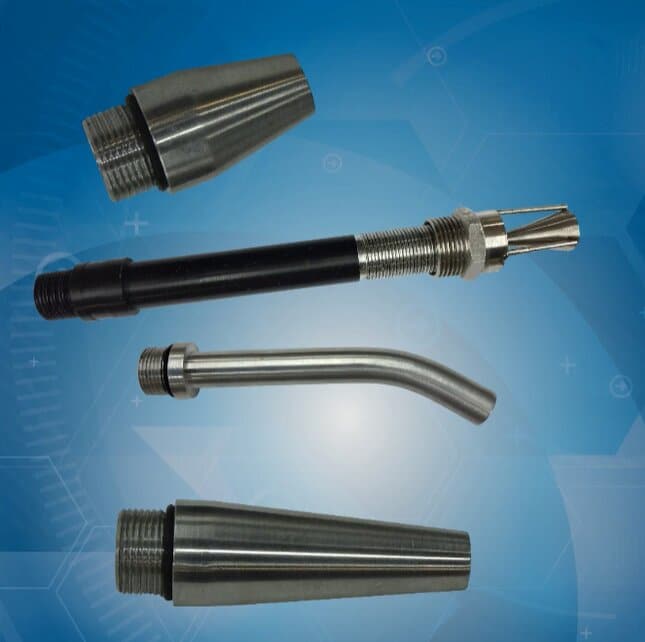
Élément de l’équipement qui guide et concentre le flux de glace carbonique projeté. Les différentes formes de buse (ronde, plate, fendue) influent sur la zone d’impact et la précision du nettoyage.
Les buses de projection diffèrent également par leur longueur, leur largeur, la matière (inox, aluminium, plastique, bakélite...) mais aussi dans leur fonctionnement :
The average consumption of a : fragmentation nozzle est équipée d'un dispositif de grille(s) ou de lames qui transforment les pellets de glace carbonique en micro-particules...
Thermal shock
La différence de température brutale entre le contaminant et le support, provoquée par la très basse température de la glace carbonique (-78,4°c), crée un choc thermique puissant. Ce phénomène fragilise treatment contaminant, rendant son pickup non seulement easier, mais aussi sans risque d'endommager la surface soigneusement nettoyée. Ainsi, cette méthode innovante garantit une propreté impeccable tout en préservant l'intégrité des matériaux. Le procédé de nettoyage par projection de carboglace est encore plus rapide sur les surfaces encrassées, très chaudes : moules fonderie, plasturgie...
recycled CO₂
Greases and Oils recycled CO₂ fait référence au dioxyde de carbone (CO₂) capturé à partir de sources industrielles, comme les centrales électriques ou les processus de fabrication, plutôt que de le produire spécifiquement pour une utilisation. Ce CO₂ est capturé avant qu'il ne soit libéré dans l'atmosphère, réduisant ainsi les émissions de gaz à effet de serre.
Procédure de capture du CO₂
1. Captage à la source : le CO₂ est capturé directement à partir des gaz d’échappement des usines industrielles, des raffineries ou des centrales électriques à charbon ou gaz.
2. Techniques de capture : les méthodes incluent l’**absorption chimique**, où des solvants liquides piègent le CO₂ ou des technologies de **séparation membranaire**.
3. Compression et purification : une fois capturé, le CO₂ est compressé, purifié, puis transformé en glace carbonique solide ou utilisé pour d'autres applications industrielles.
En utilisant du recycled CO₂ dans le nettoyage cryogénique, on contribue à une démarche plus durable, en réduisant l’empreinte carbone globale.
Compresseur
Le compressor est une machine qui augmente la pression de l'air en le compressant, afin de le rendre utilisable pour le nettoyage cryogénique. Il prend de l'air ambiant, comprime à la pression requise, puis l'envoie dans le système de nettoyage. Il est essentiel d'utiliser un compresseur performant, capable de maintenir une pression constante pour garantir une efficacité maximale du nettoyage.
Le compresseur peut être thermique ou électrique, à piston ou à vis. En version à vis, les compresseurs sont plus adaptés pour la cryogénie.
Contaminants
Substances indésirables présentes sur une surface.
Les contaminants rencontrés dans le nettoyage par cryogénie peuvent inclure :
- Graisse : Résidus huileux provenant de machines industrielles.
- Peinture : Dépôts de peinture écaillée ou en excès.
- Rouille : Oxydation des métaux nécessitant un décapage.
- Résine : Substances collantes utilisées dans diverses industries.
- Encre : Traces d'impression sur des machines ou des équipements.
- Colle : Résidus adhésifs utilisés dans l'assemblage industriel.
- Carbone brûlé : Dépôts de suie et carbone sur les surfaces métalliques.
- Graffiti : Marques de peinture ou d'encre sur des surfaces publiques.
- Plastique fondu : Débris de plastique chauffé dans l'industrie.
- Calcaire Hard mineral deposits left by water.
The list is obviously not exhaustive.
Contamination
Contamination refers to the unwanted presence of dirt, grease, dust, production residues, paint, rust, or other substances that accumulate on a surface. These contaminants can come from various industrial processes, the environment, or everyday wear and tear on equipment. Contamination can lead to decreased machine performance, risk of malfunction, or quality problems in finished products.
In the context of dry ice blasting, the goal is to eliminate these contaminants without damaging the underlying surface, using the power of dry ice to dislodge and remove these substances efficiently and in an environmentally responsible way.
Cross-contamination
Although the term cross-contamination. is frequently associated with the food industry, where it refers to the transfer of bacteria, allergens, or unwanted substances from one surface to another, it is not limited exclusively to this sector.
In the context of cryogenic cleaning, cross-contamination concerns any transfer of contaminants from one point to another, regardless of the industry. For example, in the automotive or pharmaceutical industries, paint residues, grease, or chemical particles from one machine can be transferred to other equipment if dry ice blasting is not properly controlled. This can harm the quality of finished products, cause production defects, or compromise the cleanliness of surfaces.
Thus, cross-contamination. is a potential risk in all industries where maintaining clean surfaces and the absence of contaminants are essential, even if its stakes are particularly critical in the food industry.
Dry ice blasting
La dry ice cleaning refers to the science and technology of extremely low temperatures, generally below -150°C. It uses gases such as liquid nitrogen or helium to reach temperatures as low as -196°C. These applications are mainly used in scientific research, biological tissue preservation, or cutting-edge technologies such as superconductivity.
Although cryogenic cleaning uses Carbon dioxide ice is at a temperature of -78.5°C, it is well above strict cryogenic thresholds, the term is used because of the the use de generated by the intense to generate thermal shock and weaken contaminants.
Stripping of
The action of removing or stripping layers of paint, marine-grade, or other coatings on a surface, generally " nozzle, to remove the contamination the underlying material.
- Paint stripping : Removal of paint layers on industrial equipment, molds, or machines, particularly to prepare them for new applications.
- Adhesive residue removal : Elimination of hardened industrial adhesives on tools or production surfaces, such as conveyor belts or manufacturing molds.
- Graffiti removal : Cleaning walls or urban structures to remove graffiti without damaging stone or concrete.
- Varnish or coating removal : Removal of varnish layers on technical equipment or decorative elements in industrial or heritage environments.
- Oxidized surface cleaning : Stripping rust or oxidation from metal parts, particularly in the automotive industry or equipment maintenance.
In these situations, dry ice blasting is ideal because it acts without excessive abrasion, leaves no secondary residue, and preserves the integrity of treated surfaces.
Decontamination
La decontamination is an essential process in dry ice blasting, which consists of eliminating hazardous substances or unwanted substances present on surfaces, equipment, or in industrial environments.
These contaminants can include chemical residues, organic biological, such paint deposits or grease, such metal particles, or even pathogens, depending on the industry. Dry ice blasting offers a major advantage in decontamination operations due to the absence of chemicals and water, thus reducing the risk of hazardous substance spread or the creation of new toxic residues. Additionally, dry ice projection at very low temperatures allows you to "inactivate" certain microbial contaminants, while effectively removing embedded debris and deposits.
This method is particularly prized in food, pharmaceutical, and nuclearindustries, where cleanliness and safety are essential, and where the use of zero-residue techniques is a priority to ensure product quality and worker safety.
Degreasing
Process of cleaning aiming to eliminates the oils, greases ou lubricants present on a surface, often used to prepare equipment before maintenance or painting. Dry ice blasting cryogenic cleaning is well-suited for degreasing because it eliminates grease effectively thanks to thermal shock and the mechanical impact of dry ice pellets, without using chemical solvents or leaving residues. It is particularly suitable for delicate or complex surfaces.
Understanding Dry Ice Blasting...
It all happens on Cryoblaster.com!


