
Dry ice blasting on car bodies: separating fact from fiction!
Every month, many of you ask us whether cryogenic blasting on car paint is effective.The question is not innocent, as many of you would simply like to abandon the traditional sandblasting process in favor of a less constraining method of stripping surfaces.
Whether true or false, videos circulating online fuel the mystery surrounding the effectiveness of dry ice blasting on car bodies.
Youwill find below a perfect illustration of the subject discussed (see video below)...
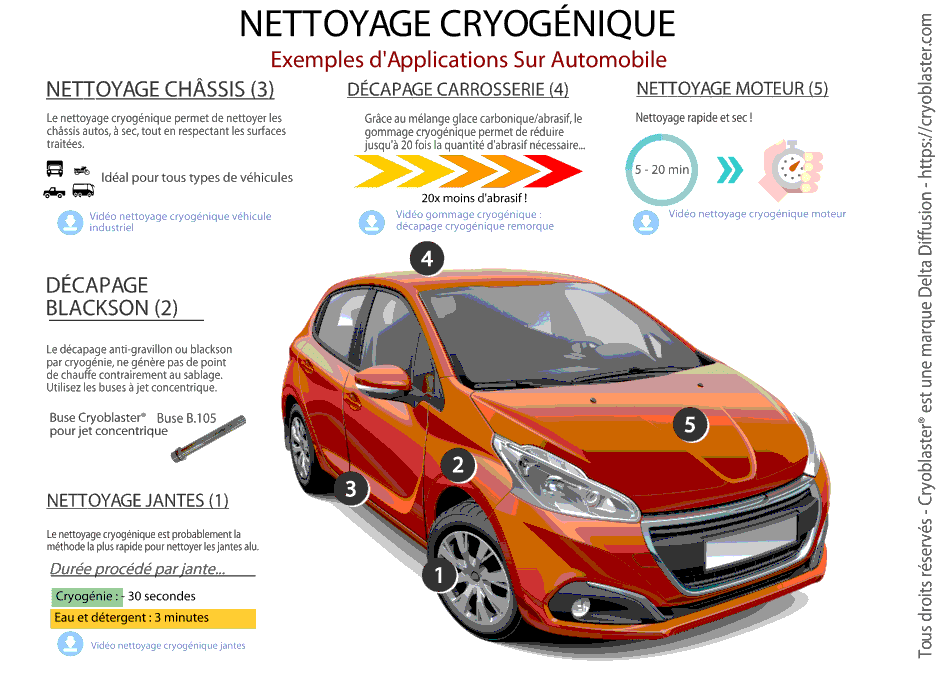
Download the infographic :
Dry ice cleaning: examples of applications on automobiles, by clicking here
HOME > CRYOGENIC CLEANING > DRY ICE BLASTING > BODY STRIPPING
After watching this video, here's what stands out:
- Le result mixed impressive in terms of speed and quality:the paint does not resist and thee metal is not damaged(complete surface respect).
- No debris on the ground or very little: pas de dust, water, or chemical stripper residue...
In short, one could be tempted to conclude that dry ice projection is the ultimate technique for restoring automotive bodies!
What you don't know...
Modern automotive paints, called "two-component", have little to nothing to fear from dry ice cleaning 🙂
Why?
Dry ice cleaning works on the principle of an interaction of 3 phenomena:
- Kinetic energy: energy released upon impact of dry ice,
- Thermal differential : difference between the temperature of the surface and the contaminant (here the paint exposed to a -80° C blast)
- Sublimation: the transition of dry ice from solid to gas state, which blows away dirt.
La car body of vehicles is typically made up of 3 layers,starting from the metal:
- primer adhesion layer (primer base),
- color layer,
- clear coat layer.
Anti-static paints on our automobiles are to a certain extent designed to for withstand numerous attacks:gravel, high heat, cold and extreme winter temperatures: Canada, Russia...
But...
La hardness of Carbon dioxide ice is only 1.5 Mohs which is the hardness of chalk*: suffice it to say that cryogenic cleaning is is not a procedure abrasive.
So on two-component paints, which are very widely used today, dry ice cleaning is simply is not la method the most designed.
Imagine : after a very harsh winter, our car paint flakes off because it cannot withstand low temperatures... that would delight body shop owners and sadden our wallets!
Despite the cold of dry ice, automobile paint does not peel off: the thermal differential created on the paint relative to the car body has no effect on the paint's adhesion level.
* : composed essentially of calcite with a hardness of 3 Mohs, chalk is estimated to have a hardness of 1.5 Mohs

Hardness of dry ice comparable to that of chalk, namely: 1.5 Mohs...
How does automotive paint react to a dry ice blast?
A dry ice blast will very slowly affect the clear coat layer, then in a second phase the color layer will be diminished, then... generally speaking "dry ice" will not go beyond that: the primer layer has little to nothing to fear from dry ice cleaning.
But be careful, stripping the clear coat and color layer requires such pressures, such air volumes, in such an important time periodand such an consumption amount of dry ice so astronomical, that this type of process has no economic interest whatsoever.
Imagine that stripping the car body would take 2 or 3 days, and therefore for an astronomical price and for a mediocre result !
Very well, but what about that YouTube video (above)?
Well yes, the YouTube video shows stripping a car body, but nothing tells us the exact nature of the paint stripped coating.
It could very well be a paint de shiny spray interior decoration , like those found in hardware stores, and indeed a dry ice blast on this type of paint is very effective.
On the other hand, for stripping an car body old coating, such as in the case of automotive restoration where the paint is, shall we say... tired and whose composition is quite different from current formulations:why not?
Only a test could prove whether the dry ice process applies in this case or not.
However, yes il there is a process for cryogenic blasting capable of using only a tiny amount of abrasive compared to traditional processes such as sandblasting or micro-abrasive blasting, for stripping automotive bodies. Its name: dry ice micro-blasting.
Discover more details about this process by clicking on the article link below.
Learn more
- Abrasive Blasting
- Dry ice micro-blasting
- Industrial stripping
- Dry ice blasting
- Dry ice cleaning rust removal
- Sandblasting
- Dry ice sandblasting


