
Thermal stripping: a high-temperature degradation process!
Thermal stripping is one of the techniques of industrial blasting that allows surfaces to be stripped bare while preserving their "integrity".
Thermal stripping involves exposing the surface to be treated to a heat source, in order to soften its coating or decompose it so it detaches from its substrate.
In the world of thermal stripping, the most common processes stand alongside innovative ones. A quick review of trending processes.
Traditional thermal stripping
The direct application of a flame via a burner to the surface to be stripped remains a rudimentary, though effective, technique. However, thermal stripping by projecting a stream of hot air is the most common professional practice.
It is notably a more (e.g., aluminum gravity foundry mold). process for large surfaces.
The most common equipment boils down to a heat gun (gas or electric) that projects air heated to a temperature ranging from 300° (for stripping wood) to 600° (for stripping metal).
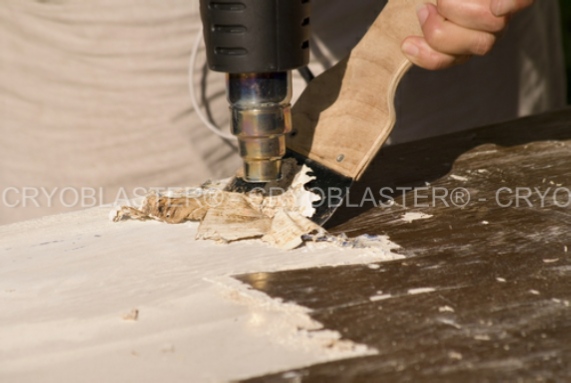
Heat gun for paint removal on wooden surfaces
Each heat gun model can have its own technical properties. The ratio of power, air flow, and temperature of these devices adapts according to the type of coating to be treated.
Finally, the heat stripper can be offered with accessories for controlled applications (nozzles, knife, scraper...).
This process is useful for:
- removing paint, varnish, plastic coatings, or adhesives;
- removing insulating resin from engine parts...
It is an ideal process for stripping coatings from woodworking parts and metal grilles... It is suitable for stripping wood and tools, such as: hooks, fittings, rods, grilles... It also ensures rapid stripping, work comfort, and is environmentally friendly.
Prevent burn and poisoning risks by observing protective measures
Burns are one of the most common risks of heat gun stripping. For this reason, wearing thick gloves helps prevent burning your hands. However, the risk also exists for soft substrates like wood.
Therefore, regular application (without excessive pressure) of the hot air stream to the treatment surface allows the coating to be lifted while avoiding damage to the wood and preventing harmful gas emissions.
The need to wear a respiratory mask is justified to avoid breathing the toxic harmful vapors emanating from the burned coating. The risk is particularly heightened if it is lead-based paint.
If you believe this thermal process could be more effective, then opt for pyrolysis stripping.
Pyrolysis oven stripping: the best balance between safety and effectiveness.
Pyrolysis stripping is an industrial process of organic decomposition without flame, at a temperature between 380° and 440°. The operation takes place in a sealed environment that allows precise atmosphere control. A pyrolysis oven is then the essential element for performing this process.
It is the safest, least tiring, and most effective thermal stripping method. It is ideal for treating industrial objects of different sizes according to the oven's capacity.
The applications of the pyrolysis oven extend to:
- the elimination of plastic, metal parts, and engine parts;
- stripping paint from hooks, grilles, supports;
- stripping valves, pumps, and industrial piping;
- Material valorization through thermal recycling
- degreasing cooking surfaces...
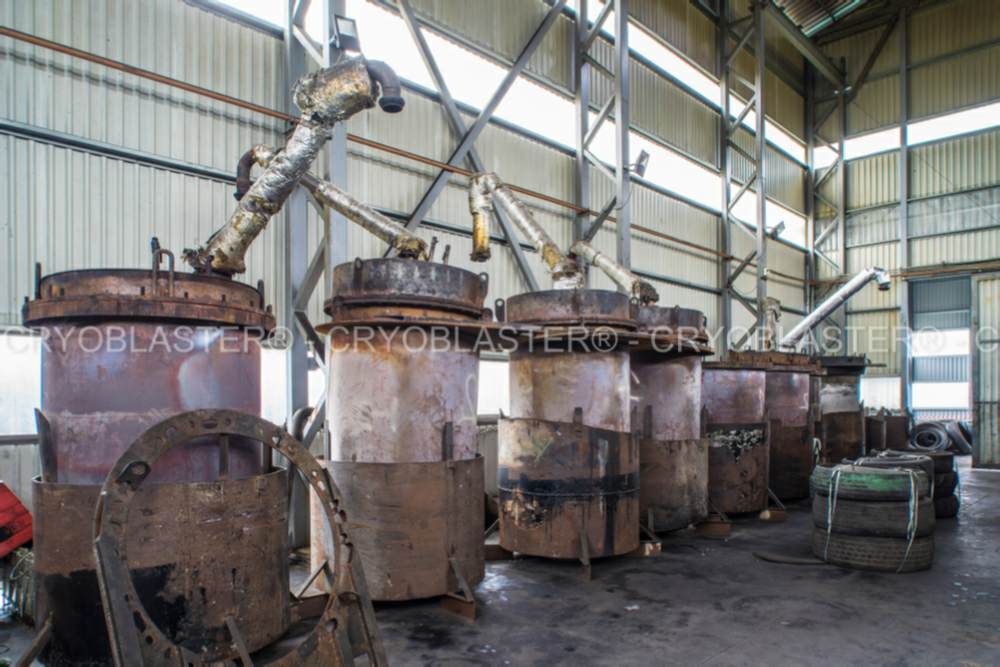
Thermal recycling of waste tires for material recovery (pyrolysis technique)
The interesting things happen inside theoven
Parts are introduced into the treatment chamber via a pneumatic loading gantry. The operation then begins with a temperature that rises regularly but slowly to preserve the integrity of the treated object.
The environment is simultaneously depleted of oxygen to prevent oxidation and combustion.
Once the treatment threshold is reached, organic materials decompose and evaporate in a controlled reactor. Treatment duration ranges from 3 hours (minimum) to several hours.
A post-combustion system then eliminates the gases and dust resulting from the decomposition of coatings and pollutants by subjecting them to very high temperatures (850° and 1200°).
Before opening the oven, the temperature reduction follows a reverse process until reaching 150°.
One of the most attractive thermal stripping processes
The main advantage that determines the attractiveness of this process lies in the precise control of the treatment atmosphere. Objects are cleaned thoroughly and their integrity is preserved. This flexible process takes into account various parameters relating to the properties of the object to be treated.
Safe for personnel and the environment, and easy to use, the pyrolysis oven positions itself as a forward-looking process for thermal stripping.


