
Benefit #3: Dry ice blasting, a non-abrasive process!
Among the many benefits of dry ice blasting, the fact that this process allows surfaces to be cleaned without damage makes it one of the most appreciated cleaning methods in the plastics and foundry industries. Discover below the article that explains why dry ice blasting is non-abrasive and its benefits.
The hardness of dry ice: a "soft" medium...
Unlike abrasive media used in sandblasting techniques, dry ice possesses a hardness comparable to that of chalk.
The hardness of an abrasive medium is expressed in Mohs, named after a German mineralogist Friedrich Mohs.
This hardness is expressed on a scale of 1 to 10:1 being the softest et 10 le hardest mineral.
This scale is based on 10 minerals which are:
- Talc : 1 Mohs
- Gypsum : 2 Mohs
- Calcite : 3 Mohs
- Fluorite : 4 Mohs
- Apatite - 5 Mohs
- Feldspar - 6 Mohs
- Quartz - 7 Mohs
- Topaz - 8 Mohs
- Corundum - 9 Mohs
- Diamond - 10 Mohs

Mohs scale from 1 to 10: 1 being the softest mineral and 10 the hardest mineral. Dry ice equals the hardness of chalk at 2,5 Mohs
Dry ice = Chalk - 2.5 Mohs
Dry ice is therefore by definition a non-abrasive... Unless of course the hardness of the material being treated is lower than the hardness of the dry ice.
To determine if the treated surface would be able to withstand dry ice blasting or ice projection, perform a test in an inconspicuous area: use low pressure, then gradually increase the blasting power until you achieve the desired result (removal of contamination). If the treated material "marks"... stop.
Another remarkable characteristic of dry ice: sublimation
One of the remarkable characteristics of dry ice used in dry ice blasting lies in the fact that this medium is capable of sublimation : that is, it is capable of passing from solid to gaseous state without going through a liquid phase.
As a result, only the removed contamination is found on the ground: no reprocessing of secondary waste unlike sandblasting and abrasive blasting techniques.
Furthermore, unlike techniques using traditional abrasives, and because the ice sublimes, you will not find any abrasive on or in the bearings, or on seals, which could cause damage or loss of sealing.
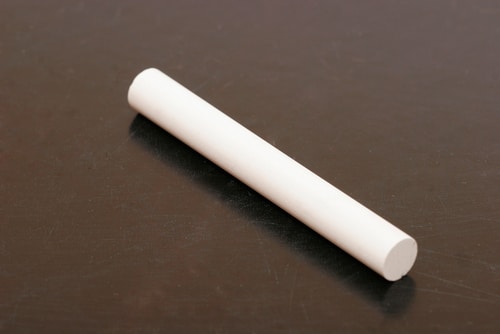
The hardness of dry ice is comparable to that of chalk. Upon impact it sublimes and passes from solid to gaseous state...
Examples of applications achievable with dry ice blasting, due to its non-abrasive nature...
- Seals: due to the low hardness of dry ice, rubber seals are not cut. Be sure to adjust the blasting pressure to avoid rebound effects.
- Glass: dry ice blasting of tags, graffiti and stickers. Since glass hardness is 6.5 Mohs, theoretically no problem. However, you must ensure the blasting is done at low pressure, on glass not exposed to sunlight. It must also not be heated by heating systems or cooled by air conditioning, to avoid thermal shock and the creation of cracks.
- Plastics industry: due to the non-abrasive nature of dry ice, no risk to mold impressions, mirror-polished surfaces or parting planes, same applies in aluminum foundry.
- Stickers: stickers can be easily removed from car bodies without damaging the paint.
- Plastics on electrical enclosures : gently clean electrical components without removing identification labels, this is perfectly possible with cryogenic cleaning (see the video above on the right).
Dry ice blasting operation on glass for paint removal. The hardness of dry ice at 2.5 Mohs does not alter the surface. The blasting must be done at low pressure and fine granulometry...
How does the dry ice blasting process work?
Dry ice in the form of pellets or mini-cylinders with a diameter of 3, 5 mm, is introduced inside the tank or hopper of a dry ice blasting machine. This machine must be connected to an electrical power supply and/or a compressed air supply.
The compressed air from the network or a site compressor becomes the vector for projecting the dry ice:
The mixture of dry ice and compressed air is created inside the blaster, then is projected using a gun and spray nozzle, through a delivery hose.
La dry ice allows cleaning through the interaction of 3 phenomena which are in order:
- Mechanical shock : the projected dry ice builds up kinetic energy and causes cracking on the residue.
- Thermal shock : due to the low temperature of dry ice, the contamination contracts causing it to separate from the surface.
- Sublimation : the passage from solid to gaseous state of ice in a ratio of 1 to 700, blows away the dirt.
With dry ice blasting, there is no use of scrapers that scratch surfaces, no chemicals, cryogenic cleaning is dry cleaning that respects treated surfaces.
Dry ice blasting is ideal for degreasing surfaces, for industrial maintenance, for removing pollutants without solvents, for cleaning stainless steel surfaces in food processing...
For more information contact us about 09 81 37 76 93servicerental, purchase or dry ice blasting cleaning services.
Other articles on the same topic


