
Benefit #2Dry ice blasting: cleaning without chemical products!
It's hard to imagine a cleaning operation without using detergents, solvents, acids... so accustomed are we to using such products to overcome the various forms of pollution that industry generates. Yet, beyond the environmental footprint of these products, the health consequences for users are very real...
Discover in the article below a cleaning technique that doesn't rely on the products mentioned above: dry ice blasting, cleaning without chemical products.
This article comes from the section: Benefits of dry ice blasting
Dry ice blasting: how does it work?
The dry ice blasting technique dry ice cleaning is similar to the process of sandblasting.
The media, the Carbon dioxide ice in the form of pellets or mini-cylinders with a diameter of 3 mm, are introduced inside the hopper of the blaster (or dry ice blasting machine).
Mixed with a flow of(compressor or factory pressurized air network), these pellets are conveyed to the gun and spray nozzle, then projected at a speed close to the speed of sound.
Unlike sandblasting, the media used, dry ice, does not fall to the ground, unlike the media used in sandblasting techniques.In reality, the solid CO2 pellets sublimates on impact with the contamination, meaning they transition from a solid state to a gaseous state.
On the ground: no water, no abrasive media to separate from the contamination. Only the loosened contamination remains to be vacuumed up.
Examples of dry ice blasting applications in industry...
Dry ice cleaning: a safe process
Many cleaning tasks that traditionally involved the use of hazardous chemicals can now be replaced by dry ice cleaning, thus eliminating the chemical risks that have caused so many chronic health problems over the years for users and have contributed to environmental pollution.
The cleaning agent (solid carbon dioxide) is a natural gas, essential to plant life. These plants produce oxygen, among other things, during photosynthesis, which is essential to all living beings.
Outside of use in confined spaces (where additional ventilation or a breathing apparatus may be necessary), dry ice cleaning is completely safe?.
No secondary waste reprocessing
Used chemical cleaning solutions (contamination and chemical product) cannot be dumped into sewers: they must be collected and transported to an approved disposal facility.
All cleaning cloths used are contaminated and often end up in plastic bags in the trash, which aggravates the landfill problem.
And the chemical product containers themselves must be rinsed multiple times and transported to an approved waste treatment facility.
Industrialists, even if your company plans for waste reprocessing, what responsibility do you have in environmental pollution given the points mentioned above?
Dry ice blasting simply eliminates the problems mentioned above and their associated costs.

Dry ice blasting does not promote the creation of wastewater...
Disinfection without chemical products
Due to the extreme of dry ice temperature (-80°C), dry ice cleaning has a sanitizing effect during the cleaning of treated surfaces.
Certainly, this advantage is of no use in industrial foundry work for example, but in the food and pharmaceutical sectors, this advantage is extremely valuable: bacteria, mold, and fungi are eliminated on impact.
Since the dry ice cleaning process is completely dry, you further inhibit bacterial growth.
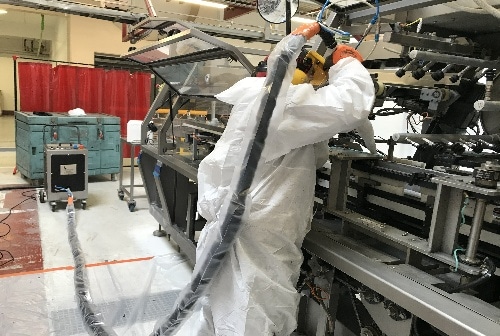
Dry ice blasting operation in food processing... without chemical products
Other articles on the same topic
- Benefit #1: dry ice blasting, dry cleaning
- Advantage #3: dry ice blasting, non-abrasive cleaning
- Advantage #4: dry ice blasting reduces production downtime


