
Dry ice blasting on stairs is an increasingly popular technique in various industrial and residential sectors due to its effectiveness and environmental responsibility. This method involves using dry ice, also known as solid carbon dioxide, to remove impurities and other unwanted elements from surfaces to be cleaned, such as stairs or steel grating. In this article, we will present the steps and equipment necessary for this type of cleaning, as well as its advantages over traditional techniques.
The process is based on three physical phenomena: the
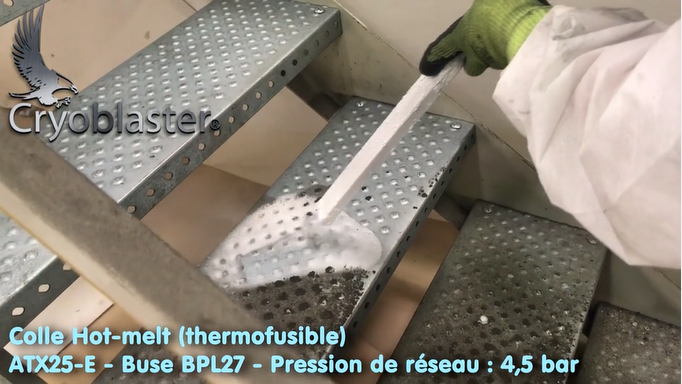
Before adopting this method and investing in a Cryoblaster machine, it is essential to understand how dry ice blasting works. Dry ice, which is carbon dioxide (CO₂) in solid form, is projected onto the surface to be cleaned using a Cryoblaster and a blast hose and a projection nozzle. The dry ice is then conveyed using(compressor or factory pressurized air network). Upon contact with the surface, the dry ice instantly sublimates, transitioning from solid to gaseous state, while causing a thermal shock. This phenomenon effectively removes ingrained impurities and other residues, such as hot melt adhesive ou hotmelt (see video above), without damaging the underlying surface.
Steps for dry ice blasting on stairs
- Surface preparation: it is important to properly prepare the surface to be cleaned by removing large debris and securing the area to prevent any risk of accident.
- Machine adjustment: depending on the type of surface and level of dirt, adjust the compressed air pressure, the size of dry ice particles and their flow rate, using a fragmentation nozzle.
- Dry ice projection: while maintaining a safe distance between the projection nozzle and the surface, dry ice is projected onto the area to be cleaned with regular and uniform movements.
- Residue collection: after undergoing the thermal shock and detaching from the surface, residues are collected and disposed of appropriately: vacuum or broom.
Equipment necessary for dry ice blasting
To successfully perform dry ice blasting, you must have several specific pieces of equipment:
- A single Cryoblaster machine, which propels the dry ice onto the surface to be cleaned, in this case: galvanized steel stairs.
- Un blast hose, which connects the machine to the projection nozzle and transports the dry ice using compressed air.
- A single projection nozzle (round or flat), which allows precise direction of the dry ice jet onto the surface. However, a fragmentation nozzle can be used for delicate cleaning or for removing thin layers of contamination.
- Du solid CO₂ in the form of 3 mm pellets for maximum aggressiveness, which can be modified into microparticles using a fragmentation nozzle.
- Hose personal protective equipment (PPE), such as gloves, safety glasses, appropriate mask and noise-cancelling helmet, to protect against risks associated with extreme cold and compressed air pressure, and therefore contamination projections.
Advantages of dry ice blasting compared to traditional methods
Dry ice blasting offers several benefits that make it an attractive alternative to conventional techniques:
- Non-abrasive: unlike sandblasting or shot peening, dry ice blasting does not damage the treated surface. It is therefore ideal for fragile or delicate surfaces, such as wooden, metal or natural stone stairs.
- Eco-friendly: since dry ice is a natural and biodegradable product, this cleaning method generates no polluting waste and preserves the environment.
- Cost-effective: dry ice blasting allows for savings in water, energy and time compared to other techniques. Additionally, dry ice is a relatively inexpensive product to produce and store.
- Versatile: this method can be used on a wide variety of surfaces and to remove many types of contaminants, such as grease, paint, hot melt adhesives or mold.
Examples of stairs that can be cleaned with dry ice blasting
Types of stairs in industry are generally chosen based on their specific environments, safety constraints, hygiene requirements and usage. Here is a list of several types of industrial stairs for which dry ice blasting is perfectly suited:
- Galvanized steel stairs (galva) : Resistant to corrosion, this stair type is commonly used in heavy industries or outdoor environments.
- Stainless steel stairs : Used in environments requiring extreme cleanliness, such as food or pharmaceutical industries, as it resists corrosion well and cleans easily.
- Aluminum stairs : Lightweight and corrosion-resistant, it is often used in light-duty applications and for accessing equipment at medium heights.
- Painted steel stairs : Steel is frequently painted to increase its corrosion resistance and improve its aesthetic appearance.
- Steel grating stairs : These stairs have steps made of steel grating, which are metal grids. They are used in environments where dirt, snow, water, etc. can be a problem as they allow debris to pass through the steps.
- Mobile industrial stairs : These stairs can be moved from one location to another, they are often used to access elevated storage areas.
- Spiral or winding stairs : Used when floor space is limited, this stair type winds around a central post.
- Concrete stairs : These stairs are durable and resistant, used in heavy industrial environments.
Each type of stair has its own advantages and disadvantages, and the choice depends on the specific requirements of the industry and location. However, the dry ice blasting cleaning technique is perfectly suited to these types of surfaces.
Other examples of dry ice blasting applications
Dry ice blasting is particularly well-suited to the following sectors:
- Food and beverage industry: cleaning of equipment and facilities, decontamination of production areas, equipment maintenance, cleaning of steel grating and walkways.
- Building and construction: facade stripping, graffiti removal, historic monument restoration, cleaning of stairs and steel grating.
- Aerospace and automotive: degreasing of mechanical parts, cleaning of bodies and engines, maintenance of production lines.
- Electrical industry: maintenance of electrical and electronic equipment, cleaning of transformers and electrical cabinets.
In conclusion, cryogenic cleaning is an innovative method that offers numerous advantages over traditional techniques. Thanks to its versatility, effectiveness and environmental responsibility, this technique is well-positioned to establish itself as the cleaning solution of the future.


