
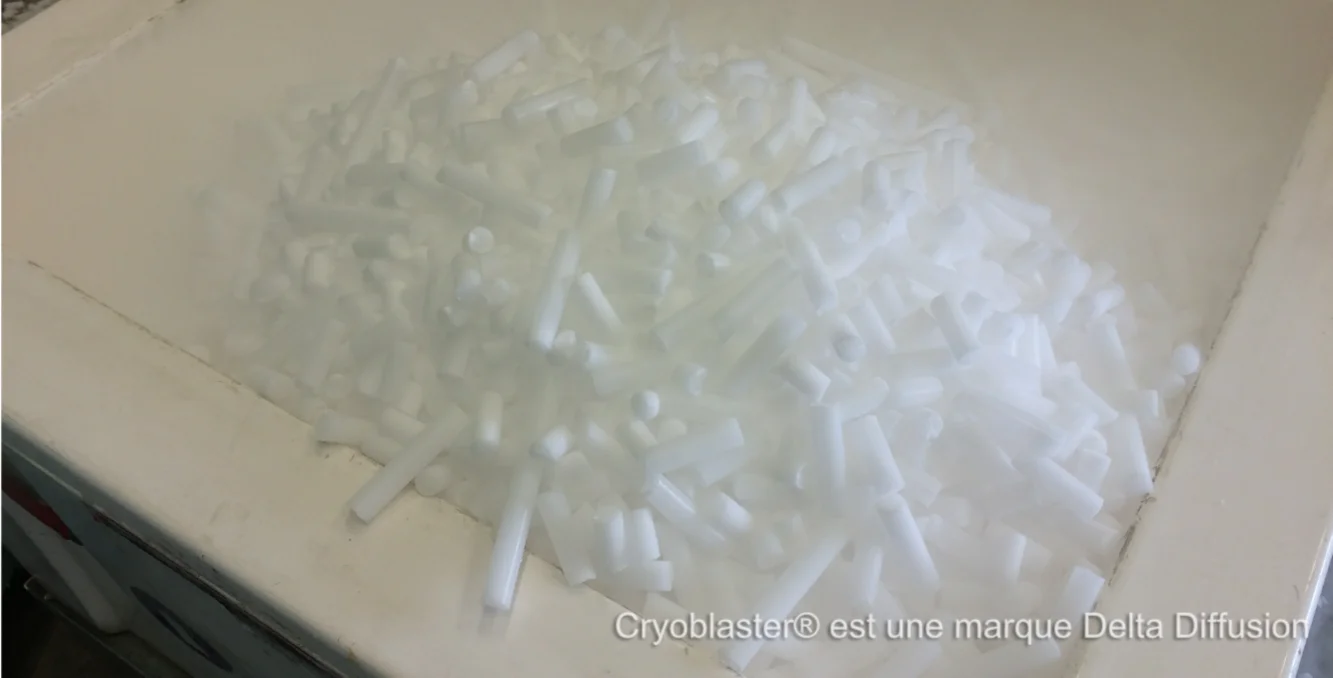
Faced with growing environmental challenges and new restrictive regulations on chemical pesticides, French agriculture is actively seeking integrated pest management solutions that respect the environment. Dry ice is emerging as a promising alternative for managing pest populations without compromising ecosystem health or organic certification of crops.
This technology, already adopted in several European countries and the United States, harnesses the physical properties of solid carbon dioxide to create a pest control method that is both effective and sustainable.
Mechanism of action: dual natural mechanism
Thermal shock and controlled asphyxiation
Dry ice acts according to adual physical mechanismparticularly devastating. At -78.5°C, it causes an instantaneous thermal shock that immediately neutralizes harmful organisms upon contact. Simultaneously, its sublimation generates a CO₂-saturated environment that progressively displaces oxygen, creating an asphyxiating atmosphere for targeted pests. As a reminder, CO₂ is 1.5 times heavier than air.
This approach fundamentally differentiates dry ice from conventional pesticides: instead of poisoning, it exploits natural physical phenomena to eliminate pests in apermanent and residue-free.
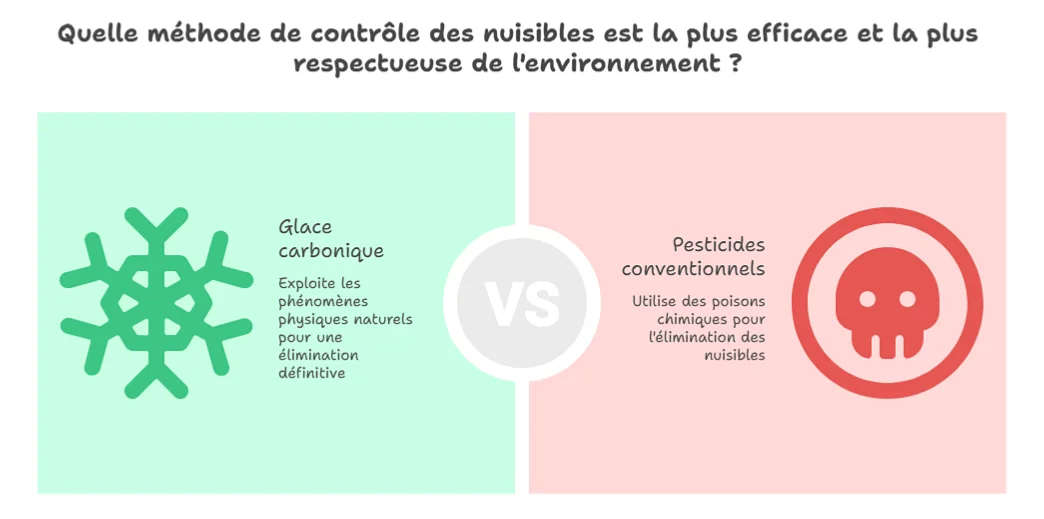
Major Environmental Advantages
Unlike traditional chemical treatments, dry ice leaves no trace in the environment. The CO₂ used often comes from industrial recovery processes, transforming waste into a useful solution. This economic circularity fits perfectly with the approachessustainable developmentsought by modern agriculture.
Since June 2024, France officially authorizes the use of CO₂ fumigation devices to treat legumes, cereals and other stored products. This regulatory revolution responds to the pressing needs of organic and conventional producers seeking alternatives to traditional fumigants.
Anti-statichermetically sealed fumigation chambersdeveloped by specialized French companies now make it possible to effectively treat insect infestations in silos, warehouses and storage facilities. The attractive cost - less than 5 euros per ton for small facilities and dropping to 3 euros for large capacities - makes this technology economically viable.
Optimized treatment duration
La speed of interventionis a major advantage of this method. Treatments take between one and three weeks depending on the volume treated, allowing rapid commercialization of products without prolonged waiting periods. This temporal efficiency meets the modern logistical constraints of the food industry.
Rodent management: technical innovation through targeted application method
Rodent control using dry ice requires a methodical and secure approach. Technicians equipped withprotective glovesidentify burrow networks and introduce dry ice sticks into them. This technique, imported from the United States where it has proven effective in New York, is beginning to be adopted by certain French municipalities.
The effectiveness relies on the natural accumulation of CO₂ in underground tunnels. Heavier than air, the gas progressively concentrates in confined spaces, creating a lethal environment for rodents without impact on surrounding wildlife.
Intervention Safety
Implementation imperatively requiresopen and ventilated spaces to guarantee operator safety. This technical constraint limits application to outdoor areas, but ensures complete safety for operators trained in best practices.
Your supplier de Carbon dioxide icein theFrance :
Phone 04.81.61.02.75
DELTA DIFFUSION
- Open : Monday to Friday
- Hours Monday-Thursday: 8:30 AM-12:00 PM | 1:30 PM-5:30 PM
- Friday hours: 8:30 AM-1:30 PM
- Closed: weekends, public holidays
- Order: Monday - Friday
- Delivery : from 5 kg - Contact us

Applications in sensitive environments
This technique is particularly suited tosensitivewhere pesticide use is limited or prohibited: professional kitchens, hospitals, schools, urban green spaces. The complete absence of chemical residues guarantees food and health safety in these special environments.
Regulatory framework and developments: the European legislative context
European legislation already authorizes the use of CO₂ in controlling certain pests such as voles and moles. This official recognition paves the way for broader development of these techniques across the entire EU territory.
However, French regulations remain under development regarding the practical modalities of use. This transitional situation explains why certain applications remain experimental or limited to trials overseen by research organizations.
Evolution of phytosanitary certifications
Obtaining phytosanitary approvals for dry ice-based products represents a complex technical and administrative challenge. These authorizations, issued per production facility, require lengthy and costly procedures that currently slow the democratization of these technologies.
Nevertheless, the gradual prohibition of"permanent baiting"(long-term preventive use of chemical rodenticides) creates a regulatory void that alternative solutions such as dry ice are called upon to fill.
One of the major strategic advantages of dry ice lies in itscomplete compatibilitywith organic farming requirements. Unlike chemical fumigants that compromise organic status, solid CO₂ fully maintains European and international certifications.
This characteristic meets the specific needs of organic producers who represent a rapidly growing market. The absence of conversion periods or temporary downgrading preserves the economic value of certified crops.
Integration into sustainable systems
Methods using dry ice naturally fit into theagroecological transitionpromoted by European public policies. They contribute to the goals of reducing chemical inputs while maintaining production yields and quality.

Technical challenges and limitations: implementation constraints
The use of dry ice imposes specificlogistical constraintsrelated to its storage and transport. The constant sublimation of the product requires rigorous planning of interventions and appropriate storage equipment.
Training applicators is also an essential prerequisite to ensure the effectiveness and safety of treatments. These technical aspects can represent an initial barrier for farms lacking equipment.
Our teams are here to help you implement the treatment: training in dry ice use.
Contact us at 04 81 61 02 75
Conclusion: a future alternative
La Carbon dioxide ice is gradually emerging as areference solutionin the arsenal of integrated pest management for agricultural pests. Its growing adoption testifies to its relevance in the face of contemporary environmental and regulatory challenges.
Although certain technical limitations persist, the advantages environmental, financial et health benefits of this approach make it an essential tool for sustainable agriculture. Its development is accelerating thanks to favorable regulatory changes and technological innovations that constantly improve its performance.
The future of this technology appears promising, driven by growing demand for environmentally respectful solutions that are compatible with modern agriculture's quality requirements. Its integration into common agricultural practices represents a significant step toward more sustainable management of cultivated ecosystems.
Need dry ice? Contact us at +33 (0) 4 81 61 02 75 or by filling out the form below


