
Contents
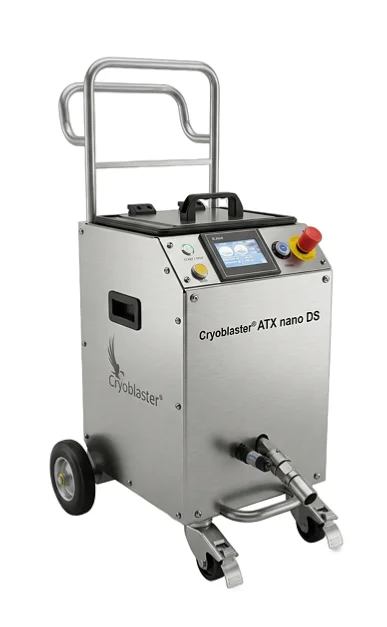
How a dry ice blaster works
Un dry ice gun projects dry ice pellets with a compressed air stream. Thekinetic energy generates a shock wave that dislodges contaminants. The temperature extremely low (–78 °C) creates a thermal shock that weakens the pollution. The sublimation of the dry ice finishes removing the waste.
From pellet storage to supersonic projection
The dry ice blaster stores pellets in an insulated tank, then mixes them with filtered compressed air. This mixture is conveyed through a hose to the gun, ready for projection.
- Storage tank : preserves the Carbon dioxide ice solid, away from heat sources.
- Compressed air supply system : compressor or compressed air network provides dry, clean, non-conductive air.
- Blast hose : transports the air/pellet mixture to the gun.
- Projection speed : nozzle supersonic delivers pellet velocity up to 150 m/s.
The air used is rigorously filtered and dried to guarantee the effectiveness of cryogenic cleaning and preserve the treated surfaces.
Dry ice gun with supersonic nozzle
The gun, equipped with a supersonic nozzle, is designed to concentrate the air flow and optimize kinetic energy at the point ofimpact. This configuration ensures efficient and precise cleaning without energy dispersal.
La supersonic nozzle plays an essential role in transmitting energy during treatment, offering excellent precision. Its maneuverability allows the equipment to be used directly on-site without disassembly, minimizing production downtime in industrial environments.
Sandblasting comparison: similarities and differences
Le process shares technical similarities with sandblasting, particularly pressure-based projection. However, it distinguishes itself by the absence of abrasion and residue after cleaning.
- Mechanical similarity : tank, high-pressure piping, ergonomic gun.
- Major difference : unlike hard abrasives, dry ice is gentle on surfaces, with non-destructive impacts.
- Specific sublimation : direct transition from solid form to gas state, eliminating secondary residue.
Unlike traditional sandblasting, this process generates no additional waste, simplifying post-cleaning. Immediate sublimation allows for reduced consumption of raw materials, optimizing costs and protecting delicate surfaces.
The triple mechanism of dry ice cleaning
Le cryogenic cleaning relies on three distinct physical mechanisms that work in synergy. Upon impact, there is the release of a kinetic energy, the appearance of a powerful thermal shock, and a micro-explosion. This last phenomenon results from the sublimation almost instantaneous of solid carbon dioxide into gaseous state.
Kinetic impact and contaminant shearing
The projection of dry ice at a speed high velocity (approximately 150 m/s) generates kinetic energy that mechanically shears residues upon first contact. This process detaches the contaminant without damaging the substrate. Its effectiveness is linked to the energy particular properties of the particles.
Although dry ice has a hardness close to that of chalk, the energy transfer to the surface remains very limited. Used in a dry ice blaster, this non-abrasive method produces a shock wave that effectively removes stubborn impurities.
Thermal shock at -78.5 °C and contaminant weakening
This shock results from a thermal differential pronounced difference between the part being treated (often at room temperature) and the dry ice particles projected at -78.5 °C. This extreme thermal gradient fragments dirt layers by cracking them. The dry ice projector generates this ideal temperature contrast to remove paints, greases, or resins.
The difference in thermal conductivity between the Carbon dioxide ice and the contaminant causes rapid contraction, creating internal microfractures. Meanwhile, the base material retains its structure thanks to the very localized action.
Micro-explosions and blast effect through sublimation
La instantaneous sublimation of CO₂ at the moment of impact causes an expansion of 1 to 700. This abrupt transition from carbon dioxide solid to gaseous state triggers a series of micro-explosions. This rapid expansion is the third major advantage of this technology.
The highly localized shock wave lifts impurities without rubbing the surface. The gaseous blast forcefully pushes the fuel residues away from the treated area. This ingenious mechanism definitively eliminates any residual contaminant.
| Mechanism of action | It is important to understand that adhesion is often the result of an interaction between the chemical nature of the contaminant and that of the surface: | Physical effect | Result: |
| Kinetic impact | -78.5 °C | Mechanical shearing at 150 m/s | Contaminant fragmentation |
| Thermal shock | Extreme differential | Microfractures in dirt | Weakening and debonding |
| Micro-explosion | Solid-to-gas transition | Expansion 1:700 of carbon dioxide | Blast ejecting residues |
The success of this method rests on a simple equation: combine an temperature extremely low temperature with strong acceleration. The combination of intense cold and the velocity of dry ice projection offers efficiency clearly superior to traditional cryogenic cleaning techniques.
Dry ice and dry ice cleaning quality
Dry ice is essential to industrial cryogenic cleaning cleaning. Its extreme temperature of -78.5 °C and its freshness determine the success of the operation. The overall effectiveness of this technique therefore depends mainly on the quality of the raw material used.
Physical properties and sublimation of dry ice
This material is made up of pellets formed by the expansion of carbon dioxide liquid. Dry ice passes directly from thesolid state to the gaseous state, a process named sublimation. This immediate transition characterizes solid carbon dioxide.
- Progressive sublimation : In open air, the dry ice evaporates slowly and can lose up to 8% of its mass per day.
- Instantaneous transition : During a impact at high speed, or dry ice sublimates immediately, increasing its volume considerably.
- Absence of liquid residue : Unlike water ice, its transformation to gas generates no moisture, guaranteeing an entirely process dry cleaning.
Pellet density is optimal immediately after production. A stock of one hundred kilograms can however lose approximately eight kilos in twenty-four hours. This loss of mass reduces the force energy during projection.
Pellet freshness and blaster performance
To optimize blaster performance, very fresh pellets must be used. Their high density produces excellent thermal waves. The properties of dry ice also determine the precise power of the shock wave generated.
During extended operations, regular supply of fresh materials (dry ice) is recommended. Aging granules lose effectiveness, requiring greater consumption to accomplish the same cryogenic cleaning.
cleaning work.
A dry, eco-friendly process with no chemical residue Dry ice cleaning is a entirely dry cleaning process thanks to immediate gas evaporation. Unlike high-pressure cleaning, it leaves no liquid deposit on the surface. This method uses neither detergent nor toxic solvent.
After the dry ice blasting, simply vacuum the contaminant loosened from the surface. This process eco-friendly process generates no polluting secondary waste, giving it a far superior environmental balance compared to traditional chemical methods.
- Absence of chemical products : The exclusive use of this neutral component guarantees maximum safety for teams.
- Regulatory compliance : Official agencies recognize this volume as a sound and perfectly legal industrial method.
- Enhanced versatility : Complementary abrasives can be added to eliminate stubborn rust or old paints.
The only notable limitation concerns soft woods, which risk being marked by the blast. Settings for the nozzle and working distance must then be adjusted. These adjustments perfectly preserve the appearance of the cleaned material.
Frequently asked questions
How does dry ice work in a cleaning blaster?
Le process Dry ice cleaning relies on three combined physical mechanisms. First, theimpact kinetic energy of the dry ice pellets projected at high velocity (approximately 150 m/s) causes immediate elimination of contaminant through shearing.
Then, the extremely low temperature of the ice (-78.5 °C) generates a thermal shock that weakens and cracks dirt. Finally, the sublimation instantaneous sublimation of pellets produces strong gaseous expansion that detaches and expels residues, with no abrasive effect on the treated substrate.
What are the advantages of dry ice cleaning compared to high-pressure washing?
Dry ice cleaning technique surpasses the traditional method by high-pressure washing on several points. This process is entirely dry, uses no chemical products, and perfectly respects sensitive or delicate surfaces.
Its effectiveness is superior, with speed execution speed up to eight times faster. Using a dry ice blaster allows equipment to return to service immediately, as no drying time is needed after the operation.
Why is the freshness of dry ice pellets important for the blaster?
The freshness of dry ice pellets is critical, as it directly determines their density and therefore their effectiveness. Even in storage, dry ice naturally sublimates: a mass loss of approximately 8 kg can be observed after 24 hours for a block of 100 kg.
This loss directly affects the energy ofimpact and the thermal shock during projection, two key elements of processcleaning. Using old pellets requires increased consumption to achieve the same cleaning result, making regular supply of fresh granules particularly important.


