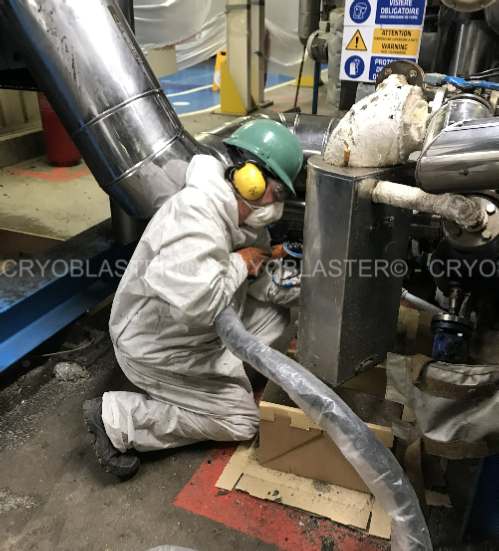
DRY ICE BLASTING PRINCIPLE OF ACTION
From the section dry ice blasting explanations, discover in High Definition video dry ice blasting and its principle of action.
Dry ice blasting: principle of action in images...
Le cryogenic cleaningis based on the triple action of dry ice carbonique during its projection:
- à the impactor impact on the contamination, dry ice generates kinetic energy creating a shearing effect on the pollutant,
- the temperature of dry ice at -
78.5°C, creates a thermal differential between the pollutant and the surface: since the thermal conductivity coefficient is not the same, the contaminant detaches due to the thermal effect, - the transition of dry ice from solid to gaseous state (sublimationgenerates a blast effect.
- La Carbon dioxide iceis projected in this video using compressed air andCryoblaster® equipment
Dry ice blasting a method comparable to sandblasting
Dry ice blasting is comparable to sandblasting in its operation.
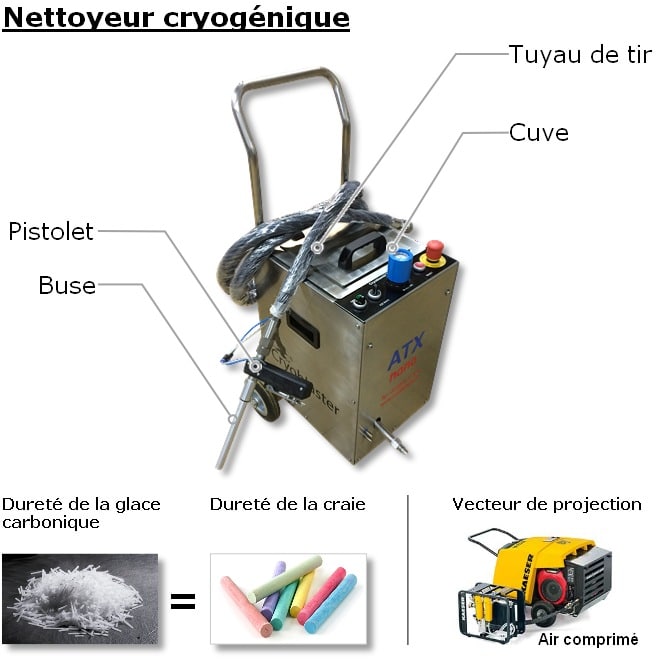
Like the abrasive, dry ice is introduced inside a tank, then projected at supersonic speed using a blast hose, a lance ou gun as well as a nozzle.
The projection vector for dry ice, like in sandblasting, is compressed air.
However, the comparison ends there because, unlike sandblasting technique, the principle of dry ice blasting is to detach dirt, without causing abrasion on the treated surfaces.
Indeed, the Carbon dioxide ice, has a hardness comparable to that of chalk and sublimates during cleaning (transitions from solid to gaseous state).
The advantages of dry ice blasting
As the name suggests, this process harnesses the power of cold (cryogenics) to clean surfaces.
The media used is, as already stated, Carbon dioxide ice.
This media does not go through a liquid phase during its sublimation transition from solid to gaseous state: which is why it is originally called "dry ice".
The main advantages of dry ice blasting are:
- a dry process et non-conductive : as long as the projection vector, compressed air, is properly treated (dryer, cyclonic separator)
- a non-abrasive process : the hardness of dry ice is comparable to that of chalk.
Warning : on materials like softwoods (Pine, fir...), dry ice projection has an effect comparable to sandblasting: brushed effect
- an environmentally friendly technique : no solvents, detergents, no reprocessing. The waste obtained is the contaminant alone, unlike sandblasting technique, where separation of the abrasive and contaminant must be performed.
- a very fast technique and therefore cost-effective: 4 to 8 times faster than traditional methods
Dry ice blasting can be used for decontamination, cleaning delicate surfaces (plastic molds, fabrics, car seats), cleaning moderately and heavily soiled surfaces.
For stripping stubborn contamination, such as rust deep fouling, or stripping paints two-component coatings, you will need to add an abrasive supplement (see ATX10 kit).