Risks of laser cleaning
Laser cleaning technology is considered one of the most effective methods for restoring metallic and non-metallic surfaces*. However, you must strictly comply with safety rules, both for yourself as the user and for all people "nearby". Discover in this article the risks associated with using a laser cleaner.
How does a laser cleaner work?
Laser cleaner: following safety rules...
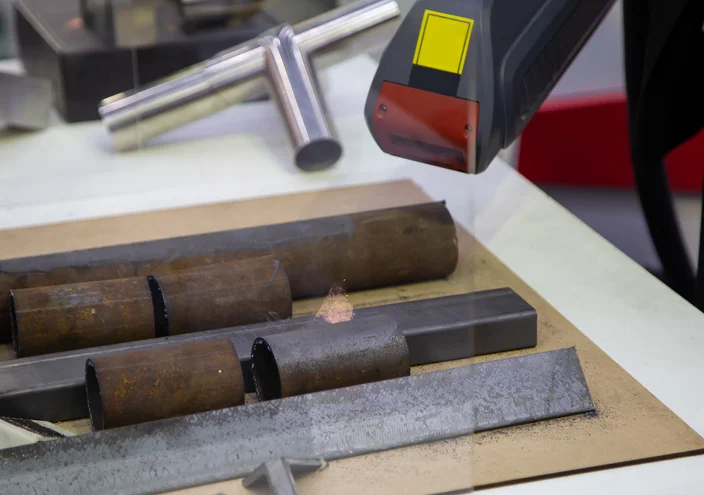
Un laser cleaner works by amplifying light into a high-energy beam known as coherent. Laser pulses whose duration is measured in nanoseconds are then directed onto the surfaces to be treated. The repetition of these pulses varies between 1 and 4000 kHz (H series laser). Contaminants interact with this significant energy source and transform into gas et particles, thereby exposing the surface.
The wavelength of H series lasers series H is 1064 nm, which is a wavelength invisible to the human eye. Although the process is highly effective on treated surfaces, the laser cleaning process must nevertheless be carried out in compliance with the following requirements.
List of elements that must be strictly observed
A laser cleaner must not be used :
- Without training P.E.R.L (Persons Exposed to Laser Risks) provided by a state-approved organization
- Without a medical examination
- Without training on how to use the laser cleaner
- Without laser safety glasses suitable for your unit's power. These must be certified EN207.
- Directly on bare skin or body. Forget all those videos where you see the operator passing the laser beam over bare hands
- In an uncontrolled environment. This means that:
- Any flammable material near your laser cleaner must be removed
- Laser firing must be carried out in an enclosed room or area protected by panels or protective curtains with appropriate signage
- It is also mandatory to capture particles released by the process (e.g.: welding fume extractor with HEPA filter, etc.)
- In ATEX zones: use is strictly PROHIBITED
- Without signage to warn of ongoing laser cleaning
- In the immediate vicinity of unprotected persons
- For any use other than its originally intended purpose
Other recommendations to follow
Furthermore, cleaning non-metallic surfaces, such as wood, paper, or plastic, even if carried out in an appropriate area: signage, particle extraction, laser protection panels, fire extinguisher, etc., the efficiency, fire risks, health risks (particularly with plastic)
Additionally, stripping energized components is prohibited, unless you have specific training and equipment.
*: wood stripping must once again be performed with appropriate parameters. Stripping clear varnish or certain paints often damages wood: the power needed to remove the "contamination" is often too high compared to what the wood can withstand...


