


This guide covers everything you need to know about how to build a dry ice blaster, from the underlying physics to component selection, compressed air requirements, dry ice storage, safety protocols, and honest cost comparisons. Whether you are assessing a DIY build or comparing professional dry ice blasting machines, the technical foundation is the same: the three physical mechanisms that drive every cleaning result.
How dry ice blasting works before you build anything
Before you assemble a blaster or choose a blasting machine, you need to understand what actually drives dry ice blasting. The cleaning effect does not come from abrasion alone. It depends on three physical mechanisms acting together at the instant each pellet hits the surface.
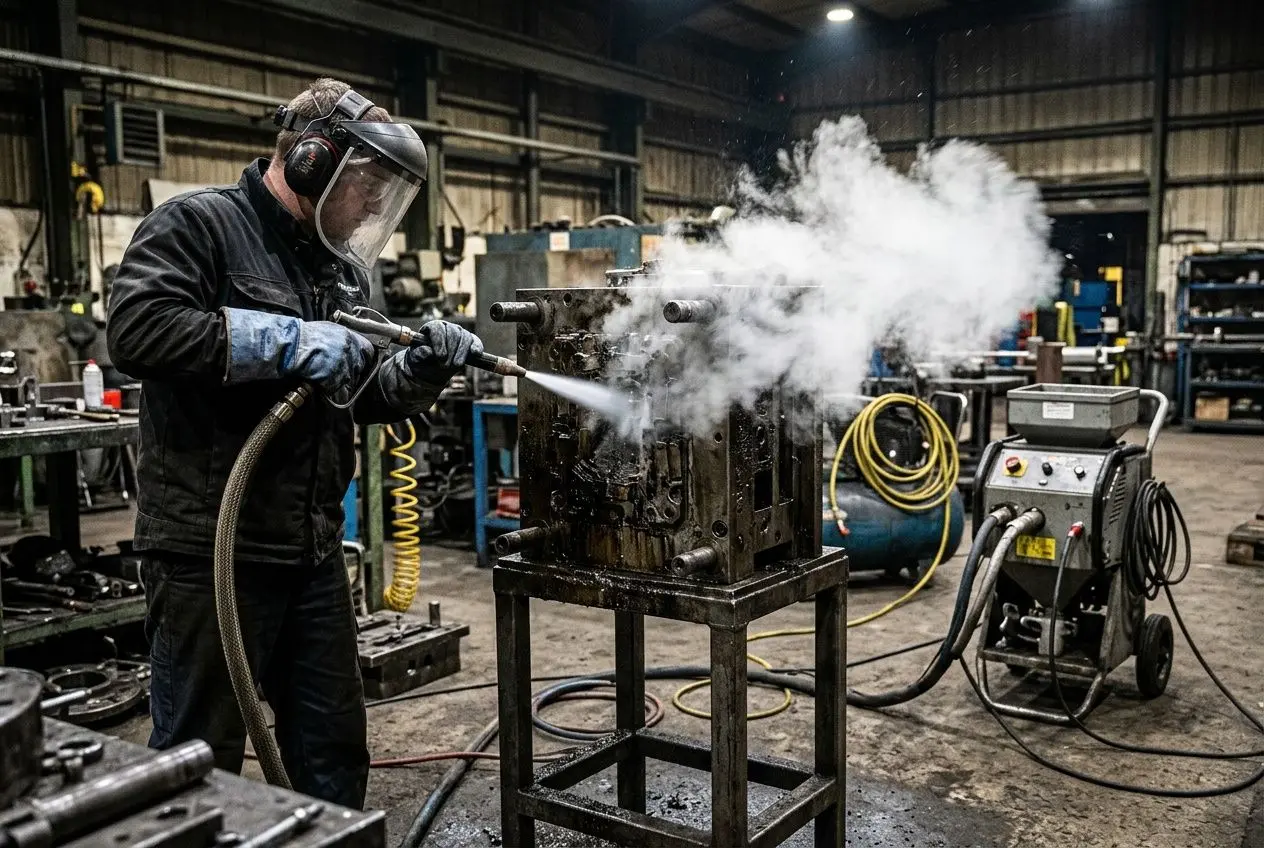
The three physical effects behind dry ice blasting
To understand how a dry ice blast works, start with the interaction between pellet and contaminant. No single mechanism explains the result on its own; the difference comes down to three effects occurring within milliseconds and reinforcing one another.
The dry ice blasting principles are:
- Kinetic impact: pellets accelerate to 60–290+ m/s, transferring energy into the contaminant layer and weakening its bond with the substrate.
- Thermal shock: dry ice reaches the surface at −78.5°C, causing contaminants to embrittle, micro-crack, and contract differently from the base material.
- Sublimation expansion: on impact, solid CO₂ changes instantly to gas and expands up to 800 times in volume, creating a lifting force beneath the contamination.
As a result, dry ice blasting can deliver non-abrasive surface cleaning without leaving moisture or spent media behind. Once the process is complete, there is no secondary blasting residue to recover, which is why the method is used on food-contact equipment, electrical assemblies, and precision tooling.
Why these principles shape every component choice
These same effects determine how a blasting machine must be specified. Air pressure controls pellet velocity and therefore kinetic impact. Dry ice feed influences how much cold mass reaches the surface, while pellet size and nozzle geometry affect contact, breakup, and sublimation behaviour.
In practice, four variables have to work together: compressed air pressure from 0.3 to 15 bar, dry ice feed from 0 to 75 kg/h, pellet sizes from the 3 mm standard down to 0.2 mm micro-particles, and nozzle geometry matched to the task. If a build cannot control those variables with consistency, the blasting process becomes difficult to repeat, even when individual parts appear suitable.
Evaluating a dry ice blasting machine means assessing control over airflow, metering, and nozzle performance, not treating the blaster body as the whole system.
Is dry ice blasting a realistic DIY project?
Dry ice blasting requires more than improvised hardware. You are working with high-pressure compressed air, cryogenic material, and CO₂ accumulation risk at the same time, so safety planning has to come before any DIY dry ice blasting attempt.
Beyond that, system performance depends heavily on factors outside the main blaster assembly. The blast unit itself accounts for only about 15% of cleaning performance; the remaining 85% comes from air supply quality, dry ice quality, dry ice feed stability, nozzle selection, and operator skill.
A self-built dry ice blasting machine can be viable for technically competent users with the right infrastructure. In contrast, many operators find that comparing DIY dry ice blasting against rental or established dry ice blasting machines gives a clearer view of total cost, reliability, and risk before they commit to a build.
Core components needed to build a dry ice blaster
A workable dry ice blasting system relies on four elements that must function together: a compressed air supply, a blasting unit with hopper and feed mechanism, a dry ice supply with suitable storage, and a blast gun with hose and nozzle. The dry ice blaster guide explains these essentials in detail, including the four main adjustment variables and the compressor requirements for effective dry ice blasting.
Hopper, feeding system, and grinding stage
The dry ice blasting machine components start with the hopper: a container that holds standard 3 mm dry ice pellets and feeds them steadily into the air stream. A vibration mechanism keeps the pellets moving and prevents bridging during longer runs. Without it, the feed becomes irregular and the blaster may stop altogether mid-run.
Professional hopper capacity usually falls between 9 kg and 25 kg. Beyond that, some systems include a grinding stage that reduces 3 mm pellets to micro-particles as fine as 0.2 mm. This matters for precise work on injection mould cavities or sensitive electronic components, where dimensional precision is critical.
Hydraulic pelletisers produce denser dry ice pellets with stronger stripping power, while counter-rotating roller designs improve consistency on detailed surfaces. For heavy industrial cleaning, this stage is not always required. In contrast, for delicate substrates it can be a defining part of the blasting system.
Blast gun, hose, and nozzle configuration
The system architecture of the blast gun shapes both cleaning accuracy and operator control. A regulator mounted directly on the gun allows pressure changes during use, which helps when you move from one surface type to another. A gun that also includes anti-static protection and LED lighting covers darker industrial recesses without requiring a separate torch.
The hose must resist abrasion and dissipate static. In practice, professional layouts often use a 7 m hose with a 340° rotating coupling, giving the operator better movement around complex shapes. Nozzle choice then adjusts the behaviour of the dry ice blast: flat nozzles cover broader areas, while focused impact nozzles direct more energy onto stubborn localised deposits.
Interchangeable nozzle systems allow a single blasting unit to shift from broad surface cleaning to focused deposit removal without interrupting the compressed air supply.
Twin-tube versus single-hose system architecture
The two main ways of propelling dry ice pellets differ in speed, air demand, and cleaning force. The difference comes down to the type of contamination and how sensitive the target surface is. In a twin-tube venturi blasting system, air and pellets travel through separate lines before the venturi effect draws the pellets into the air stream: this produces speeds of 60 to 120 m/s and typically requires 4,000 to 5,000 l/min at 6 to 7 bar.
A single-hose airlock design works differently. It introduces ice pellets directly into the pressurised flow through a cycling airlock, allowing velocities above 290 m/s at 6 to 15 bar. That makes it better suited to heavy fouling and thicker deposits.
Material choice is just as important as layout. Professional blasting machine and blasting unit construction generally uses stainless steel throughout, apart from the airlock mechanism, because the equipment must withstand high-pressure flow and pellets at −79°C under intensive use. DIY builds made from unsuitable materials wear quickly and create avoidable safety risks.
Whatever the system architecture, integrated micron filtration on the compressed air supply remains essential. Moisture in the compressed air line can freeze when it meets the dry ice pellets inside the hose, leading to complete blockage. Reliability over long runs depends heavily on that detail: fewer blockages and more stable output are the direct consequence.
The blasting machine, blasting system, compressor, dry ice supply, compressed air supply, hose, and nozzle must match each other in capacity and operating range.
Compressed air supply requirements for dry ice blasting
The compressed air supply is often the most underestimated part of a dry ice blasting setup. Two measurable factors decide whether the setup will work: air volume sets blasting speed and throughput, while blasting pressure sets pellet velocity and cleaning intensity.

What pressure and volume does dry ice blasting need?
Your compressed air supply must meet pressure and volume requirements at the same time. In practice, most industrial dry ice blasting applications need at least 4,000 l/min at 6 bar, and around 85% of standard tasks run effectively within 4,000 to 5,000 l/min at 6 to 7 bar.
- Compact / light duty: 800–1,500 l/min at 4–6 bar; suitable for small surface areas and precision cleaning tasks with low dry ice feed rates.
- General industrial: 4,000–5,000 l/min at 6–7 bar; covers approximately 85% of standard dry ice blasting applications across most industries.
- Heavy fouling / high performance: 5,000–12,700 l/min at 8–16 bar; required for single-hose airlock systems achieving 290+ m/s pellet velocity and maximum stripping power.
- Precision tasks: blasting pressure typically 4–8 bar (58–116 PSI); reduce dry ice feed rate and pellet size alongside lower pressure when treating sensitive substrates.
At the other end of the range, a dry ice blast process aimed at heavy fouling needs far more air volume and higher pressure to maintain cleaning force. The difference comes down to matching the blasting unit to the task, rather than relying on nominal pressure alone.
Pressure regulation should be available both at the machine and at the gun. As a result, you can adjust the dry ice blasting process during operation as surface conditions change. Fixed-pressure arrangements are a common limitation in undersized or improvised installations, because they prevent the operator from responding to changing surface conditions during the blasting run.
Workshop compressors versus portable diesel units
The compressor needed for dry ice blasting depends directly on the scale of the work. Permanently installed workshop compressors typically deliver 6 to 7 bar but rarely exceed 1,500 l/min in volume, which limits them to compact blasting units used for light cleaning tasks. Beyond that, they do not provide the volume required for medium or heavy industrial use, so a standard workshop compressor should not be assumed capable of running a full blasting system.
In contrast, larger dry ice blast applications rely on portable diesel units delivering 200 to 450 cfm, or about 5,700 to 12,700 l/min, at 8 to 14 bar. These machines are often hired rather than purchased for occasional work. That is the right choice when compressed air demand is intermittent, since capital investment in a high-output compressor is rarely justified for occasional use.
Moisture control, filtration, and leak prevention
Once higher-output equipment is involved, air quality becomes just as important as air quantity. An after-cooler is essential when a portable diesel compressor is used: it removes moisture before the air enters the blasting unit and reduces the risk of ice forming inside the hose or machine. Where it matters most is at the dry ice feed point, because any condensation that reaches the pellets freezes immediately and can stop the process.
In complement to cooling and filtration, inspect every hose connection and fitting for leaks before each session. Even small losses reduce effective blasting pressure and waste compressor capacity.
Dry ice supply, pellet quality, and storage guidelines
A correctly configured blasting machine still depends on one variable that is often underestimated: the condition of the dry ice itself. In dry ice blasting, pellet freshness, density, and consistency directly influence the energy delivered at the surface.

Pellet production, size, and quality requirements
Standard 3 mm pellets are formed by depressurising liquid carbon dioxide into CO₂ snow, then compressing and extruding that material through a die: this is the basis of industrial dry ice production. Density and dimensional consistency affect both impact energy at the surface and feed stability inside the blasting machine.
When pellet quality is poor and blasting conditions are inconsistent, the dry ice blast becomes less predictable. Irregular pellets can reduce cleaning consistency and increase the likelihood of blockages during operation. In practice, hydraulic pelletisers produce denser and more uniform pellets than many mechanical alternatives.
Fresh material performs best. Pellets are generally most effective within one to two days of production, since dry ice sublimates by about 10% of its volume per day under typical storage conditions. As a result, older pellets lose mass and deliver less kinetic impact and thermal shock at the contact point.
That is why you should purchase dry ice from a qualified industrial supplier rather than relying on retail stock. Dry ice supply intended for supermarkets or event use often lacks the density and diameter consistency needed for professional dry ice blasting. The difference comes down to process stability as much as cleaning performance.
Storage conditions and sublimation management
Once pellets leave production, storage becomes the next control point. Solid carbon dioxide must be kept in purpose-built insulated containers or high-quality coolers, and never in airtight sealed containers: sublimating carbon dioxide generates gas pressure that can rupture a sealed box. Vented insulated containers remain the standard approach for short-term dry ice supply storage on site.
Beyond that, the gas released during sublimation requires careful attention. Carbon dioxide is heavier than air and can accumulate at floor level, so storage areas need ventilation at or near ground level. Storing dry ice in vehicle boots, sealed rooms, or other enclosed unventilated spaces creates a serious asphyxiation hazard.
Handling dry ice also requires the correct protection. Contact with ice pellets or other dry ice surfaces can cause cryogenic burns within seconds, so insulated gloves rated to −78.5°C are essential during transfer and loading.
Calculating dry ice consumption for your sessions
Planning the right dry ice supply for each session prevents waste on one side and stoppages on the other. Over-ordering accelerates sublimation losses before work begins; under-ordering interrupts the process mid-session. The right choice when estimating demand is to begin with the feed rate range of your blasting machine and match delivery volumes to the actual application.
Consumption varies widely by equipment category and task intensity, as the table below shows. Sensitive cleaning may require only a few kilograms per hour, while continuous industrial work can demand several times that amount.
For operations with frequent or continuous use, on-site dry ice production using Liquid to Pellet technology can reduce losses linked to transport and sublimation. Once the process is complete, pellets are available for immediate use, which helps where access to dry ice is limited or where regular dry ice supply becomes a logistical constraint.
| Machine Category | Dry Ice Consumption (kg/h) | Typical Application | Hopper Capacity |
| Compact precision units | 3–20 kg/h | Sensitive surfaces, electronics, small areas | Up to 9 kg |
| Mid-range versatile units | 25–35 kg/h | General industrial, mould cleaning, food processing | 9–25 kg |
| High-performance industrial | 75–90 kg/h | Heavy fouling, tank stripping, building restoration | 25 kg |
| Maximum duty systems | Up to 120 kg/h | Extreme industrial, continuous production line use | 25 kg+ |
Safety requirements, limitations, and dry ice blasting costs
Building and operating a dry ice blasting system involves real hazards that need to be addressed from the outset. You are working with compressed air, cryogenic media, and CO₂ released during the blasting process, so the workspace, the blasting equipment, and the operator all need proper preparation before any dry ice blast begins.
Mandatory safety measures for dry ice blasting
Dry ice blasting safety rests on three physical risks: cryogenic burns from pellet contact, CO₂ asphyxiation as pellets sublimate, and injury linked to high-pressure air or equipment failure. CO₂ concentrations above 1% are hazardous to health, and in enclosed or poorly ventilated areas the gas can displace oxygen within minutes.
As a result, ground-level exhaust ventilation is essential: CO₂ is heavier than air and will not clear properly through ceiling-level extraction alone. This is where it matters most, because even a well-designed blasting machine cannot compensate for an unsafe working atmosphere.
- Insulated gloves: rated to −78.5°C minimum; mandatory for all dry ice handling tasks, including hopper loading, pellet transfer, and dry ice feed adjustments.
- Eye protection: safety goggles that seal against the face; pellets and dislodged contaminants travel at high velocity during dry ice cleaning and must not reach the eyes.
- Ear protection: the blasting process generates significant noise; prolonged exposure without hearing protection leads to cumulative hearing damage.
- Respiratory protection: a mask or respiratory device suited to the contaminant involved; essential in enclosed spaces where CO₂ and loosened particulates can accumulate.
Operator training must cover emergency response, shutdown procedures, and recognition of CO₂ exposure symptoms before the blasting system is used for the first time. In practice, that training also needs to include safe handling of the air supply, media loading, and machine isolation.
Beyond that, the low temperature of the media can affect the substrate itself: thermal shock at −78.5°C may embrittle aged rubber seals or sensitive materials if pressure or dry ice feed is too high. Reduce pressure, test a non-critical area first, and check how the surface responds before continuing with full dry ice blasting.
Known limitations of dry ice blasting systems
The dry ice blasting machine cost only makes sense when you also account for the limits of the process. Dry ice blasting is not well suited to deep oxidation and rust, heavy mineral scale, or epoxy and baked-on industrial paint; for those applications, conventional abrasive methods or sandblasting are often more efficient and less costly per square metre.
In contrast, ice blasting technology performs best when contamination can be broken by thermal shock, lifted by kinetic impact, and removed without secondary abrasive residue. The difference comes down to the material being removed and how strongly it is bonded to the surface.
Very thick deposits may need several passes, and even then the blasting process may not achieve full removal on its own.
DIY build costs versus professional dry ice blasting machines
If you are assessing dry ice blasting machine cost, include the full system rather than the blaster alone: compressor purchase or hire, insulated storage for media, PPE, stainless steel or equivalent build materials, pressure regulation components, antistatic hose, fittings, and ongoing dry ice supply. In many cases, the surrounding infrastructure costs as much as, or more than, the blasting unit itself.
Beyond the cost breakdown, the dry ice blaster design of a professional industrial machine shows the specification level typically required for reliable operation. That reference is useful when costing a self-build blasting system, especially for air management, media handling, and safe dry ice feed.
For occasional work, rented blasting equipment can reduce upfront cost and avoid the risks tied to improvised assembly. For more regular use, a dry ice blaster comparison across professional ice blasting machines often shows that entry-level units are closer in cost to a well-specified DIY build than expected.
Certified safety features, precise pressure regulation, and technical support are difficult to reproduce in a homemade blasting machine, a cost that rarely appears in DIY estimates.
Frequently asked questions
What PSI is needed for dry ice blasting?
The required blasting pressure depends on the contamination and on how sensitive the substrate is. For precision work such as injection moulds, electronic components, or other delicate surfaces, dry ice cleaning usually runs at 4–8 bar (58–116 PSI), with a lower dry ice feed and smaller pellets to avoid marking the surface.
In contrast, heavy fouling calls for more force. Tank stripping or the removal of baked-on varnish may require up to 16 bar (232 PSI), using a higher dry ice feed through the blasting machine and a larger nozzle bore. The difference comes down to control: pressure adjustment should be available both at the blasting equipment and at the gun so the operator can respond immediately as conditions change during the blasting process.
What are the problems with dry ice blasting?
Dry ice blasting has clear operational limits. The ice blasting process is not effective on deep rust, oxidation, heavy mineral limescale, or epoxy and baked-on industrial coatings; in those cases, abrasive methods are often more economical.
Very thick deposits can also demand several passes. As a result, dry ice cleaning may take longer when the contamination layer is dense or strongly bonded, even when the dry ice blast is correctly set up.
In enclosed spaces, CO₂ can accumulate and create a serious asphyxiation risk if ventilation is inadequate. Beyond that, dry ice supply requires careful timing because the material sublimates by roughly 10% per day, and dry ice blasting equipment for industrial use also depends on a compressed-air infrastructure that can cost more than the blasting machine itself.
Can I make dry ice at home for blasting?
It is technically possible to make dry ice by rapidly depressurising liquid CO₂. In practice, that does not produce the dense, uniform pellets needed for reliable cleaning with dry ice in an industrial blasting system.
Standard 3 mm pellets used in dry ice blasting equipment are made with industrial pelletisers: these compress CO₂ snow through precision dies under controlled pressure. Dry ice blasting relies on consistent pellet size, mass, and hardness, because irregular material leads to unstable performance and can interrupt the blasting process through feed blockages.
Sourcing pellets from a qualified industrial supplier is more reliable than attempting in-house production without proper liquid-to-pellet (L2P) infrastructure. As a result, you maintain continuity of supply and more stable blasting performance for regular industrial use.