



A CO₂ pellet hits a contaminated surface at −78.5°C and vaporises in milliseconds. That single event makes dry ice blasting for industrial cleaning entirely different from other methods. Here, we cover how the dry ice blasting process operates in practice, helping you match a blasting machine to your exact contamination issue.
How dry ice blasting works as an industrial cleaning method
Solid carbon dioxide blasting propels 3 mm dry ice pellets through supersonic nozzles using compressed air. It removes surface contamination without abrasion, moisture, or chemical residue. To understand how dry ice blasting works, you need to look at its three simultaneous physical effects.
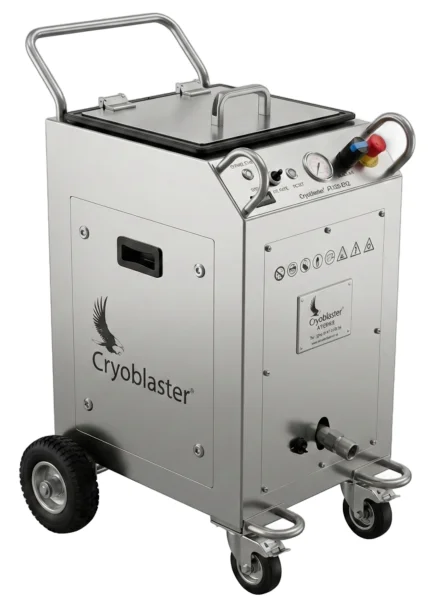
ATX25-E - Heavy-duty dry ice blasting machine
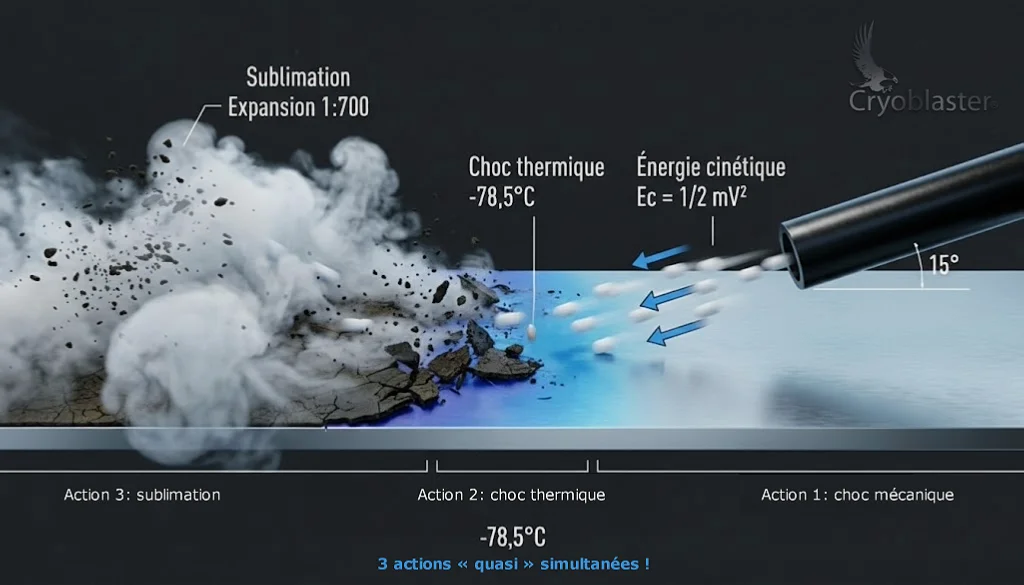
The three mechanisms behind ice blasting
Every dry ice blasting industrial clean runs on the same physics. Dry ice particles rate at just 1.5–2 on the Mohs scale, delivering impact without eroding the substrate. The dry ice blasting benefits come directly from these three mechanisms working simultaneously.
- Kinetic impact: Ice pellets strike the surface with controlled force, loosening deposits without scratching precision components.
- Thermal shock: At −78.5°C, solid carbon dioxide embrittles contaminants and breaks their bond with the underlying surface.
- Dry ice sublimation: Ice sublimates on contact, expanding the carbon dioxide 800 times in volume, lifting the residue layer clean away.
- Zero residue: Because the ice sublimates completely, a dry ice blast leaves no secondary waste behind.
What changes everything here is the sublimation effect. Unlike abrasive blasting, where spent media demands costly disposal, the CO₂ simply vanishes. The only material remaining is the contaminant itself, ready to be swept or vacuumed away.
Key components of a dry ice blasting setup
A proper dry ice blasting setup requires the machine, compressed air between 2 and 16 bar, and a sufficient media supply. Consumption ranges from 3 kg/hour on precision units to 120 kg/hour on heavy ice blasting machines. Matching that capacity to your specific application is the first operational decision you will make.
Single-hose configurations propel dry ice pellets faster, delivering aggressive power against heavy fouling. Two-hose systems are gentler, better suited to lighter contamination or delicate substrates. You can compare our full range of dry ice blasting machines online to see these differences in flow rate.
Choosing the right machine pressure and configuration
Operating pressure determines whether ice cleaning is the right approach for a circuit board or a foundry mould in manufacturing. Precision tasks typically call for 4 to 8 bar; heavy fouling demands up to 16 bar. That adjustability is what makes the same dry ice blasting equipment viable across entirely different jobs.
Dry ice blasting uses across key industrial sectors
A CO₂ pellet sublimates on contact, leaving zero secondary waste behind. That is why ice blasting performs just as effectively on active food processing lines as it does on live electrical panels. In practice, dry ice blasting eliminates the residue problem that makes conventional surface cleaning so disruptive.
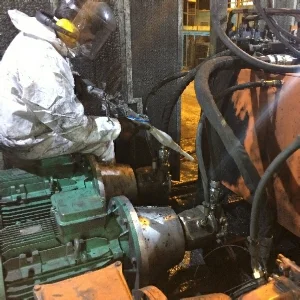
Food, plastics and foundry ice blasting applications
In food processing, the case for dry ice blasting uses is straightforward. Ice cleaning strips baked-on grease and bacterial biofilms directly from equipment surfaces. You introduce zero water, no moisture means no breeding ground for Salmonella left behind.
For plastics, a dry ice blast cleans injection moulds in situ without affecting dimensional tolerances. The ATX nano DS is the right tool here: its digital display delivers repeatable settings for delicate cavities. In foundry environments, the thermal shock mechanism works in your favour on hot tooling, which measurably reduces pellet consumption.
Electrical, aerospace and specialist dry ice cleaning
A dry ice industrial clean on electrical cabinets depends entirely on the non-conductive nature of the medium. Applying solvents to sensors or circuit boards creates an immediate short-circuit risk. Dry ice cleaning removes that moisture hazard entirely, provided your operator holds the correct authorisations for live equipment.
Aerospace components such as turbine fins require tight tolerances, which makes traditional methods too aggressive for the task. Fire damage restoration and heritage stonework both respond well to the controlled kinetic impact of CO₂ pellets. Where thermal shock cannot shift fully cured enamels, that is when Cryoblaster® turns to abrasive blasting or laser alternatives.
Why choose dry ice for clean industrial operations
A maintenance process that runs two to eight times faster fundamentally restructures your production schedule. When evaluating dry ice blasting industrial clean operations, three practical factors dictate the outcome.
Equipment returns to service immediately, secondary waste disappears from the equation, and labour costs fall. Run the numbers on choosing dry ice for clean operations and the savings accumulate quickly against conventional shutdowns.
Productivity and downtime benefits of ice blasting
Cleaning in-situ removes the need to strip equipment down, relocate it, and reassemble it afterwards. That single change produces a substantial reduction in downtime, in practice, the cleaning window shrinks the moment disassembly stops.
- In-situ cleaning: You clean machinery in place without tearing it down. Transport, rebuild, and drying phases are removed from the process entirely.
- Immediate return to service: No moisture means production restarts the moment ice blasting finishes, no drying period, no waiting.
- Documented cycle reduction: Using our ATX80 and ATX25 units, one food plant cut conveyor chain maintenance from seven days down to 2.5 days.
Ice cleaning is substantially faster than wire brushing or solvent wiping on heavy contamination. One operator handles a task that previously demanded a full crew armed with hand tools.
The real measure is not the cost of the cleaning machines, it is the value of recovered production hours. A two-hour shutdown compressed to forty minutes justifies the investment in dry ice cleaning entirely.
Environmental and safety advantages of dry ice blasting
Solid carbon dioxide sourced from existing manufacturing processes adds no new greenhouse gases to the atmosphere. The carbon dioxide is reclaimed and repurposed, the impact comes from the physics of sublimation, not from any additional emission.
This aligns directly with cleaner production principles: zero water, zero solvents. Cleaning with dry ice removes operator exposure to aggressive degreasers and the physical risks of hazardous manual scrubbing.
Dry ice blasting systems eliminate both chemical procurement and the liability of waste disposal. In regulated sectors, that is a structural cost reduction, not a marginal convenience.
How dry ice blasting compares to other clean methods
The distinctions between a dry ice blast and alternative methods are categorical, not marginal. Each competing technology carries a specific failure point that sublimation avoids by its nature.
- Vs. pressure washing: Water introduces moisture, rust risk, and electrical faults. Because dry ice blasting is completely dry, contaminated wastewater treatment disappears from the process entirely.
- Vs. abrasive blasting: Sand and crushed glass erode surfaces and alter precision dimensions. Dry ice particles cause zero pitting, that is precisely where abrasive blasting falls short on sensitive components.
- Vs. laser cleaning: Laser technology is residue-free but demands significant capital investment. For broad surface preparation, pellet projection through ice cleaning machines remains the far more accessible choice.
Solvent wiping exposes staff to hazardous vapours and cannot reach complex geometries. Ice cleaning machines access narrow crevices with ease, and often reveal hidden cracks once the accumulated grime is gone.
For electrical panels, the non-conductive nature of dry ice blasting makes it the only safe option with no drying time required. Where geometry becomes too fine for pellet projection, laser is worth discussing, but that is rarely the general case.
Costs, safety, and choosing the right ice cleaning equipment
Top-tier ice blasting machines reach £30,000, and at that price point, three factors determine whether the purchase makes sense. You need to match performance to the contamination, satisfy safety constraints, and justify the capital outlay. Miss any one of those, and you either under-spec the rig or pay for capacity you will never use.
What affects dry ice blasting cost and ROI
A thorough dry ice industrial clean costs more than the sticker price on the ice cleaning machines. The real figure includes equipment, pellet logistics, compressed air, and operator time. Facilities that ignore recovered production hours consistently underestimate the actual ROI, often by a significant margin.
- Equipment tier: Compact units like the XP02 are built for precision tasks, while heavy-duty models reach £30,000. For daily industrial cleaning, mid-range models typically offer the most practical balance.
- Dry ice consumption: Compact units draw 3–20 kg/hour for light-duty work. Mid-range rigs run at 20–40 kg/hour, and high-performance dry ice cleaning machines handle 25–120 kg/hour.
- Pellet logistics: Carbon dioxide sublimates, you cannot stockpile dry ice on site indefinitely. A reliable dry ice blasting setup depends on insulated storage and carefully timed deliveries.
- Waste elimination savings: Because sublimation leaves nothing behind, you eliminate sand disposal from abrasive blasting and cut out wastewater treatment entirely, both of which offset the cleaning equipment investment directly.
In practice, the ROI calculation shifts considerably once recovered production time enters the equation. A 60% reduction in downtime in food processing delivers returns that standard assets cannot match. That faster dry ice blast turnaround is the metric that actually moves the decision.
| Machine model | Dry ice flow rate | Hopper capacity | Best application fit |
| XP02 | 3–12 kg/h | 3 kg | Precision cleaning, electrical cabinets, automotive detailing |
| XP07 | 6–26 kg/h | 7 kg | Technical applications: plastics, foundry, automotive |
| ATX nano / nano DS | 0–35 kg/h | 9 kg | Versatile industrial cleaning, digital settings for repeatable jobs |
| ATX25-E | 0–75 kg/h | 25 kg | Intensive industrial tasks, large surface areas |
| ATX25-P | 0–90 kg/h | 25 kg | ATEX Zone 2 Gas / Zone 22 Dust certified environments |
Safety requirements for an ice blasting operation
Carbon dioxide is heavier than air, concentrations accumulate at low levels and can displace oxygen in confined spaces. That displacement is a structural hazard, and it requires verified airflow before any dry ice blasting begins. Personal protective equipment is non-negotiable: continuous operating noise during ice blasting routinely reaches 115 decibels.
The ice cleaning process uses a non-conductive medium, but live electrical work still requires site-specific authorisation. In explosive atmospheres, the ATX25-P is the required unit for petrochemical or manufacturing zones. It is the only Cryoblaster® model certified for ATEX Zone 2 Gas environments.
Selecting the right dry ice blasting machine
The real question is not which blasting machine carries the highest flow rate. It is what substrate you are working with and what contamination you need to remove. For electrical cabinets, the XP02 delivers the low-impact dry ice cleaning that fragile components require.
Heavy manufacturing equipment and large conveyor systems demand the sustained output of the ATX25-E. Where a site carries an ATEX classification, the ATX25-P becomes the only viable unit within our dry ice blasting systems. In those restricted zones, no other model substitutes for compliance.
A CO2 blasting process loses effectiveness against fully cured paints or elastic sealants that resist thermal shock. For those specific scenarios, laser cleaning or abrasive blasting is worth considering. Matching the method to the fouling keeps your cleaning machines running efficiently, without stalling mid-job.
Frequently asked questions
How much does dry ice blasting cost in the UK?
Entry-level dry ice cleaning machines like the Cryoblaster® XP02 start at a few thousand pounds, while high-performance industrial dry ice blasting machines reach approximately £30,000. Your ongoing operating costs come down to two things: dry ice pellets and your compressed air supply. In practice, getting a food processing line back into production 60% faster covers the capital cost of most ice blasting machines within a measurable timeframe.
What are the limitations of dry ice blasting?
A dry ice blast struggles with fully cured paints and elastic sealants, these flexible contaminants simply absorb the thermal shock of solid carbon dioxide rather than fracturing under it. Ice pellets cannot be stored indefinitely, which means your ice cleaning logistics depend on tight delivery planning. For stubborn coatings, complementary cleaning machines using laser technology or conventional abrasive blasting are the more practical alternatives; in those specific cases, a dedicated blasting machine is the right tool.
How long will 20 kg of dry ice last during an ice blasting job?
Compact ice blasting machines like the XP02 run for up to six hours on 20 kg of carbon dioxide. Mid-range ice cleaning machines exhaust that same stock in under an hour. High-flow equipment built for heavy dry ice cleaning consumes 20 kg in twenty minutes, that consumption gap is exactly why operating dry ice cleaning machines during intensive dry ice blasting jobs demands proper insulated storage, planned in advance, not improvised on site.