


This guide explains precisely how a dry ice blaster works, from the way pressurised air and particle preparation interact to the thermal shock effect and sublimation that occur on impact. By the end, you will understand the complete dry ice blasting process, the physics behind it, and how equipment is matched to different industrial tasks.
How dry ice blasting works as a cleaning process
Dry ice blasting is a non-abrasive cleaning method that uses dry ice pellets, or ice pellets made of solid carbon dioxide, as the blasting media. In this cleaning process, a dry ice blasting machine uses pressurised air to propel and accelerate dry ice particles towards a contaminated surface. Unlike wet cleaning or chemical treatments, the blasting process leaves no moisture or chemical residue, and generates no spent media to recover.
The effectiveness of this cleaning method rests on three physical effects acting at the same moment: kinetic energy, the thermal shock effect, and sublimation. The result is measurable in reduced residue, lower cleanup requirements, and better protection of the underlying substrate.
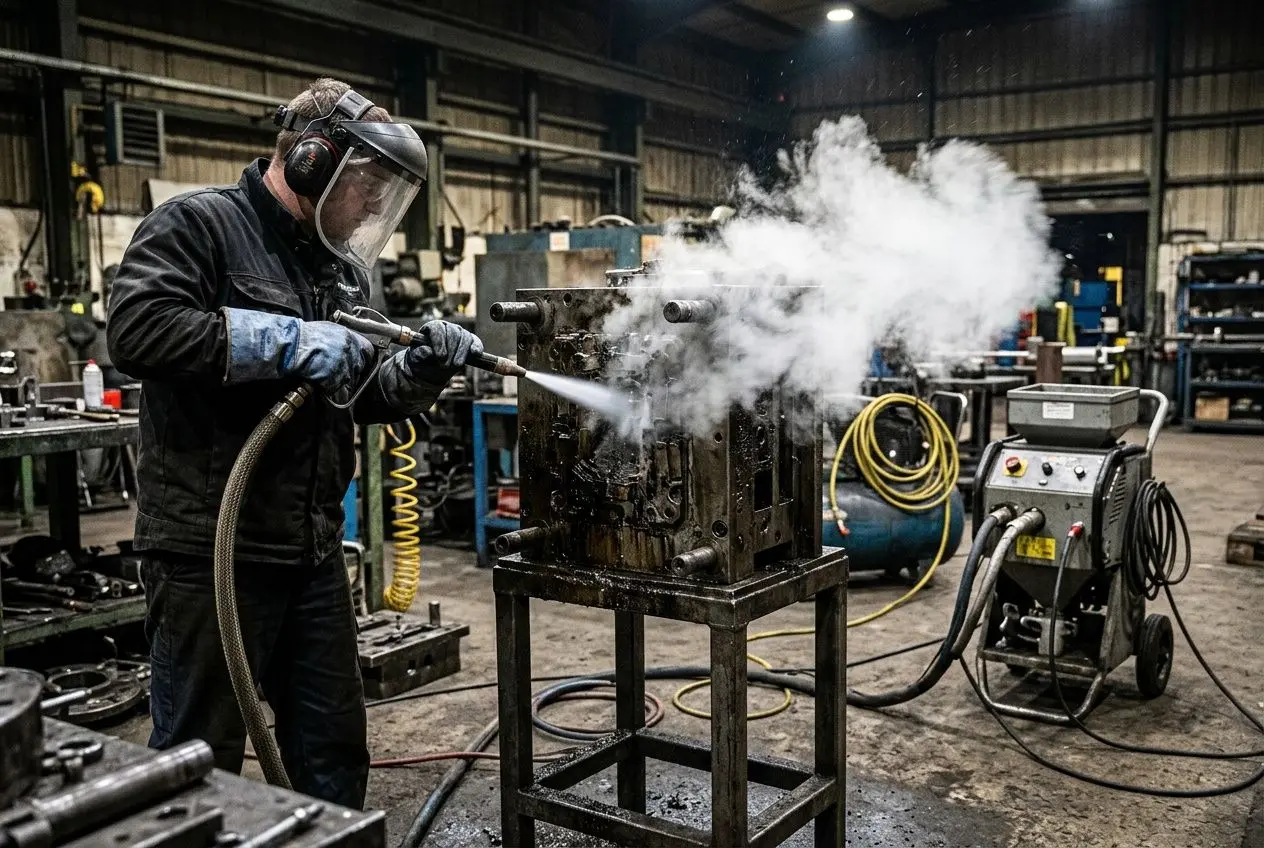
The three physical effects behind every clean
To understand how dry ice sandblasting works, you need to look at what happens in milliseconds when dry ice particles strike the surface. The difference comes down to their combined action at the point of impact.
- Mechanical impact: the dry ice blast transfers kinetic energy into the contaminant layer, helping break its bond with the surface without the cutting action associated with abrasive blasting.
- Thermal shock effect: solid carbon dioxide is at -78.5°C, cold enough to embrittle many deposits and create micro-cracking in the contamination layer.
- Instant sublimation: dry ice sublimates directly from solid to gas on impact. As the pellets sublimate, the rapid gas expansion helps lift and eject loosened contamination.
- Critical energy threshold: safe operation depends on setting the dry ice blasting process so the contaminant releases before the substrate is damaged, using pressure, feed rate, and nozzle choice to control the effect.
Because dry ice pellets sublimate on contact, no residual blasting media remains on the cleaned surface. Once the process is complete, only the removed contaminant needs to be collected. That is a major difference from abrasive blasting, where spent media becomes an additional waste stream.
How the blasting machine prepares and projects dry ice
A dry ice blasting machine starts at the hopper, where standard 3 mm dry ice pellets can be reduced into much finer dry ice particles for more controlled coverage. In practice, some systems use a double-grinder arrangement with counter-rotating rollers to produce particles averaging around 0.2 mm. Finer ice pellets improve precision, especially on detailed components and sensitive surfaces.
From there, the machine draws the particles towards the blast gun and nozzle, where pressurised air is used to accelerate dry ice particles to working speed. Venturi-based systems can deliver particle velocities of around 60 to 120 m/s for general industrial cleaning, while higher-performance single-hose systems can propel dry ice particles beyond 290 m/s. Equipment selection depends on the contaminant, the substrate, and the required intensity of the blasting process.
Why dry ice differs from sandblasting and abrasive methods
The key difference between dry ice blasting and abrasive blasting lies in both hardness and residue. Dry ice, as solid carbon dioxide, has a Mohs hardness of about 1.5 to 2, closer to chalk than to mineral or metallic blasting media. As a result, this non-abrasive cleaning approach can clean cast iron, steel, stainless steel, aluminium, and many sensitive components without eroding the base material.
Conventional media blasting depends mainly on impact energy to wear away contamination, and often part of the substrate with it. In contrast, a dry ice blast combines kinetic energy with the thermal shock effect and sublimation, so the cleaning force is not based on abrasion alone. Where it matters most, that reduces the risk of surface damage while still removing stubborn deposits.
Beyond surface protection, dry ice blasting leaves no secondary media waste because dry ice sublimates completely after impact. The cleaning process can often be carried out in place, including on hot equipment, since elevated temperature can reduce contaminant adhesion and improve release. In industrial use, this makes dry ice blasting especially effective where downtime, dismantling, and post-cleaning recovery need to be kept under control.
The correct way to use dry ice for effective blasting
Effective blasting results depend as much on parameter selection as on the equipment itself. Before any dry ice blast begins, you need to match the settings to the substrate and the contaminant in front of you. In practice, incorrect settings are the most common reason for incomplete surface cleaning or avoidable damage.
Setting the right parameters before you start blasting
The correct way to use dry ice starts with four adjustable variables: compressed air pressure, dry ice feed rate, pellet size, and nozzle type. Typical pressure ranges from 0.3 to 15 bar depending on the machine, while feed rate can vary from 0–35 kg/h to 0–75 kg/h on higher-performance units. Each variable affects energy at impact: all four must be adjusted together rather than one by one.
A pressure regulator mounted on the gun allows real-time adjustment during operation. For sensitive materials such as plastics, electronic boards, copper, and fabrics, carry out a preliminary test on a small, inconspicuous area before full surface cleaning. As a result, you can confirm that the ice pellets remove the contaminant without affecting the substrate and establish a repeatable dry ice blasting process for similar applications.
What happens at the surface during sublimation
Sublimation sits at the centre of the cleaning mechanism. When the dry ice blast reaches the surface, the solid CO₂ converts directly into gas, bypassing the liquid phase, within milliseconds of impact, leaving no moisture or secondary residue.
During sublimation, CO₂ expands by roughly 400 to 700 times its original volume, depending on ambient temperature, and creates a micro-explosion at the point of contact. In complement to that expansion, latent heat is absorbed from the top layer of the contaminant, producing a sharp thermal gradient and high shear stress that weakens adhesion.
The cold of -78.5°C prepares the surface first. Contaminants become brittle and contract, while micro-cracks form within the dirt layer and reduce cohesion with the substrate. Beyond that, the three physical effects work in sequence rather than in isolation: impact, cold, and expansion each prepare the next stage, and the result is measurable in how efficiently deposits detach.
Handling different contaminant types during the process
Once material is released, its behaviour depends on its physical state. Dry contaminants such as dust, soot, food residues, and adhesives usually fall by gravity onto prepared collection surfaces once the process is complete, which makes recovery relatively simple. In contrast, grease and oils need a more controlled approach during blasting, because dislodged material must be directed towards predefined collection points to avoid being spread across the cleaned area.
Designate separate collection zones for dry and liquid contaminants before the blast begins. In addition, this helps you organise waste handling around the behaviour of the released material during the process.
Choosing the right dry ice blasting machine and system
Machine selection determines how effective a blasting operation will be. The difference comes down to four practical variables: available output from your compressed air system, the type of contaminant, the sensitivity of the substrate, and how often the equipment will be used under load. Once these points are clear, choosing a dry ice blasting machine or a complete dry ice blasting system becomes a technical decision rather than a matter of preference.
In practice, most industrial configurations fall into two core architectures, differentiated by how they move dry ice pellets and pressurised air through the hose: a twin-tube venturi feed or a single-hose airlock system.
Twin-tube venturi vs single-hose blasting systems
When selecting a dry ice blasting machine configuration, the first decision is the feed system. Twin-tube venturi designs use one hose for air and a second line from which the Venturi effect draws ground CO₂ pellets or ice particles into the stream. In contrast, single-hose systems use a rapidly cycling airlock to introduce the media directly into the pressurised air flow, which supports longer hose runs with less pressure loss.
That structural difference defines the operating envelope. Twin-tube venturi systems typically propel particles at 60 to 120 m/s, which suits controlled cleaning across general industrial applications and sensitive surfaces at lower air flow rates. Single-hose systems can exceed 290 m/s with supersonic nozzles, making them the right choice when impact energy is needed for thick coatings, heavy adhesive residues, or other demanding cleaning tasks.
- Twin-tube venturi velocity: Particle speeds of 60–120 m/s support precise, uniform contaminant removal in general cleaning applications, especially where lower air consumption is important.
- Single-hose supersonic velocity: Particle speeds above 290 m/s through supersonic nozzles deliver the impact force required for heavy residues and robust industrial cleaning.
- Dual-hose with double grinder: A dual-hose layout combined with a double grinder improves performance in grooves, deep cavities, undercuts, and complex geometries where even particle distribution matters most.
- Application-matched aggression: Nozzle selection can vary the cleaning intensity so the same dry ice blasting system can address delicate electronic components and heavy cast-iron machinery.
This supports uniform treatment even when the available dry ice pellets or CO₂ pellets are of lower quality.
| System type | Particle velocity | Typical air flow | Best suited for |
| Twin-tube venturi | 60–120 m/s | 4,000–5,000 l/min at 6–7 bar | General industrial cleaning, sensitive substrates |
| Single-hose supersonic | Up to 290+ m/s | Higher flow, 6–15 bar | Heavy coatings, demanding industrial tasks |
| Compact venturi | Subsonic | 800–1,200 l/min at 6–8 bar | Electrical cabinets, precision cleaning, low air availability |
Air supply requirements for dry ice blasting equipment
The air supply must be matched to the blasting technology before work begins. Most industrial applications need at least 4,000 l/min at 6 bar, and around 85% of tasks run effectively within 4,000 to 5,000 l/min at 6 to 7 bar. As a result, the available compressor often determines whether a high-output dry ice blasting machine or a compact dry ice blasting system is the better fit.
Smaller units used for electrical cabinets, detailed components, or vehicle interiors can operate at only 800 to 1,500 l/min. That makes some forms of ice blasting technology compatible with medium-sized site compressors already in place, without additional capital expenditure.
Integrated micron filtration helps protect the process by ensuring the air reaching the blast gun is dry and clean. Additional drying is generally only needed in exceptional cases, such as rental compressors without adequate treatment.
How dry ice pellets are produced for the machine
Dry ice pellets are produced by expanding liquid CO₂ from high pressure to atmospheric pressure, which forms dry ice snow. That snow is then compressed and extruded through a die or matrix in a pelletiser. Hydraulic pelletisers produce denser pellets with greater stripping power, while mechanical units remain suitable for less demanding duties.
Standard CO₂ pellets are typically loaded into the hopper at 3 mm diameter. From there, a grinding stage can reduce the media to micro-particles of about 0.2 mm before blasting, improving uniformity on surfaces that require controlled cleaning. The same principle explains why a system with grinding can process lower-grade ice pellets without a significant drop in performance.
Rather than projecting full-size dry ice pellets directly, the dry ice blast uses conditioned particles accelerated by pressurised air through the nozzle.
How does dry ice car cleaning and industrial use work
The same three physical effects govern every dry ice blast: impact, thermal shock, and sublimation. Whether you are dealing with vehicle components or industrial equipment, the difference comes down to operating pressure, pellet size, air flow, and nozzle geometry.

Dry ice cleaning for automotive surfaces and components
CO₂ micro-particles at -78.5°C are projected onto the surface during the dry ice blasting process: the cold creates thermal shock, contaminants become brittle, and sublimation helps lift away road film, tar, adhesives, grease, and paint overspray. Because there is no water and no aggressive abrasive blasting action, bodywork, seals, and sensitive finishes can be treated with far lower risk of damage than with many conventional blasting methods.
Once the process is complete, the surface remains clean and dry, ready for inspection, repair, or reassembly without a separate drying stage.
For engine compartments and electrical assemblies, the dry and non-conductive character of ice blasting technology is particularly important. Electronic control units, wiring looms, and sensors can be cleaned without introducing moisture, provided the equipment is treated correctly and standard safety procedures are followed.
Rubber seals, plastics, door trims, chassis sections, and even some upholstery can also respond well to dry ice pellet blasting at reduced settings. The right choice when working on delicate automotive parts is to lower pressure, match the nozzle to the profile, and test first on a small area, because the low Mohs hardness of dry ice, around 1.5 to 2, does not remove all risk if parameters are poorly set.
Industrial blasting applications across key sectors
Dry ice blasting applications extend across food production, pharmaceuticals, mould maintenance, electrical systems, aerospace work, and controlled decontamination.
In contrast with wet surface cleaning or many abrasive blasting operations, dry ice blasters do not add water or chemical residue to the work area. As a result, dry ice blasting applications are well suited to maintenance where downtime, waste handling, and substrate protection all matter at the same time.
In food and pharmaceutical environments, CO₂ is recognised by the FDA, USDA, and EPA as a cleaning medium. The absence of water reduces the microbial risks associated with some wet blasting methods, while dry ice cleaning leaves no chemical residue on food-contact equipment. The result is measurable: machinery can often be cleaned in situ, with less dismantling and shorter planned stoppages.
- Mould cleaning (plastics and foundry): moulds can be cleaned on-site while still hot, often three to five times faster than cold cleaning approaches, with no residue left to affect the next production cycle.
- Electrical and aerospace maintenance: de-energised cabinets, electrical assemblies, and precision aerospace parts can be treated at low air volumes because dry ice blasting technology remains dry and non-conductive.
- Hazardous material removal: dry ice pellet blasting does not create the same secondary media waste as abrasive blasting, and it avoids the dust pattern typical of sand-based blasting in applications involving asbestos coatings, lead paint, or radioactive contamination where containment is critical.
Beyond that, the dry ice blasting principle remains effective on grooves, cavities, undercuts, internal profiles, and other difficult geometries. Conventional pressure washing and other blasting methods often need more tooling or create more residue in these areas, whereas a properly configured dry ice blasting machine can carry the dry ice blast directly into hard-to-reach zones.
Disadvantages, safety and limits of dry ice blasting
No industrial cleaning method is without constraints. Dry ice blasting requires attention to safety requirements, process limits, and the operating conditions under which it performs well or poorly. Addressing these factors early makes the blasting process safer, more predictable, and easier to integrate into production.
Key safety requirements for dry ice blasting operations
Among the disadvantages of dry ice blasting, the main safety issue is carbon dioxide exposure. CO₂ becomes increasingly hazardous above 1% concentration and, in enclosed areas, can displace oxygen and create an asphyxiation risk if ventilation is inadequate. Because carbon dioxide is heavier than air, extraction for indoor blasting should be placed at or near floor level: this is where sublimated gas collects first.
- Insulated gloves: Mandatory when handling dry ice pellets at -78.5°C to prevent cryogenic contact burns.
- Eye and ear protection: Required during blasting because ice pellets are accelerated at high speed and the compressed air system generates sustained noise.
- Ground-level exhaust ventilation: Essential indoors to remove gas as dry ice sublimates and before hazardous concentrations build up.
Dry ice blasting safety also depends on operator competence. Incorrect settings can damage sensitive surfaces, while CO₂ risks demand a clear understanding of ventilation, PPE, and emergency response. In practice, dry ice blasting is not a do-it-yourself method; it requires training, a suitable workspace, and controlled operating conditions.
Real limitations and disadvantages of the process
Beyond safety, the process has clear technical limits. Very thick deposits or heavily bonded coatings may need several passes, and some jobs that abrasive blasting tackles more aggressively, such as heavy mill scale on structural steel, are often less efficient with this method alone. A combined method or a higher-pressure single-hose setup is the right choice when removal rates are critical.
There are also logistical constraints. Dry ice pellets are consumables that diminish in storage because dry ice sublimates continuously, so unused material left in the hopper is gradually lost. Consumption ranges from 35 kg/h on standard units to 75 kg/h on high-performance systems, so delivery scheduling must match actual session volumes rather than nominal hopper capacity.
Equipment and ice pellets are typically more expensive than simple pressure washing, and facilities without sufficient compressed air capacity may need to hire or install a compressor. In contrast, dry ice blasting avoids wastewater treatment, chemical handling, solvent residues, and disposal of secondary blasting media once the process is complete, so the full economics should be judged across the entire blasting process rather than on purchase cost alone.
The disadvantages of dry ice blasting are specific: adequate CO₂ ventilation, trained operators, and a compressed air supply matched to the system's consumption rate. In complement, process suitability remains decisive because dry ice blasting is a non-abrasive cleaning method and will not match conventional abrasive blasting on every surface or deposit type. The result is measurable when the application aligns with contamination removal rather than surface profiling or aggressive material removal.
Frequently asked questions
What are the main disadvantages of dry ice blasting?
The main disadvantages of dry ice blasting are practical rather than chemical: dry ice undergoes sublimation during storage, so consumable loss begins before the dry ice blast even starts. The process also depends on a suitable compressed air supply, and the equipment cost is typically higher than for pressure washing.
In contrast, indoor use requires proper ventilation because CO₂ can accumulate at low level. Very thick or heavily bonded coatings may need several passes, and effective blasting demands trained operators with appropriate PPE.
Because dry ice cleaning avoids water, chemical residues, and secondary media recovery, the total cost of ownership is often lower for sites running regular cleaning programmes.
Does dry ice blasting damage rubber seals or gaskets?
Dry ice used for blasting has a Mohs hardness of 1.5–2, close to chalk, so it is non-abrasive in mechanical terms. As a result, dry ice cleaning will not wear rubber surfaces in the way mineral blasting media can.
In practice, seals, gaskets, and door trims are usually preserved during a dry ice blast. However, the difference comes down to condition and settings: thermal shock at -78.5°C can embrittle aged or already degraded rubber if pressure or feed rate is too high.
Reduce operating pressure, lower the dry ice feed rate, and test a non-critical area first before carrying out full ice cleaning.
Can you carry out dry ice blasting yourself without professional equipment?
Safe and effective blasting depends on correct control of pressure, feed rate, and nozzle selection so that contamination is removed without harming the substrate.
In complement to machine settings, safety controls are essential: CO₂ hazards require adequate ventilation at ground level, along with suitable PPE such as insulated gloves and eye protection. Operator training is also needed to understand emergency procedures and the process conditions created by sublimation.
Without proper equipment, training, and compressed air infrastructure, dry ice cleaning carries a real risk of injury and surface damage. Professional equipment, trained operators, and a proper compressed air supply are what make dry ice cleaning both safe and effective.