




Dry ice blasting: professional machines and equipment
Dry ice blasting is an industrial dry-cleaning method that removes a wide range of contaminants without water, chemicals, or abrasion to the substrate. The process is based on the projection of dry ice — solid CO₂ at -78.5°C — accelerated by a stream of compressed air.
This technology is used across many industrial sectors to clean sensitive surfaces: de-energised electrical equipment, industrial moulds, production machinery, food-processing lines, mechanical parts, and installations that are difficult to dismantle.
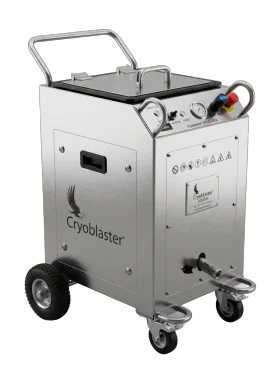
Cryoblaster® designs and markets a complete range of dry ice blasting machines, from compact models for precision work to high-performance industrial equipment. The choice of a dry ice blasting machine depends on the industry sector, the contaminant to be removed, the sensitivity of the substrate, the available compressed air volume, and the frequency of use.
Compare the different Cryoblaster® machines and identify the equipment best suited to your business.
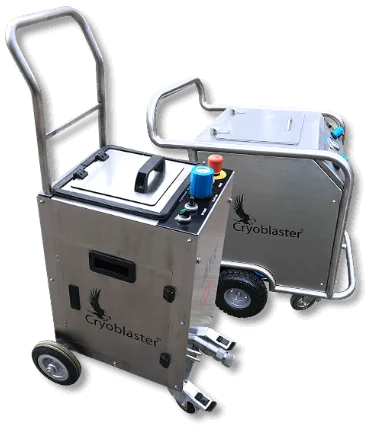
Cryoblaster® dry ice blasting machines: a range designed for industry
Cryoblaster® offers a range of dry ice blasting machines designed for cleaning, light stripping, degreasing, and preventive or corrective industrial maintenance operations.
Depending on the model selected, the machines can meet very different requirements: cleaning delicate surfaces, restoring industrial moulds, maintaining electrical equipment both de-energised and energised — with specialised nozzles required — cleaning production lines, or carrying out more intensive work on heavy contamination.
The range incorporates technical solutions adapted to real-world operating constraints: a high-frequency vibrator to improve dry ice feed, specific nozzles according to the required level of aggressiveness, fragmentation accessories for sensitive surfaces, and an optional abrasive kit for certain specific applications.
Cryoblaster® equipment is used in demanding sectors such as plastics processing, foundries, food processing, pharmaceuticals, aerospace, industrial maintenance, and electrical applications. The selected components — Festo®, Siemens®, Phoenix Contact®, Eaton®, depending on the model — contribute to the reliability of the equipment in professional environments.
Equipment, services and related technologies
News
Dry ice blasting for industrial cleaning: a complete guide
Discover how dry ice blasting transforms industrial clean processes. From ice blasting setup to ice cleaning benefits, explore dry ice cleaning solutions with expert dry ice blasting services.
What is dry ice blasting: the complete ice cleaning guide
Discover what dry ice blasting is, how the dry ice blasting process works, its benefits and applications. Your ultimate guide to dry ice cleaning explained.
Our Services
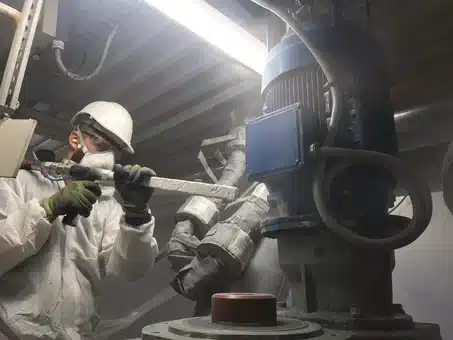
Industrial Cryogenic Cleaning
Benefit from our expertise in industrial dry ice blasting. We work on all types of installations, whether machine tools, production lines, or sensitive equipment.

Electrical Installation Cleaning
Entrust us with cleaning your electrical installations, with the assurance of a safe and effective intervention. Thanks to the dry ice blasting process, we decontaminate your equipment with no water required and no chemicals.

Automotive Cleaning
For automotive enthusiasts, we offer a dedicated dry ice blasting service. Our method is gentle on surfaces while being remarkably effective—ideal for detailing...
Why choose dry ice blasting for your industrial operations?
In industry, conventional cleaning methods often involve water, solvents, abrasives, or extensive equipment dismantling. These constraints can generate secondary waste, extend downtime, and increase the costs associated with returning equipment to operation.
Dry ice blasting addresses these limitations by projecting dry ice directly onto the surface to be treated. The contaminant is dislodged, while the solid CO₂ sublimates without leaving any liquid or abrasive residue.
This technology is particularly relevant when the objective is to clean faster, preserve the substrate, limit dismantling, and reduce post-cleaning treatment operations.
How does dry ice blasting work?
Dry ice blasting is based on the projection of dry ice, either in the form of pellets or fragmented particles, depending on the application, using a stream of compressed air. The dry ice is accelerated through a blasting hose and then projected through a nozzle onto the surface to be treated.
The result comes from three simultaneous effects: the mechanical impact of the particles, the thermal shock caused by solid CO₂ at -78.5°C, and the instant sublimation of the dry ice upon contact with the substrate.
This combination helps weaken and dislodge contaminants without the use of water, solvents, or secondary abrasive media.

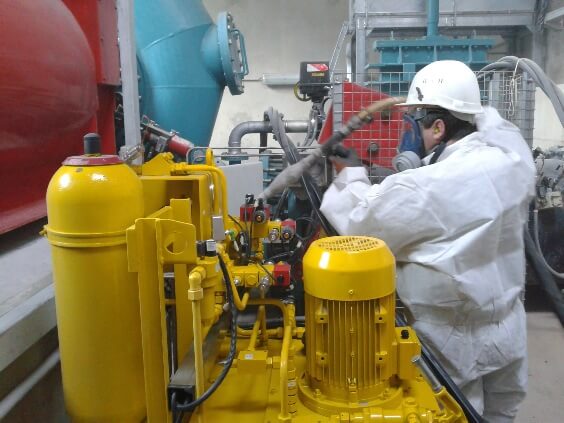
Cleanliness operation by spraying dry ice. Purpose of the treatment: hydraulic unit
A dry process that limits secondary waste
Dry ice blasting does not use water, sand, or mineral abrasives. The dry ice used during the operation sublimates upon contact with the surface and turns directly back into gas.
Unlike sandblasting, abrasive blasting, or certain wet cleaning methods, the process does not add any secondary media that must be recovered after cleaning. Only the removed contaminants need to be collected according to their nature: grease, dust, food residues, soot, adhesives, varnishes, or other industrial deposits.
This characteristic simplifies cleaning operations, reduces restoration time, and limits post-treatment constraints when the intervention context allows it.