


How dry ice cleaning works on electrical equipment
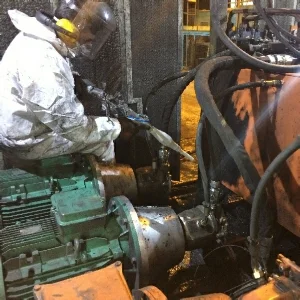
The three physical effects behind the cleaning process
Dry ice cleaning electrical equipment is based on three combined physical effects. The difference comes down to how they act together: kinetic impact breaks the bond of contamination, thermal shock makes deposits brittle, and sublimation lifts them away without adding moisture or chemical residue.
- Kinetic impact: dry ice pellets accelerated by compressed air strike the surface and loosen deposits such as carbon dust, grease, and industrial fouling.
- Thermal shock: at −78.5°C, the pellets create a sharp local temperature change that embrittles stubborn buildup and helps it detach from the substrate.
- Sublimation: on impact, dry ice sublimates instantly and expands from solid to gas, lifting contaminants from electrical components, circuit boards, switchgear, and control panels while limiting secondary waste.
Once the process is complete, the surface is clean and dry.
Is dry ice cleaning safe for sensitive electrical components?
For sensitive electrical components, safety depends on the same three effects rather than on aggressive abrasion. In practice, dry ice cleaning uses no water, no solvents, and leaves no conductive residue, which is why it is widely used for electrical maintenance on live or sensitive installations.
Control over pellet size and pressure is what makes safe blasting possible. Dry ice pellets can be adjusted from 0.3 mm to 3 mm, and for circuit boards, wiring, and other delicate electrical equipment, lower pressure with microparticle output allows efficient cleaning while protecting fragile surfaces.
Performance gains on turbine and generator equipment
The result is measurable on large assets. Insulation resistance improvements averaging 600%, with documented cases up to 1,000%, have been recorded after dry ice cleaning on generator windings and high-voltage installations, helping restore operating values from critical levels to acceptable ranges.
Beyond insulation recovery, the same process can improve operating efficiency. Up to 12% more power output has been documented after cleaning a heat recovery steam generator, while an 8 MW turbine generator was cleaned in 4 hours instead of 5 days, showing how maintenance windows can be reduced without introducing moisture.
| Equipment type | Key contaminants removed | Documented performance gain |
| Generator windings | Carbon dust, salt spray, industrial pollutants | Insulation resistance up to +1,000% |
| Heat recovery steam generator | Insulating deposits, fouling on finned surfaces | Power output +12%; cleaning 40% faster than pressure washing |
| Gas turbine (8 MW) | Grease, carbon buildup, organic residues | Cleaning time reduced from 5 days to 4 hours |
| Electrical panels and switchgear | Dust, oils, conductive contamination | Immediate return to service; no drying period required |
Choosing the right machine and pressure settings
The right choice when selecting dry ice blasting machines depends on the contamination, the sensitivity of the substrate, and the working environment.
For precision work on electrical equipment, including electrical panels, control panels, and other enclosed electrical components, 4 to 8 bar is generally the recommended range. This range supports efficient contaminant removal during dry ice cleaning of electrical equipment while maintaining safety and control throughout the process.
Frequently asked questions
Is dry ice blasting safe for electrical panels and circuit boards?
Yes. Dry ice cleaning is well suited to cleaning electrical equipment because the process adds no moisture and leaves no chemical residue behind. Once the pellets strike the surface, dry ice sublimates immediately, so the surface stays dry and there is no conductive film that could increase the risk of short circuits.
In contrast with abrasive methods, dry ice blasting can treat sensitive substrates without eroding them. That matters for electrical panels, circuit boards, printed assemblies, and winding insulation, where preserving the original surface is central to both safety and cleaning performance. In practice, pressure is usually set between 3 and 5 bar for delicate parts, and equipment should be de-energised before dry ice blasting.
What dry ice blasting machines are best suited for cleaning electrical equipment?
The difference comes down to the size of the job, the level of contamination, and how often the work forms part of maintenance. Compact dry ice cleaning machines suit occasional tasks and fine-detail work: the XP02 operates with ice consumption of 3–12 kg/h and adjustable particle sizes down to 0.3 mm, which supports controlled dry ice cleaning on sensitive components.
For regular maintenance programmes where contamination levels are higher, a higher-output machine is the more appropriate choice. The XP07 delivers five times higher cleaning performance for recurring work on electrical equipment, while the ATX25-P is designed for sites that require fully pneumatic, certified operation in ATEX Zone 2 or Zone 22 environments.
In additiont, sites where equipment ownership is not practical can have dry ice blasting carried out by a specialist operator on a contract basis.
What are the main dry ice blasting benefits for electrical equipment maintenance?
The method supports access to assemblies with limited disassembly, which helps shorten downtime and reduce reassembly risk during the cleaning of electrical equipment. Where it matters most is continuity: the process can be integrated into maintenance routines for assets ranging from electrical panels to a turbine enclosure.
Because sublimation eliminates liquid and solid residues, there is no contaminated water, spent abrasive, or solvent stream to manage after cleaning.
Beyond that, the method preserves the underlying material. Dry ice blasting removes contamination without stripping base surfaces, which protects insulation, sensor housings, and profile-critical parts while maintaining reliable cleaning performance. Matching the machine to the substrate sensitivity and contamination profile is the practical starting point for any equipment selection.