
HOME > CRYOGENIC CLEANING > PRICING & EQUIPMENT CONFIGURATOR
Dry ice blasting equipment pricing: 7 criteria for choosing the right configuration
Our goal is not to give you a bare-bones price, but to recommend a configuration sized to your actual needs.

1. Selection Assistant
2. ROI Simulator
Receive my personalized assessment
The Cryoblaster team will analyze your data and contact you quickly to validate the technical feasibility of your project.


The common mistake to avoid when buying your dry ice blasting equipment
A widespread misconception is that an expensive dry ice blaster can, on its own, cover all dry ice cleaning applications. In practice, this reasoning often leads to oversized investment and lower-than-expected profitability.
Today, for roughly 50% of the price of a high-end dry ice cleaning machine, it's possible to cover most routine dry ice blasting services while reducing dry ice consumption by up to 50% with equivalent effectiveness on many applications.
Choosing a dry ice blaster should therefore not be guided by maximum power, but by the match between the equipment and your actual needs.
- There's no point investing in an undersized machine if your goal is to handle varied applications.
- Conversely, there's no point choosing an oversized machine just to perform technical work on small surfaces.
To make the right choice, your dry ice blasting equipment must meet a number of technical and operational criteria. Here are therefore the 7 essential criteria to analyze for selecting a configuration truly suited to your business.
1. Single-tube or dual-tube technology: understanding the difference
There are two main families of dry ice blasting machines: the dual-tube and single-tube.
Dual-tube technology (Venturi principle)
Dual-tube machines use a suction principle (Venturi) to project dry ice at subsonic speed. This solution, often more affordable to purchase, is generally more air-demanding and less effective on stubborn soiling.
Single-tube technology (supersonic projection)
Single-tube technology projects dry ice at supersonic speed. It covers a wide variety of applications, from the most delicate to the most demanding, with superior efficiency.

2. Dry ice consumption: a key profitability factor
Dry ice consumption is often underestimated when selecting a dry ice blaster. Yet on many jobs, this cost can represent a significant portion of intervention expenses.
- Moderate consumption may be sufficient to achieve an excellent balance between aggressiveness and efficiency.
- Conversely, certain precision applications require low consumption rates.
- The key is to fine-tune the dry ice flow according to the application.

3. Power and efficiency: execution speed
Pressure alone doesn't define performance. Efficiency depends on a balance between pressure, air volume et dry ice consumption — exactly like a high-pressure cleaner where flow changes work speed.
- At identical pressure, the more consistent the air volume, the faster the cleaning.
- Appropriate dry ice consumption improves effectiveness without unnecessary cost.
- The right combination of "air + ice + nozzle" makes the difference in the field.

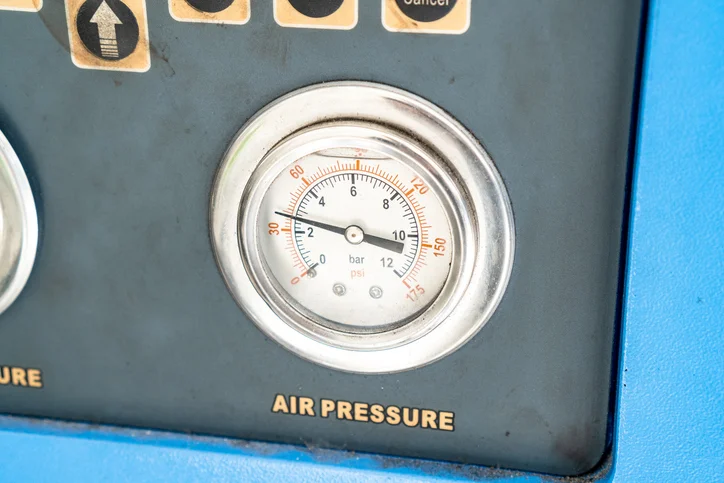
4. Compressed air actually available on-site
Compressed air is the "fuel" of dry ice blasting. The useful flow at the point of use can differ greatly from the compressor's rated output due to pressure drops (piping, lengths, diameters, fittings).
- Consider the flow actually available where you're working.
- Check service pressure and load stability.
- Account for the network (hoses, flexibles, reels, fittings).
5. Mobility and ergonomics: field productivity
Time lost moving, positioning, or maneuvering a machine directly impacts profitability. Mobility depends on the environment (workshop, outdoors, uneven ground) and operator comfort.
- Weight, stability, wheel type, and ground clearance.
- Hose length, gun maneuverability, accessibility.
- Ease of loading ice and making real-world adjustments.
6. Intervention environment: constraints and safety
Not all jobs take place under standard conditions. Some constraints require specific equipment, or you'll face operational incompatibility (power supply, ATEX, sensitive areas).
- No electrical power available or need for pneumatic operation.
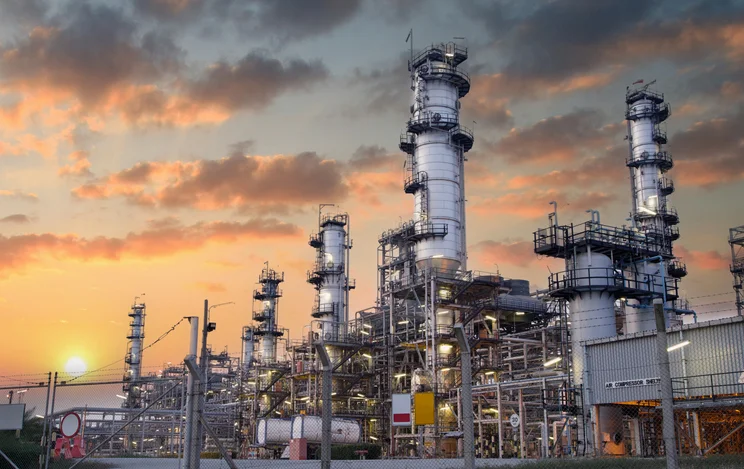
- ATEX zones (potentially explosive atmospheres).
- Safety, process, or site compliance requirements.
7. Frequency of use: investment logic
Occasional, regular, or intensive use doesn't justify the same investment. Usage frequency influences profitability, expected robustness, and whether certain options make sense (autonomy, adjustments, operator comfort).
- Occasional need: test/outsourcing logic.
- Regular use: sizing to stabilize costs and pace.
- Intensive use: priority on productivity and reliability.

Dry ice blasting equipment rental pricing: when does it make sense?
Rental can be an attractive option when the need is occasional (one-off job, test before purchase, seasonal work) or when you want to validate an application at your site.
- Rental : suited to occasional needs and trials.
- Purchase : more profitable once usage becomes regular (maintenance, production, services).
Rental terms vary by duration, model, accessories, logistics (delivery/pickup), and dry ice supply. The most reliable approach is to validate your usage scenario (frequency, available air, surface area), then decide between rental and purchase.
Dry ice blasting, laser, and micro-abrasive equipment pricing: some benchmarks
To give you a sense of scale, here are some examples of pricing observed on professional industrial cleaning equipment. These prices correspond to typical configurations and may vary depending on options, accessories, power levels, and specific needs.
- NanoGom micro-abrasive blaster : starting at 3 850 € excl. tax
- H120 laser stripper : starting at 25 000 € excl. tax
- XP02 dry ice blaster : starting at 4 690 € excl. tax
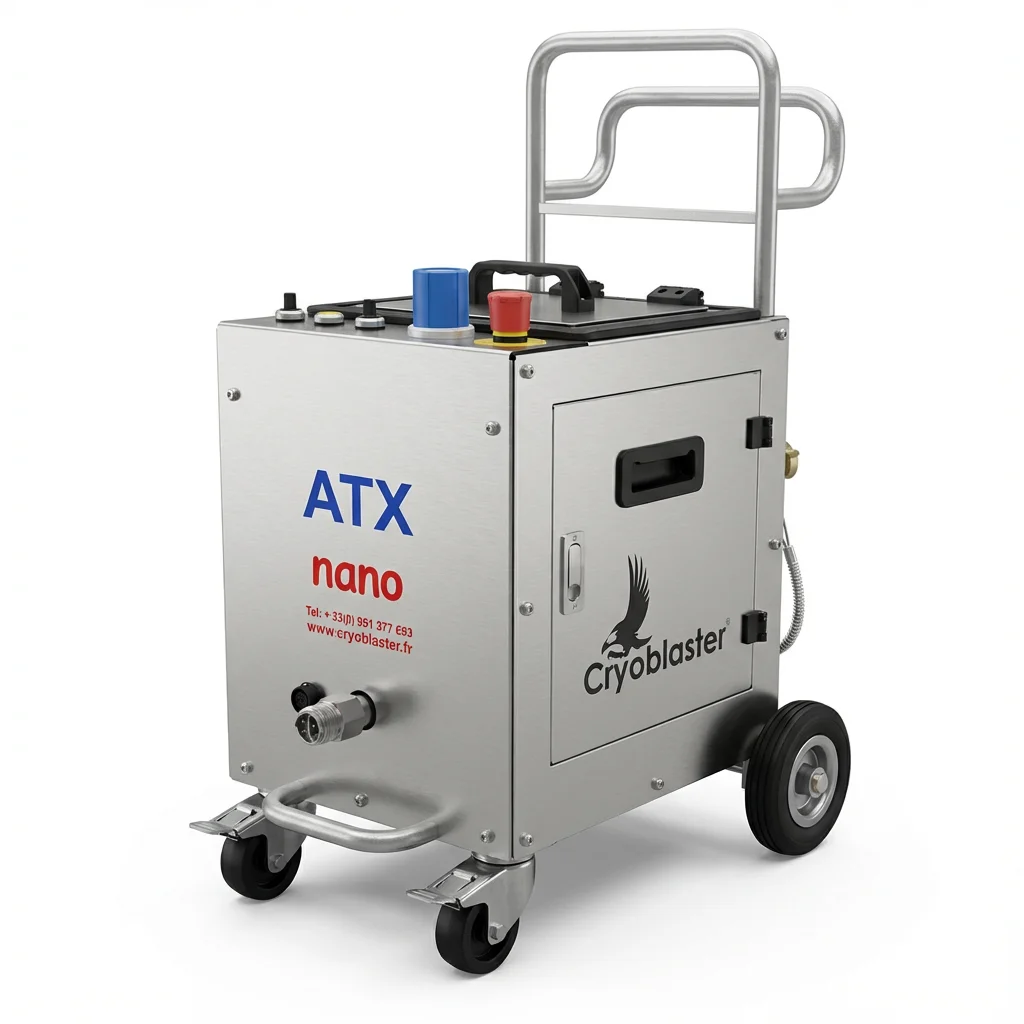
- ATX nano dry ice blaster : starting at 9 600 € excl. tax
These amounts do not replace a configuration assessment. In dry ice blasting, as in laser stripping or micro-abrasive blasting, the right investment depends above all on the application, expected efficiency, and technical constraints (compressed air, pace, surface area, environment).
This is why we systematically recommend validating equipment selection using the selection tools and profitability calculators on this page before making any purchase decision.
FAQ – Pricing & Sizing
Short, practical answers to clarify budget, compressed air, and equipment selection.
What factors influence the price of a dry ice blasting machine?
Mainly: desired pace, available compressed air, soil contamination level, frequency of use, ice tank autonomy (capacity) and accessories (nozzles, fragmentation, specific options).
Why not rely solely on a "list price"?
Because a price only makes sense if the configuration is coherent: an undersized machine (insufficient air/unsuitable nozzle) may cost less upfront but be less profitable and more frustrating to use.
What compressor do you need for dry ice blasting?
That depends on the model and nozzle. In practice, you size based on the flow actually available at the point of use (pressure drop) and the required service pressure. If in doubt, the page's selection assistant gives you a compatible range.
Can you rent equipment instead of buying it?
Yes, in some cases (occasional need, test, one-off job). For regular use, buying becomes generally more profitable: fewer delays, better responsiveness, stabilized cost over the year.
What machine should I choose to avoid undersizing?
The rule: start with your available air, surface size, and contamination level. All else being equal, it's better to secure pace with a higher-tier model rather than compensate by extending hours.
Can a dry ice blasting machine clean delicate surfaces (electrical, vehicle interior)?
Yes, provided you use the right configuration (pressure, flow, appropriate nozzle). For electrical enclosures, work with power off and dedicated nozzles recommended depending on the case.