FOOD INDUSTRY CLEANING: HOW TO REMOVE HOT-MELT ADHESIVE?
Among the many dry ice blasting services available, dry ice blasting in food processing offers a wide variety of applications. Discover in this video how to remove adhesive from surfaces with complex geometries

Why use dry ice blasting in the food industry?
- Industry : food adhesive manufacturing
- Treatment purpose : Hot Melt adhesive manufacturing process
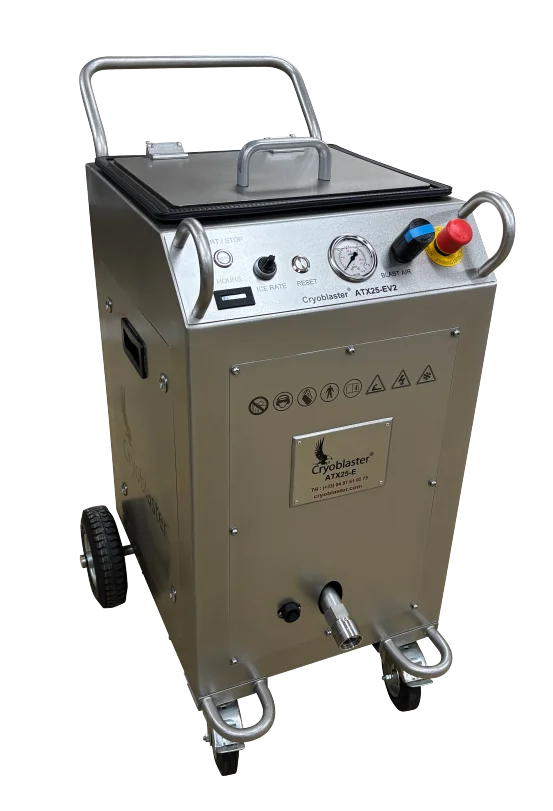
- Equipment used : ATX25-E V2
Keeping food contact surfaces clean is the primary concern of any production manager. The removal waste, fuel residues of food residues, fats, and other contaminants resulting from production equipment use is essential to prevent bacterial growth and ensure safe, high-quality food products.
As food safety regulations become stricter, labor costs rise, and the industry becomes more environmentally conscious, food companies are seeking new processes and cleaning solutions.
Unfortunately, traditional cleaning processes such as steam, water, and manual washing with detergents are slow, time-consuming, and sometimes ineffective.
How do you remove adhesive from production lines in this case? The answer is: through the process of cryogenic cleaning.
The dry ice blasting cleaning solution Carbon dioxide ice works similarly to sandblasting, but that's where the similarities end.
Safe for food processing environments, more cost-effectivedry ice blasting cleans more efficiently and thoroughly ecological !
How does dry ice blasting work?
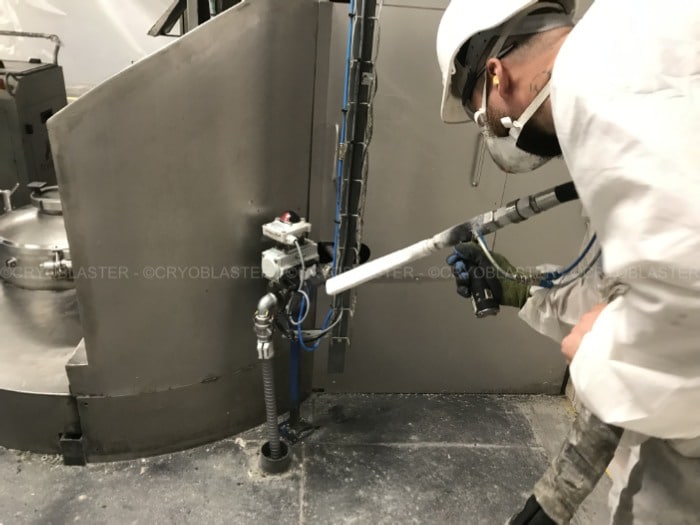
Dry ice blasting service for hot-melt adhesive removal...
Dry ice blasting units or Cryoblasterare fully mobile and self-contained systems. Dry ice pellets or mini cylinders with a diameter of 3 mm, comparable to the size of a grain of rice, are fed from the blaster tank into a stream of compressed air.
The pellets travel along a flexible hose and are projected by a nozzle at extremely high speed, approaching the speed of sound.
The operator directs the pressurized dry ice stream onto the surface to be cleaned.
The treatment is gentle, with hardness of Carbon dioxide ice is comparable to that of chalk.
3 mechanisms in action:
- The first mechanism of this process is the creation of micro-fractures on the dirt: the dry ice loaded with kinetic energyweakens the contamination. In certain cases, such as sticker removal or adhesive ou removalthe debonding process is instantaneous.
- The second mechanism is the thermal differential caused by the low temperature of dry ice at -80 °C, which facilitates the separation of contamination and, in the case of adhesive, hardening.
- The third mechanism is the sublimation of dry ice, or in other words, the transition from solid to gaseous state.
The answer to the question "how do you remove adhesive ?" is simple with dry ice blasting dry ice cleaning.
- You can remove adhesives without damaging surfaces on glass, plastic, stainless steel, PVC, and more.
- No solvents or thinners—only dry ice.
- Walls, machine tools, and tiles can be cleaned to remove food adhesive, neoprene cement, cyanoacrylate, tape, and more.
Application examples for adhesive removal in the food industry
With Cryoblaster equipment Cryoblaster® you can clean
- the labeling machines et wrapping machines,
- production equipment production dry ice. It addresses environments where cleaning control takes priority over raw power, particularly when the goal is to preserve surface integrity while ensuring effective and reproducible cleaning. processing,
- Anti-static adhesive nozzles ancillary equipment: carts
- lifts pallet jacks, electric motors control panels, Dry ice blasting for food adhesive…
Discover our dry ice blasting solutions: equipment, services and training by contacting us at +33 (0) 4 81 61 02 75 or by filling out the form below