
Laser Cleaning versus Dry Ice Blasting
In the world of cleaning and surface preparation, two major technologies have received particular attention in recent years: dry ice blasting and laser cleaning. Both methods offer unique advantages and disadvantages that make them suitable for specific applications. In this article, we will delve into the details of each technique and discuss their differences by providing a comprehensive comparison.
Overview of Dry Ice Blasting: The Essentials at a Glance
Le dry ice cleaning, also known as dry ice cleaning, uses solid particles of carbon dioxide (CO2) as the cleaning medium. These particles are accelerated by compressed air to remove contaminants from surfaces without damaging the substrate. Theprojection of Carbon dioxide ice is carried out through the use of a dry ice cleaning machine, a firing gun, and a projection nozzle.
When CO2 particles touch the surface, they sublimate, passing directly from solid state to gaseous state. This rapid expansion creates a micro-explosion effect that helps effectively remove layer, or grease, or paint or other Contaminants.
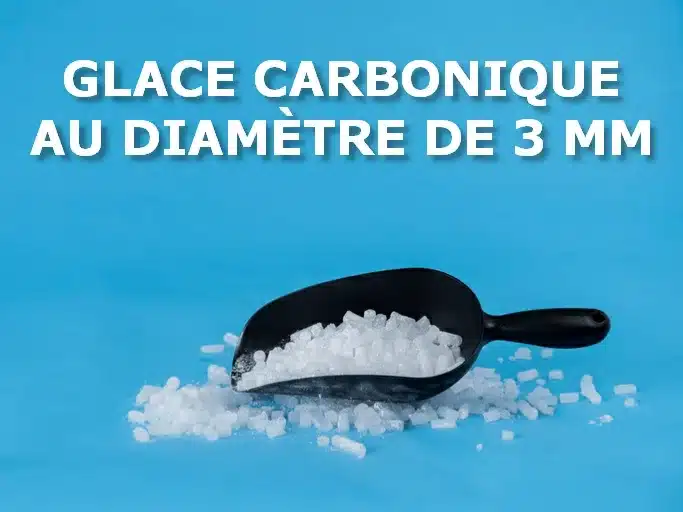
Dry ice is the cleaning media used in dry ice blasting technology
Advantages of dry ice blasting:
Environmentally friendly: since dry ice blasting uses dry ice, it leaves no additional chemical residue. The only by-product of the cleaning process is CO2 gas, which makes it an option ecological option for many industries.
Non-abrasive: unlike shot blasting or sandblasting, dry ice blasting does not cause abrasion of the underlying material, preserving its integrity and lifespan. Since the hardness of dry ice is comparable to that of chalk.
Diverse applications: it can be used in various industries, including automotive, aerospace, semi-conductors, the removal of mold,, etc.
Limitations of dry ice blasting applications:
Limited effectiveness on certain materials: although dry ice blasting can effectively remove many contaminants, it may be less suitable for removing deep corrosion, tartar, oxide layers, two-component paints ou epoxy.
Laser Cleaning: An In-Depth Analysis
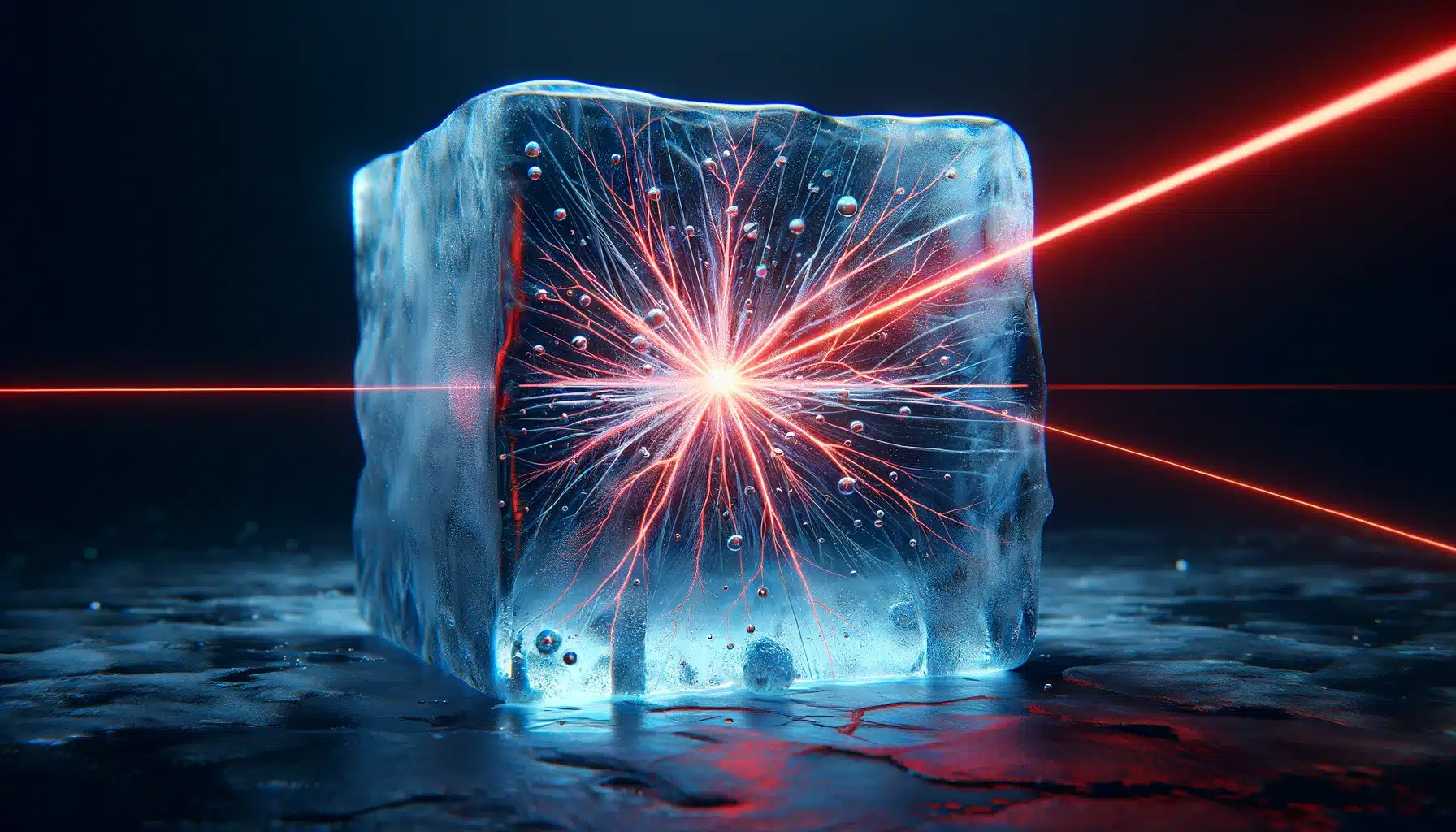
Laser cleaning uses a laser stripper that emits focused laser beams à high energy to remove contaminants from surfaces through a process called ablation. There are essentially two technologies: M.O.P.A et CW (continuous wave laser). When laser pulses hit the layer of unwanted material, the absorbed energy causes rapid vaporization of the contaminant, leaving the base intact.

Laser cleaning: the absorbed energy causes rapid vaporization rapid vaporization of the contaminant
Advantages of laser cleaning:
- Precision and efficiency: the concentrated nature of laser beams allows precise control of intensity and the area to be cleaned, minimizing waste and reducing overall cleaning times.
- No consumables: unlike dry ice blasting, laser cleaning does not rely on a consumable like dry ice, which requires regular replenishment. This reduces operating costs and promotes sustainability.
- Versatility: A wide range of industries, from automotive to art restoration, have adopted laser cleaning because of its effectiveness in handling various materials and applications.
- Non-contact method: lasers eliminate the need for physical force, which reduces the risk of damaging delicate surfaces.
Limitations of laser cleaning applications:
- Higher initial costs: The initial investment in laser cleaning systems can be much more expensive than traditional cleaning methods.
- High protective measures required: Operators must wear safety glasses during the laser cleaning process to avoid eye damage. Additionally, noise may be generated during ablation, requiring hearing protection.
- Laser cleaning also requires passive protection: laser firing must take place in a dedicated area: enclosed space or area demarcated by laser protection panels
- Limited targeting capability: laser cleaning is most effective when there is direct and unobstructed access to the surface to be cleaned. While it can reach confined spaces, its performance is optimal when the laser can directly target the area of concern.
- Finally, it is not really, or even not recommended on surfaces that absorb energy: materials plastics, wood...
Comparative Analysis: Dry Ice Blasting and Laser Cleaning
To better understand which technique might be more appropriate for specific applications or industries, we present a case-by-case analysis below.
Case Study 1: Mold Removal in Food and Beverage Manufacturing
In the food and beverage, the removal of mold, industry, mold removal is crucial to maintain hygienic facilities and ensure product quality. Both dry ice cleaning and laser cleaning have been used for this purpose, but dry ice cleaning generally offers cost-effective results and more thorough thanks to its dry ice projection technique, which effectively cleans hard-to-reach corners.
Furthermore, dry ice blasting does not produce secondary waste, making it a cleaner choice for highly regulated environments: food and beverage, pharmaceutical industry...
Case Study 2: Cleaning Semiconductor Components
La precision, will deliver results. Precision and cleanliness are paramount when dealing with semiconductor components, where even tiny particles can cause significant issues. Laser cleaning stands out in this scenario because it provides a high level of precision that ensures precise ablation, generates no dust or chemical residues, and requires no contact between the equipment and components.
Despite its higher initial costs, laser cleaning is widely recognized as an excellent ultimate solution for semiconductor applications.
Case Study 3: Cleaning Plastic Injection Molds
It is essential to remove gas and other particles that generate surface defects. Dry ice blasting dry ice cleaning allows for the removal of these contaminants directly on the press. For this, the use of a dry ice blasting cleaner does not require special protective measures, except of course for the operator, to protect, eyes, ears and hands. However, as a general rule, press operators and those in the vicinity do not have much to worry about, as long as they protect their "ears" from the noise.
Le laser firing, on the press is possible. However, it will necessarily require the installation of laser protection panels around the work area to avoid the risk to the eyes of unprotected persons due to the risk of reflection.
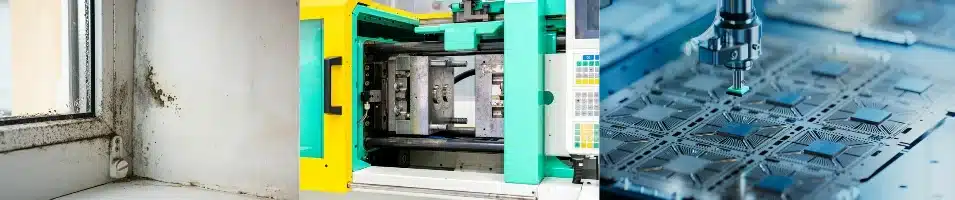
Treating mold in food and beverage, cleaning molds in plastic injection molding, cleaning semiconductor components... for each application, the adapted cleaning technology...
Critical Factors to Consider When Choosing a Cleaning Solution
When choosing an appropriate cleaning method, several factors should be considered, including:
Material composition: Evaluate whether the substrate is likely to be damaged by dry ice blasting or laser cleaning techniques.
Cleaning requirements: Assess the desired level of cleanliness, the contaminants being removed, and any special requirements for specific cases such as mold removal.
Available resources: compare the costs, equipment needs, and training requirements associated with both processes before making a decision.
Safety and environmental regulations: ensure that the chosen method complies with industry standards and does not harm operators or the environment.
Discover our industrial cleaning solutions


In conclusion
dry ice blasting and laser cleaning have established themselves as powerful and versatile competitors in surface preparation and cleaning technologies. Understanding the nuances and trade-offs of each method will enable businesses and industries to make informed decisions tailored to their unique needs and specifications.
Contact our team at 04 81 61 02 75, to help you customer area choice and to be able to perform a test with one of our 3 technologies : dry ice blasting, laser cleaning, and dry ice abrasive blasting, or complete the form here.


