

Le nettoyage cryogénique consiste à projeter des pellets de glace carbonique (CO₂ solide) à haute vitesse pour éliminer efficacement les dépôts sur tous types de surfaces. Bien que cette technologie soit largement utilisée en milieu industriel, son utilisation dans les environnements médicaux et hospitaliers soulève des questions about its effectiveness and its limitations.
Bacteriostatic properties of dry ice
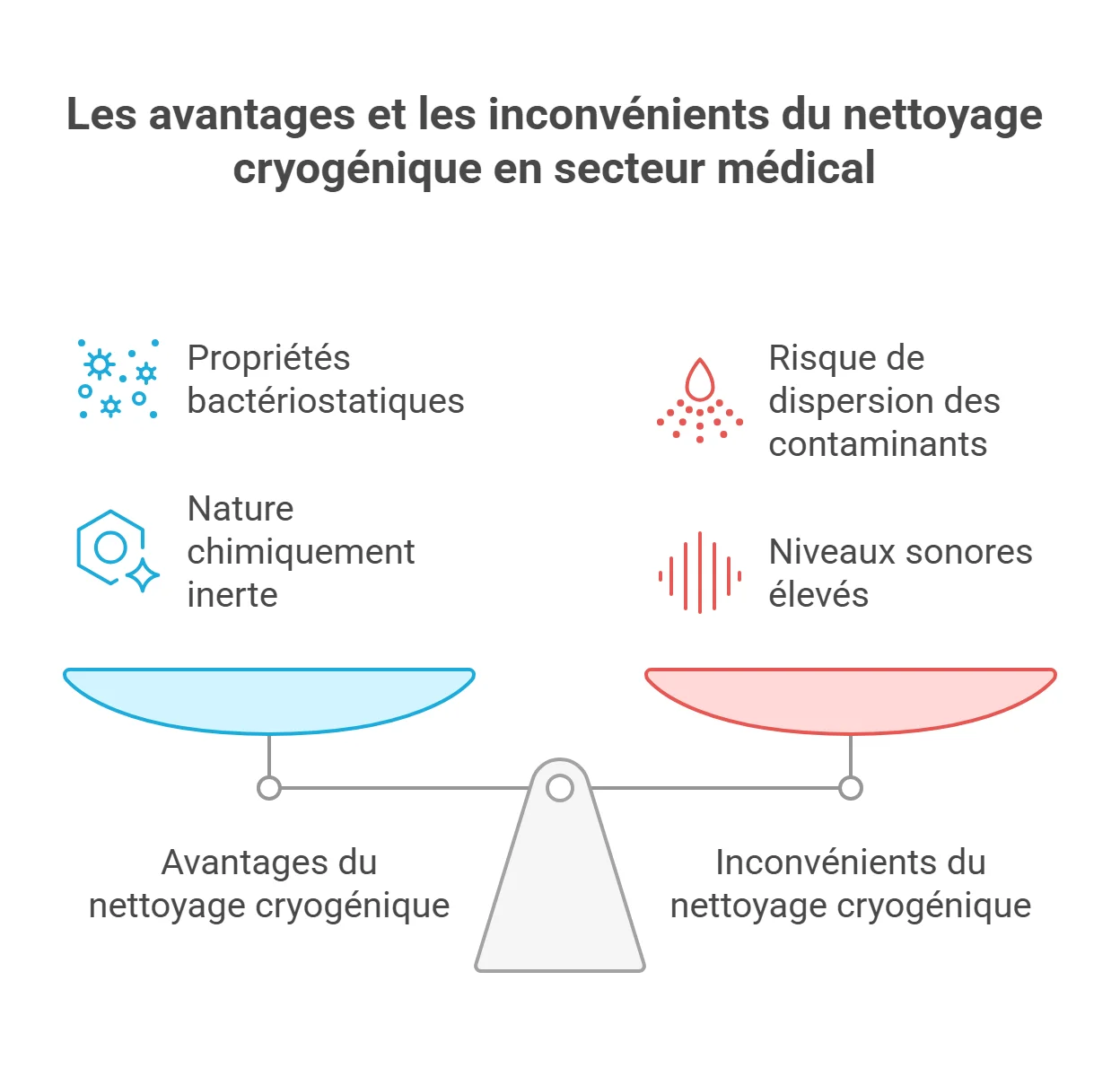
La Carbon dioxide ice is recognized for its bacteriostaticproperties, meaning it inhibits la Paint waste, bacteria and mold, without completely eliminating them. This inhibition stems primarily from the removal of organic residues and any traces of moisture.
The cold generated by dry ice (approximately -78.5°C) can also play a role by slowing or stopping the multiplication of microorganismstemporarily. Of course, it must be emphasized heavily on the treated area, since simple sweeping reduces the surface temperature by only 8 to 12 degrees compared to room temperature.
Dry ice is also appreciated for its chemically inert et non-toxicnature, which means it does not react with other substances and does not generate harmful chemical residues potentially. However, unlike conventional disinfectant agents such asbiocidal chemical products or autoclaves which ensure complete sterilization by total destruction of microorganismsmicroorganisms, dry ice does not guarantee complete disinfection.
Thus, dry ice cleaning cannot replace established methods in medical environments where absolute asepsis is essential.
Risks associated with compressed air
Le dry ice cleaning uses a powerful compressed air jet to propel the dry ice, which can lead to the dispersal of particles, particularly microorganisms microorganisms present on treated surfaces. This dispersal can create microbial suspensions, potentially problematic in a hazardous into a hospital environment where absolute control of contaminants is paramount.
Specialized occupational health and safety organizations even discourage compressed air cleaning in sensitive environments, such as operating rooms.
Some Dry ice blasting machine pricing | Cryoblaster® advance marketing arguments claiming that projecting dry ice results in "dry cleaning" without notable spread of contaminants. They explain that CO₂ sublimation generates a gas flow heavier than air that would push particles microorganisms toward the floor, thus limiting microbial spread… 😒
Furthermore, they argue that the thermal shock caused by dry ice would freeze contaminants and break down biofilms. However, these claims have not been confirmed by independent studies and do not guarantee the complete absence of microorganism dispersal.
High noise level
Un autre facteur limitant du nettoyage cryogénique en milieu hospitalier est le niveau sonore qu’il génère. À 6 baroperational intensity 115 dB (depending on the volume of air used and the diameter of the projection nozzle outlet)requiring hearing protection hearing protection and specific soundproofing devices.
These These noise levels often exceed acceptable standards in sensitive medical spaces such as such as operating rooms or intensive care de units.
Potential applications in medical settings
Malgré ces limites, le nettoyage cryogénique pourrait avoir quelques applications spécifiques en milieu médical, notamment pour le nettoyage initial d'équipements robustes non directement impliqués dans les actes médicaux critiques, comme certains dispositifs techniques ou installations externes.
For example, this may include medical air compressors, refrigeration units, basement technical cabinetsor non-sterile logistics carts .
It could also be useful for preliminary cleaning of technical areas and ventilation equipment, where wet methods present a risk of corrosion or damage.
However, its direct use on surgical instruments, operating room surfaces, or patient rooms must be considered cautiously, always as a complement to a rigorous chemical disinfection protocol.
Il est essentiel d'effectuer une évaluation approfondie des risques avant de recourir au nettoyage cryogénique dans le secteur médical. Cela inclut analysis of the waste, surfaces surface to be treated, the sensitivity of the equipment concerned, and the proximity to waste, sensitive ou sterile.
areas
Alors oui, le nettoyage cryogénique est spectaculaire : no water, no chemical products, such So yes, dry ice blasting is spectacular:visually clean surfaces, and a demonstration with real impact. Enough to seduce the marketing departments of certain suppliers, quick to tout its application even in operating rooms. But between a well-written data sheet and the reality of hospital requirements, there's a chasm. Dry ice does not disinfect, does not sterilize, and the compressed air jet is more likely to disperse pathogens than eliminate them.
Not to mention the noise generated, hardly compatible with the calm of a care unit 😨
Alors avant de croire que le nettoyage cryogénique est la nouvelle baguette magique des établissements de santéit's better to keep a cool head (sorry, that one was easy)… like solid CO₂. In hospital settings, this technique should remain a supplementary tool, strictly regulated, and not a miracle solution straight out of an overzealous sales pitch.
Découvrez nos solutions et conseils pour un nettoyage cryogénique efficace : matériel, prestations et formations en nous contactant au +33 (0) 4 81 61 02 75 or by filling out the form below


