
What are the advantages of dry ice blasting?
Dry ice blasting is an industrial cleaning technique free of chemicals, water, and abrasive products such as those used in sandblasting or air blasting.
In fact, this process uses dry ice as a cleaning agent: it is carbon dioxide (CO2) in solid state, which has certain characteristics that, in terms of advantages, make dry ice blasting the cleaning method par excellence.
Discover below the advantages of dry ice blasting.
HOME > DRY ICE BLASTING > ADVANTAGES
An innovative cleaning technology
Dry ice blasting uses dry ice pellets to eliminate contaminants with no secondary residue.
Eco-friendly technology
Reduces carbon footprint by using non-toxic and recyclable materials.
Precise cleaning
Allows reaching hard-to-access areas with surgical precision.
Application versatility
Suitable for various sectors, from the food industry to automotive.
First of all, some explanations...
Dry ice blasting: how does it work?
The dry ice blasting technique is based on projecting dry ice pellets onto the surfaces to be cleaned.
The projection vector is compressed air (air under industrial pressure or thermal compressor air). For this purpose, an ATX-type blaster will be used, equipped with a discharge hose, a gun, and a supersonic spray nozzle.
Charged with kinetic energy, the dry ice pellets (or dry ice) strike the dirt or contaminant, causing the dirt to detach from the surface through:
- Un mechanical shock (the pellets are charged with kinetic energy),
- Un thermal shock (or thermal differential) and...
- La sublimation or the transition of dry ice from solid to gaseous state in a ratio of 1 to 700: the dirt is instantly removed from the surface.
For more explanations on the dry ice blasting process, click on the "Dry ice blasting explanations" link at the bottom of the page.


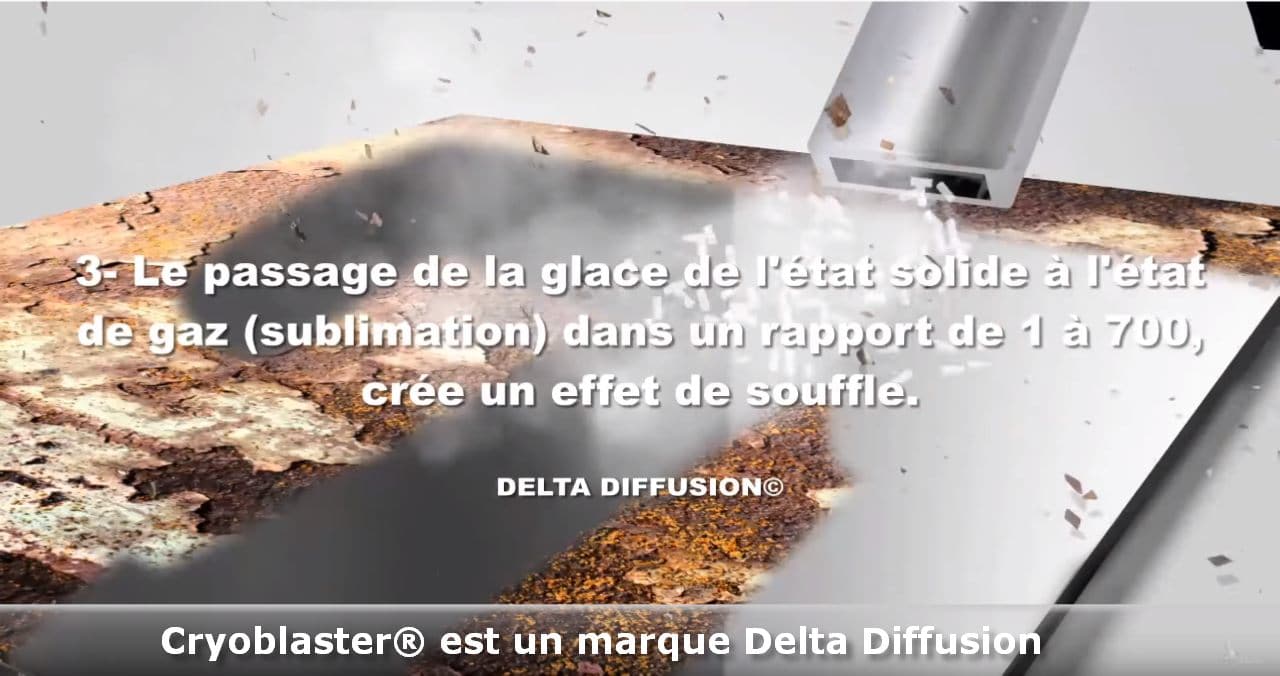
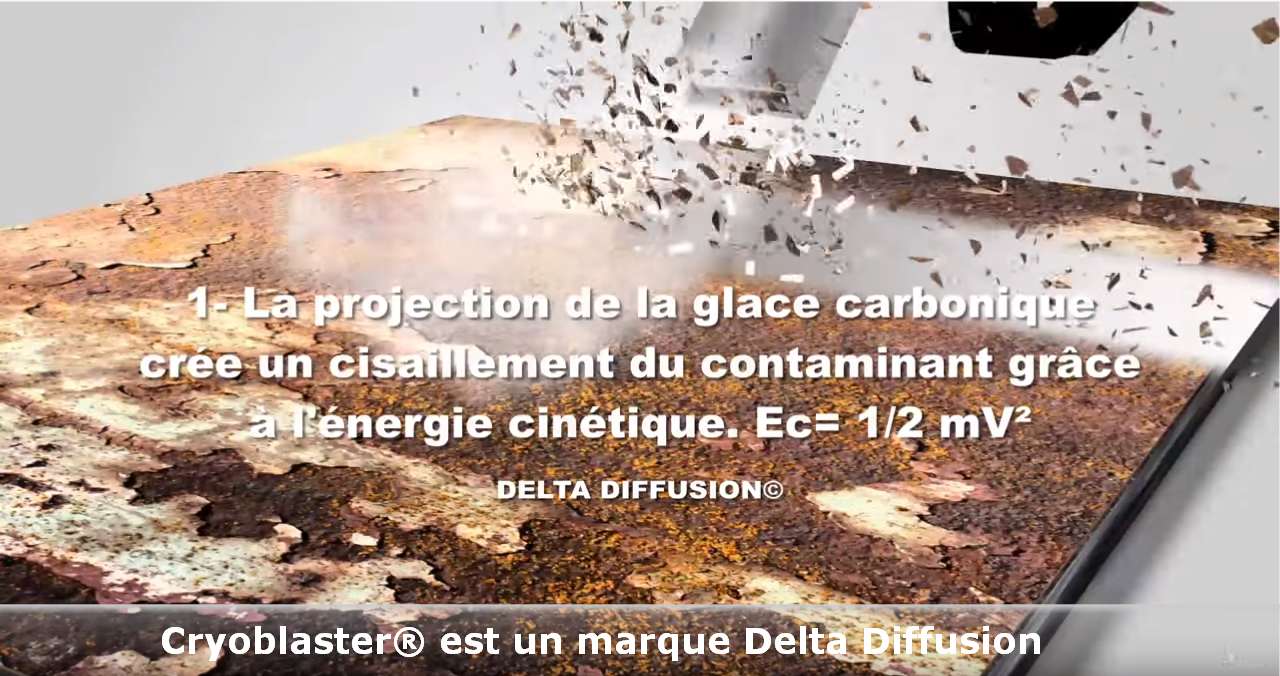
More details on the dry ice blasting technique at the bottom of the page. Click on the link Dry ice blasting explanations
Let's compare cleaning techniques
Traditional industrial cleaning almost systematically involves dismantling the machines to be treated. The cleaning of parts is carried out in a dedicated area.
Traditional methods are also limited when machines cannot be moved or other cleaning techniques would result in more cleaning and downtime.
As noted earlier, dry ice blasting has many advantages over other traditional cleaning methods.
Let's see what they are...
Dry ice blasting: dry cleaning
Cleaning techniques that use water as a cleaning medium, such as high-pressure cleaning, generate moisture in the treated area and require drying time for parts so they can be reinstalled.
Water cleaning can also cause rust, damaging metal parts, or promote the development of bacteria such as Salmonella, Listeria, and E. coli.
Since dry ice is carbon dioxide in solid state, the dry ice blasting process has the advantage of being a dry cleaning technique and "bacteriostatic" against the mentioned bacteria, due to its extreme temperature that inhibits their development. The temperature of dry ice is -80 °C.
For this reason, nowadays, many food and pharmaceutical companies equip themselves with dry ice blasting machines of the type ATX25 o ATX Nano, thus allowing them to eliminate cross-contamination.
A quick reminder:
The medium used is dry ice or the so-called "dry ice" that goes from solid to gaseous without an intermediate liquid phase.
Dry ice blasting prevents the proliferation of the bacteria mentioned above, mold, or the appearance of rust on metal surfaces.


Dry ice blasting operation on an escalator.
High-pressure cleaning is impossible in this
type of configuration...
Cleaning without chemicals
Chemical cleaning methods can not only damage parts of the treated machines but can also pose a serious hazard to both operators and the environment.
Furthermore, the use of large quantities of chemicals involves reprocessing waste.
Chemical-free, dry ice blasting:
- poses no hazard to users,
- leaves no residue, thus saving the additional cost of secondary waste disposal, but above all,
- is by far the most environmentally friendly technique: the dry ice sublimates upon contact with the surface to be cleaned, thus returning to gaseous form or CO₂,
- does not require a chemical that affects the ozone layer during its manufacture,
- produces no odors, unlike the use of solvents...


With dry ice blasting, even heavily soiled surfaces
do not require chemicals such as solvents...
Increased productivity and profitability!
Traditional cleaning methods involve in the vast majority of cases stopping machines or manufacturing processes, dismantling, letting parts dry if necessary, and then reassembling the parts after cleaning.
Needless to say, traditional cleaning techniques are slow...
Ideally, the recleaning phase should be fast, generate little waste, and require little or no dismantling...
Well, the time and money savings with dry ice blasting is enormous!
In fact, the advantage of dry ice blasting lies in the fact that there is no need to "dismantle" and "reassemble". Facilities can be cleaned on-site without additional downtime.
The traditional technique involves dismantling for 2 days, sending the 2 chains to another location to be cleaned and "re-greased" for 3 days, then returning to the customer's site and reassembling for 2 days. This is a complete production shutdown of 7 days, at a cleaning cost of 30.000 euros, not counting the costs associated with production shutdowns.
La dry ice blasting, with 2 Cryoblaster ATX80 and ATX25 cleaning units, allows degreasing chains, in situ, without dismantling in just 2 and a half days, which means 4 and a half days less of production downtime.
Dry ice blasting is 2 to 8 times faster than traditional methods. So the process is very fast.


Dry ice blasting of chains in the food industry:
2 and a half days versus 7 days with the traditional method...
Dry ice blasting is undoubtedly ultra-fast cleaning!
A quick reminder :
Since dry ice blasting is a dry process, there is no need to clean or dry the treated surfaces: a considerable time saving. Thanks to the various types of nozzles, cleaning is much "deeper" and allows you to clean every last corner. As a result, the equipment operates more efficiently and possible leaks (hydraulic, for example) are revealed.
A technique that ensures the sustainability of production tools
Since dry ice is dry, it does not promote corrosion of metal surfaces.
This technique can therefore be used to clean electrical equipment under tension, provided it does not present an electrocution risk from direct contact.
Important: cleaning electrical cabinets under tension requires authorization of the type HnBn. Make sure the operator has received this type of training. Otherwise, in case of an accident, your liability could be compromised.
Cleaning of electrical cabinets without tension and locked out requires the authorization H0B0.
Furthermore, the hardness of dry ice is comparable to that of chalk and, therefore, does not scratch the treated parts, unlike some tools such as spatulas, scrapers, scouring pads: industrial dry ice blasting increases the lifespan of the working tool by minimizing wear and keeping machines in good working order. The process is non-abrasive.
Among the many advantages of dry ice blasting, the gentleness of the treatment is highly appreciated: dry ice is much less dense than sand and, above all, it sublimates (transition from solid to gaseous state, in a ratio of 1 to 400) upon contact with the surface to be treated.
Important: to ensure the viability of a dry ice blasting project on a surface you do not usually treat (wood, plastic…), always start at low pressure and adjust the granulometry of the ice and the type of nozzle in relation to the contaminant, the substrate, and… the desired result.

Some tools or accessories may damage
the treated surfaces...

The hardness of dry ice is only 2 mohs,
that is, the hardness of chalk.
Cryogenic treatment is non-abrasive.
In summary, the benefits of dry ice blasting are:
- An industrial cleaning process safe for operators, machines, the environment: without chemicals (no solvents, no detergent, no abrasives).
- A technique that does not contribute to the increase of greenhouse gases (insofar as compressed air is of electrical origin). Dry ice is manufactured from recycled CO₂, which is ultimately given a second useful life.
- A dry, non-abrasive, non-conductive cleaning technique that uses a non-flammable medium, 2 to 8 times faster than traditional techniques, due to the fact that it does not require systematic dismantling to clean surfaces.
Other articles on the same topic...
Advantage 1 - Dry ice blasting: dry cleaning!
Discover in the following article, dry ice blasting, a non-wet process,the 3 main reasons to abandon water as a cleaning agent in industrial cleaning operations.
Advantage 2 - Dry ice blasting: Cleaning without chemicals
Among the many benefits of dry ice blasting, the absence of solvents, acid, ammonia... make this process a cleaning technique that respects the health of users and the environment. Check out the article: dry ice blasting, cleaning without chemicals,all the many benefits that arise from the absence of detergents.
Advantage 3 - Dry ice blasting: Non-abrasive cleaning
The fact that the hardness of dry ice is very different from the media used in sanding and air grinding techniques, makes dry ice blasting a non-abrasive technique. Discover in this article, everything that makes dry ice blasting a surface-friendly technique
Advantage 4 - Dry ice blasting reduces production downtime
Discover in this article how dry ice blasting boosts your productivity,how dry ice blasting allows you to optimize the cleaning of your processes in record time!
Frequently asked questions about dry ice blasting
No, dry ice blasting is a non-abrasivemethod. Unlike sandblasting, dry ice pellets sublimate instantly upon impact, removing dirt without creating mechanical wear or altering the substrate.
It allows reducing production downtime by between 50 % and 80 %. Being a dry process with no residue, it allows direct cleaning on the machine, without prior dismantling or drying phase.
It is a sustainable cleaning solution: it does not use chemical solvents, does not generate secondary waste (only the dirt needs to be collected) and uses recycled industrial CO2.
Absolutely. Dry ice is non-conductive and completely dry. It is the ideal solution for decontaminating electrical cabinets, PLCs, or motors without risk of short circuit.
The main difference is the absence of residual medium. While sandblasting leaves sand or beads everywhere, dry ice blasting disappears into the air, preventing abrasive infiltration into sensitive areas.


