
Nettoyage cryogénique d'un local TGBT après incendie
In the context of a fire in a room housing a Low-Voltage Electrical Panel (LVEP), the priority is often given to the rapid and safe restoration of the equipment. Among the various cleaning techniques available, dry ice blasting dry ice cleaning stands out for its many advantages.

Cryogenic applications for electrical equipment
What is dry ice blasting?
- Industry : Electrical
- Treatment purpose : low-voltage electrical panel room after fire
- Equipment used : MACH 1 - Replaced by ATX25-P
Le dry ice blastingconsists of projecting pellets of dry ice, also known as dry ice, onto the surfaces to be treated.
Upon impact, these pellets transition from solid to gaseous state by releasing intense cold that dissolves and dislodges contaminants without damaging materials. This technology is particularly appreciated in sensitive environments.
more information on dry ice blasting.
Principles and operation
This technique is based on three principles: thermal shock, mechanical effect, and sublimation. The thermal shock weakens soiling, making it easier to remove. Next, the impact of the pellets acts mechanically to dislodge contaminants. Finally, the sublimation instantly transforms the pellets into gas, leaving no residue.
Non-abrasive and material-friendly
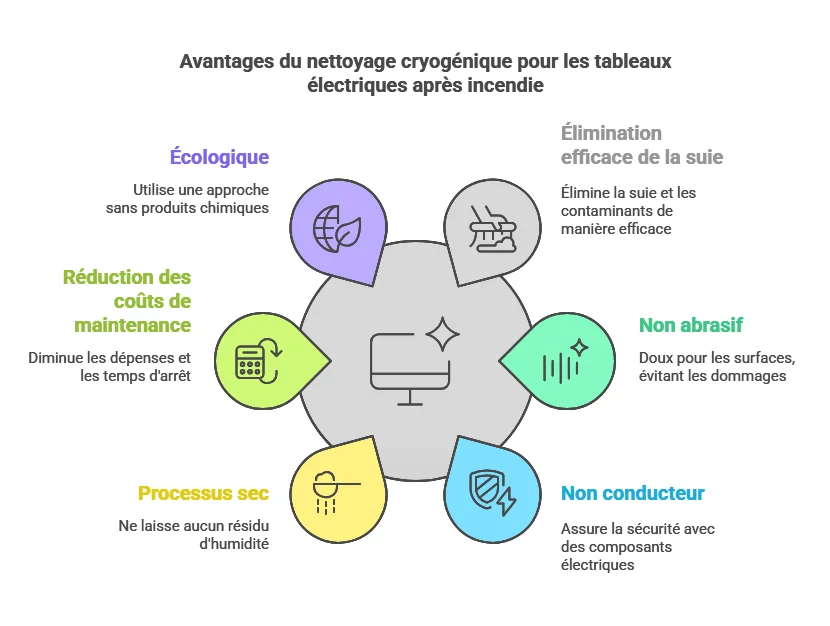
Unlike traditional methods such as sandblasting, dry ice blasting dry ice cleaning mixed non-abrasive. It does not damage delicate surfaces such as those of electrical enclosures or components of electrical panel. This preserves the physical integrity of the electrical installation.
Avantages pour le nettoyage d’un local TGBT après incendie
Opting for dry ice cleaning nozzlesafter a fire in a low-voltage electrical panel room presents multiple advantages. These range from method efficiency to compatibility with electro-sensitive environments, while also being environmentally friendly.
Soot removal effectiveness
Soot is often formed in large quantities during a fire and can be particularly difficult to remove. Dry ice blasting dry ice cleaning effectively eliminates this soot through the combined action of generated by the and themechanical impact, without harming sensitive electrical installations.
Enhanced safety
Being non-conductive, dry ice presents no electrical hazard, making this method perfectly suited for cleaning electrical panels. Furthermore, it is non-toxic, ensuring a safe work environment for those intervening after the fire.

Reduced maintenance
Equipment cleaned by dry ice blasting recovers its original cleanliness without requiring disassembly, significantly reducing downtime and associated costs. Also, since dry ice blasting dry ice leaves no moisture, there is no need to dry the equipment, accelerating the return to service of the room.
Environmentally friendly method
Using dry ice is also favorable for the environment. It produces no secondary waste and uses no hazardous chemicals. This aligns the cleaning process with sustainable development criteria.
Implementation procedure
To begin the dry ice cleaning of a low-voltage electrical panel room after fire, it is important to follow a well-defined procedure to ensure the safety and effectiveness of cleaning.
Site preparation
Site securing: Before any intervention, it is crucial to secure the site. This includes:
Work area delimitation: Access to the room must be restricted to authorized personnel (minimum qualification H0B0-H0V) and qualified to work in a post-fire environment. A safety perimeter must be established.
Room ventilation: After a fire, the room may contain toxic fumes and suspended particles. Adequate ventilation is essential to ensure the safety of workers.
Risk assessment: A fire safety expert and/or qualified electrician must inspect the room to identify potential hazards (weakened structures, collapse risks, presence of dangerous products, etc.).
Cutting off the main power supply to the electrical panel: it is imperative to cut off all power sources feeding the electrical panel to prevent any electrocution risk. A qualified electrician must perform this operation following safety procedures. The placement of individual padlocks will ensure operator safety.
Protection of sensitive equipment: Some components may be sensitive to dry ice projection (sensors, fragile electronic elements). These elements must be protected with tarps or appropriate screens before cleaning begins.
Cleaning planning: Based on the extent of damage, room configuration, and equipment present, the expert will define a precise cleaning plan. This plan will include the choice of projection nozzles, air pressure, dry ice flow rate, and the order of treatment for different zones.
Application of dry ice
Equipment installation: The cleaning team installs the dry ice projection device near the work area. Discharge hoses deliver dry ice to the projection nozzle. The operator is equipped with a respirator mask, gloves, and safety glasses.
Dry ice projection: The operator projects dry ice pellets onto contaminated surfaces following the established cleaning plan.
Projection technique: The projection technique is adjusted based on surface type and contamination level. Projection angle, distance from the surface, dry ice granulometry, and air pressure are important parameters to master.
Progressive cleaning: Cleaning is carried out by zones, starting with the least contaminated areas and progressing toward the most soiled zones.
Access to difficult areas: Dry ice blasting allows reaching difficult-to-access areas thanks to the flexibility of projection hoses and the variety of available nozzles.
Final verification
Visual inspection: A thorough visual inspection is performed to ensure that all traces of soot and contaminants have been removed. Adequate lighting is necessary for this step.
Component inspection: The condition of components is verified to ensure they have not been damaged during cleaning. Special attention is paid to electrical connections, cables, and protective devices.
Supplementary cleaning: If necessary, additional cleaning is performed on certain areas to guarantee optimal results. Manual tools (brushes, vacuums) can be used to complement the action of dry ice blasting.
Testing and return to service: After cleaning and verification, tests are performed to ensure the electrical panel functions properly. Return to service is performed by a qualified electrician.
En suivant cette procédure rigoureuse, le nettoyage cryogénique permet de remettre en état un local TGBT après un incendie de manière efficace et sécurisée, tout en limitant les risques pour les équipements et les intervenants.
Nous assurons les formations pour le nettoyage cryogénique des composants électrique.
Contact us for more information at 04 81 61 02 75
Case studies and testimonials
Many companies specializing in electrical installations have called upon dry ice cleaning for the restoration of their low-voltage electrical panel rooms after a fire. Here are some testimonials and case studies that illustrate the benefits of this method.
Customer testimonials
A company located in the Paris region reported that its low-voltage electrical panel was restored more quickly and effectively than with conventional cleaning techniques. Not only was the electrical system quickly functional, but future maintenance costs were also reduced.
Another success story comes from an industrial company in Lyon. After a serious fire causing significant damage in the low-voltage electrical panel room, they chose dry ice blasting to clean the area. Result: complete soot elimination and a significant reduction in the risk of future short circuits.
Pourquoi choisir le nettoyage cryogénique après un incendie ?
In conclusion, dry ice cleaning offers a series of unique advantages for the rapid and safe rehabilitation of a low-voltage electrical panel room after a fire. In addition to being effective against soot, this method is safe for electrical systems, reduces maintenance needs, while being environmentally friendly.
Recapitulatif des avantages du nettoyage cryogénique
- Effectively eliminates soot and other contaminants
- Non-abrasive and material-friendly
- No electrical risk, since non-conductive
- Dry process leaving no residue
- Reduces downtime and maintenance costs
- Approach ecological with no use of chemical products
results in a substantial reduction in maintenance-related costs. By prioritizing thorough and regular cleaning, unexpected breakdowns are prevented, avoiding costly and disruptive repairs. cryogenic blasting to treat a low-voltage electrical panel room after fire is to opt for a technologically advanced solution that combines effectiveness, safety, and respect for the environment. It is undoubtedly one of the best options currently available for this type of situation.
Discover our dry ice cleaning solutions: equipment, services and training by contacting us at +33 (0) 4 81 61 02 75 or by filling out the form below

Contact Form
My needsOn the same topic
- Electrical cabinet cleaning after fire disaster
- Electrical cabinet cleaning when de-energized
- Generator cleaning
- Electrical cabinet degreasing
- Electrical cabinet cleaning in food and beverage
- Cleaning main distribution board room post-disaster fire
- Cleaning electrical cabinet covered with adhesive residue
- Cleaning electrical cabinet en exterior


